The 2026 TEC Investment Plan: What Wins Now
31 August 2026 · 7 min read

Your last Investment Plan doesn't buy you the next one. TEC has said so directly, in writing, for the 2026 round — and at the same time NZQA is retiring the quality rating half the sector still quotes in funding narratives, while the whole competitive map around you is being redrawn by Te Pūkenga's disestablishment. Three systems, one bid deadline.
For a CEO or GM, that's not a compliance footnote. It's the difference between a plan that reads as evidence and one that reads as habit.
Why this lands on your desk, not your compliance team's
You sign the Investment Plan. If your organisation is seeking or holding $5 million or more in TEC funding, you're personally accountable for a Learner Success Plan with documented goals and milestones — not a document you file once, but one you're expected to keep proving against. TEC can also require a financial viability assessment at any point, and a 'high risk' finding triggers a mandatory action plan. That's a board confidence conversation, and it lands with you, not with finance in isolation.
On top of that, NZQA's move from periodic External Evaluation and Review (EER) audits to an annual self-review and improvement-plan cycle changes the reporting rhythm you have to resource — right as the EER category rating most bids and marketing materials have leaned on for years is being phased out. And the disestablishment of Te Pūkenga into regional polytechnics, alongside the handover from Workforce Development Councils to Industry Skills Boards, resets who you're benchmarked against and who sets the standards you're assessed on. All four land in the same twelve months.
The end of automatic renewal
TEC's gazette notice for the 2026 investment round is unambiguous: a previous or current allocation of funding does not entitle a provider to future funding at any level. Every Investment Plan is assessed fresh, against set criteria, over a three-year planning horizon — but TEC may approve funding for one, two or three years depending on how strong the case is.
That's a meaningful lever. A provider that can show a credible, evidenced multi-year trajectory gets rewarded with a longer funding term and the planning certainty that comes with it. A provider trading on reputation and incumbency gets a shorter leash, or nothing. If your last plan's strongest argument was 'we've always been funded', that argument no longer exists.
Learner Success Plans are now core bid material
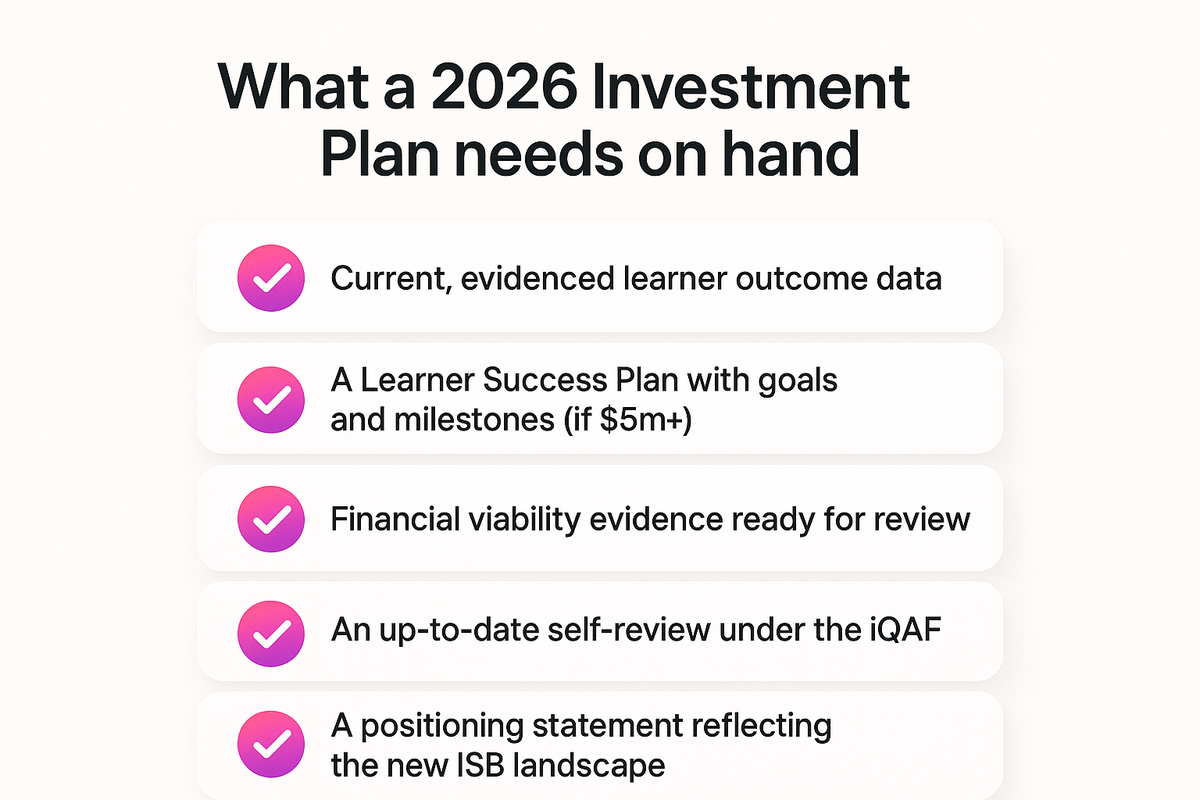
Any provider seeking or holding $5 million or more in TEC funding must submit a Learner Success Plan — or a progress update against an existing one — setting out how it's improving outcomes for all learners, with particular attention to those most in need, backed by tangible goals and milestones. This sits inside the 2025 Funding Conditions Catalogue, and it isn't a side letter. It's part of the case you're making for funding itself.
The practical implication: you need current, defensible evidence of learner outcomes on hand, not reconstructed under deadline pressure. If your organisation can't produce that quickly and credibly, the plan is weaker regardless of how strong your narrative sounds.
What a bid needs to prove now
TEC can require a financial viability assessment as a funding condition, and providers rated high risk must produce an action plan. That puts balance-sheet resilience directly into the funding conversation — not as background financial reporting, but as a condition of continued investment. For a CEO already managing margin pressure from rising compliance and delivery costs, this is one more place where the numbers need to hold up under scrutiny, not just satisfy an annual audit.
The quality signal you've relied on is disappearing
From 1 January 2026, NZQA stopped opening new EER processes. In their place: an annual self-review summary and a discussion of the provider's improvement plan, under the integrated Quality Assurance Framework (iQAF) and the Quality Assurance of Tertiary Education Providers Rules 2026. The EER category rating system is being phased out entirely, and any provider that continues to reference an EER category must attach an accompanying statement, as required under Rule 10 of the 2026 Rules.
There's a wrinkle worth flagging for anyone with international students: Immigration New Zealand will keep using existing EER ratings for visa purposes for 12 months from early 2026. That means your public quality signal for funders and your quality signal for visa purposes can temporarily point in different directions — worth clarifying in any bid or marketing material that touches both audiences.
The shift matters strategically because a category rating has functioned, for years, as shorthand credibility in bids, prospectuses and partner conversations. That shorthand is going away. What replaces it is a more frequent, more evidence-heavy cycle — better suited to organisations with live, current data than to organisations that were coasting on a rating earned two or three years ago.
A different competitive landscape
Te Pūkenga has been disestablished into ten regional polytechnics and federations under a transitional NZIST entity — a restructure affecting roughly 250,000 learners system-wide, alongside real workforce reductions across institutes of technology and polytechnics. At the same time, Industry Skills Boards took over standard-setting, programme endorsement and assessment moderation from Workforce Development Councils on 1 January 2026.
For competitive positioning, this matters two ways. First, who you're compared against in a TEC investment round has changed — regional polytechnics are re-forming their own identities and their own cases for funding. Second, who you partner and negotiate with on standards and moderation has changed too. A bid built on old relationships and old benchmarks is arguing against a landscape that no longer exists.
Key takeaways
- TEC's 2026 gazette notice removes any entitlement from past funding — each Investment Plan must stand on current evidence, not track record.
- Learner Success Plans (mandatory at $5 million or more in TEC funding) are now core bid material, requiring live, current outcome evidence, not reconstructed reporting.
- TEC can require a financial viability assessment at any time; a high-risk rating forces an action plan, making balance-sheet resilience a board-level funding issue.
- NZQA's EER category rating is being phased out in favour of an annual self-review and improvement-plan cycle under the 2026 Rules — the quality shorthand many bids relied on no longer applies the same way.
- Te Pūkenga's disestablishment and the Industry Skills Boards' takeover of standard-setting and moderation reset who you compete with and who you partner with.
Our take
The common thread across all four changes is the same: the system is asking for proof, on demand, rather than a story told once a year. That's a harder ask operationally, but it's also a fairer one — it rewards organisations that actually know their numbers, not just the ones with the best-written plan. The providers who find this round straightforward will be the ones who already treat outcome data, financial position and quality evidence as things they can produce this week, not things they assemble under deadline. If your organisation currently needs weeks of manual pulling-together to answer 'show me the evidence' for any one of these four areas, that's the gap worth closing before the next round opens — not after.
FAQ
Does our past TEC funding history still count for anything in the 2026 round? Not as entitlement. TEC's gazette notice for 2026 states plainly that a previous or current allocation doesn't guarantee future funding at any level. Track record can still support your narrative, but the plan is assessed fresh against current evidence and set criteria.
Do we need a Learner Success Plan even if we've never had one before? If you're seeking or holding $5 million or more in TEC funding, yes — it's now a funding condition under the 2025 Funding Conditions Catalogue, requiring documented goals and milestones on improving outcomes, particularly for learners most in need.
What happens to our EER rating if we're mid-cycle when the new rules land? NZQA stopped opening new EER processes from 1 January 2026, moving to an annual self-review and improvement-plan cycle under the iQAF and the 2026 Rules. If you still reference an EER category, Rule 10 requires an accompanying statement. Note Immigration New Zealand will keep using existing EER ratings for visa purposes for 12 months from early 2026, so your quality signal may temporarily differ across audiences.
How does the Te Pūkenga disestablishment affect our bid specifically? It changes who you're benchmarked against — ten regional polytechnics and federations are now forming their own positioning — and who sets standards and manages moderation, since Industry Skills Boards took that role from Workforce Development Councils on 1 January 2026. Both affect how your differentiation argument should be framed.