Aged Care Simulation Training NZ: A Missing Link
6 September 2026 · 8 min read

New Zealand's aged care workforce crisis isn't only about pay or immigration settings — it's about what happens on a trainee's first unsupported shift. Nursing and support worker students are opting out of aged care specifically because of poor placement experiences, and simulation-based coached practice, still concentrated in acute hospital settings, has yet to fill that gap.
It's not recruitment failing — it's the first shift
Every workforce conversation about aged care in New Zealand eventually lands on pay rates or visa settings. The more recent evidence points somewhere else entirely: the placement itself.
RNZ and The Conversation, citing Infometrics analysis prepared for the New Zealand Nurses Organisation (August 2026), report the sector is short 1,550 registered nurses against safe staffing levels. But the more telling finding sits underneath that number — students already enrolled in health programmes are opting out of aged care before they graduate, largely because of what they experience on placement in an under-resourced setting. This isn't a recruitment or marketing problem. It's a training-delivery problem.
Health New Zealand's Aged Care Ministerial Advisory Group said much the same thing in its August 2026 FAQ report, stating plainly that there are "not enough beds" and "not enough workforce to care for people." It recommended government work with unions, providers and community groups on a cross-sector strategy for a workforce that is "well-trained, certified, and sustainable" — a direct call for a training delivery mechanism that, notably, stops short of specifying one.
The Aged Care Association told New Zealand Doctor (26 May 2026) that New Zealand still has no publicly visible long-term workforce plan for aged residential care, and that it isn't aware of any workforce modelling covering the next 10 to 20 years. Years of warnings about an ageing population haven't yet produced a plan — let alone a training model built around it.
Who actually delivers the care, and what are they trained on?
Most hands-on aged care in New Zealand isn't delivered by nurses. It's delivered by an unregulated support workforce trained through NZQF-aligned qualifications.
- Roughly 16,300 personal care assistants and carers work in aged residential care, against around 2,100 registered nurses — near an 8:1 ratio.
- The core qualification pathway is the New Zealand Certificate in Health and Wellbeing (Level 3, Support Work), delivered by PTEs and ITPs around the country.
- B2B News NZ (17 June 2026) puts the sector's total headcount at about 38,700 people, over half earning below 120% of minimum wage and roughly 70% born overseas.
- The same analysis cites a Health NZ review projecting a shortfall of almost 12,000 aged residential care beds by 2032 without faster build rates.
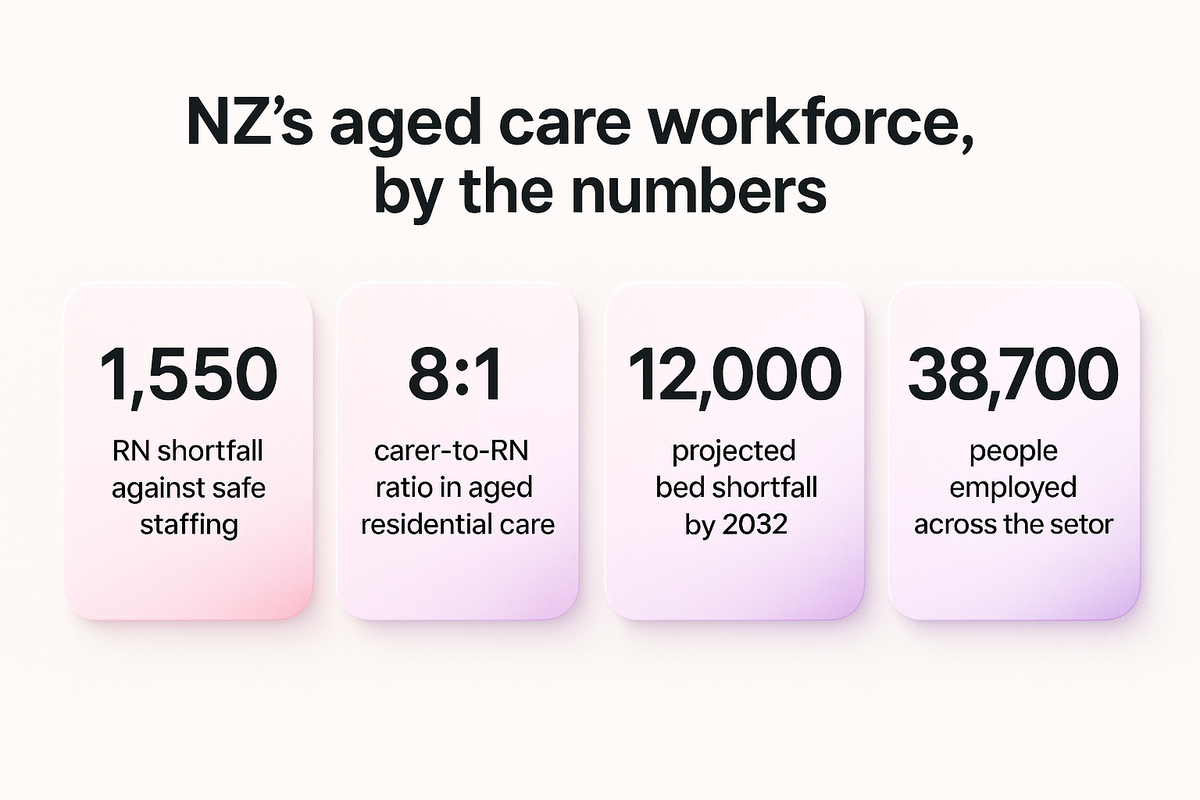
That 8:1 ratio matters for training design. If the placement experience is where trainees decide aged care "isn't for them," then it's overwhelmingly support worker trainees making that call — not nursing students. Any workforce strategy that doesn't build competence and confidence at the support worker level is solving the wrong end of the problem.
Why hasn't simulation training reached aged care yet?
New Zealand has an organised simulation community. It just isn't looking at aged care.
The New Zealand Association for Simulation in Healthcare (NZASH) published a white paper in the New Zealand Medical Journal (8 March 2024) and ran its 2026 conference at Te Papa, but the sector's simulation effort remains concentrated on acute and clinical hospital settings — theatres, emergency departments, undergraduate nursing skills labs.
Meanwhile, peer-reviewed research from 2025 and 2026 (indexed on PMC) shows simulation training improves empathy, communication, practical skills and self-efficacy specifically in elder-care contexts. The same body of research notes simulation hasn't yet been applied to train interprofessional teams in holistic, in-home assessment of older adults' needs — an approach directly relevant to home and community support qualifications, not just residential care.
Put those two things together and you get a gap that's well documented but currently unclaimed: peer-reviewed evidence says simulation works for aged care, but New Zealand's simulation infrastructure hasn't been built around it.
What would aged-care-specific coached practice actually look like?
A support worker's hardest moments aren't clinical procedures — they're conversations. Simulation designed for aged care needs to reflect that.
- Difficult conversations with family members about a resident's declining health or a care plan change.
- De-escalating and responding to dementia-related behaviours safely and with dignity.
- Falls response and reporting under time pressure.
- End-of-life communication with residents, whānau and colleagues.
- Culturally safe practice with Māori and Pacific whānau, reflecting Te Tiriti obligations built into NZQF-aligned qualifications.
Building these as live role-play exercises has traditionally meant hiring facilitators or actors — expensive, hard to scale, and hard to keep current as unit standards and best practice evolve. AI-generated coached practice tools, such as Nova, are starting to make it possible to build contextual audio and video-based role-play scenarios in minutes rather than weeks, mapped to a provider's own qualification and regulatory context rather than generic off-the-shelf content. For a sector this stretched, the appeal isn't novelty — it's being able to give every support worker trainee repeated, coached practice before their first real placement, without needing a facilitator in the room every time.
Key takeaways
- Trainees are leaving aged care because of poor placement experiences, not recruitment or pay settings alone — per RNZ/The Conversation, August 2026, citing Infometrics analysis for NZNO.
- Government's own Aged Care Ministerial Advisory Group (August 2026) has called for a certified, well-trained workforce strategy, but the Aged Care Association says no publicly visible long-term plan exists (NZ Doctor, 26 May 2026).
- Support workers, not nurses, deliver most hands-on aged care in New Zealand — roughly an 8:1 ratio — via NZQF-aligned qualifications like the Level 3 Support Work certificate.
- New Zealand's organised simulation community (NZASH) remains focused on acute clinical settings, leaving aged-care-specific simulation largely unaddressed despite peer-reviewed evidence of its benefits.
- Health NZ projects a shortfall of almost 12,000 aged residential care beds by 2032 — a capacity problem that coached, confident support workers will need to help absorb.
Our take
The policy conversation keeps asking for a "well-trained, certified, sustainable workforce" without describing what training actually needs to change. We think that's backwards. The evidence already points to the exact failure point — the unsupported first placement — and the exact cohort affected — support workers, not just nursing students. Providers delivering NZQF-aligned aged care qualifications don't need to wait for a national strategy to start closing that gap; they need to treat coached, repeatable practice as a normal part of the qualification, not an optional extra bolted on before a placement begins.
FAQ
What is aged care simulation training and why does New Zealand need it? It's structured, coached practice — role plays, scenario-based exercises, or AI-generated simulations — that lets trainees rehearse real aged care situations before facing them unsupervised. New Zealand needs it because trainees are currently deciding aged care "isn't for them" during unsupported first placements, per RNZ and The Conversation reporting (August 2026).
Why are nursing and support worker trainees leaving aged care specifically? Analysis by Infometrics for the New Zealand Nurses Organisation, reported by RNZ and The Conversation in August 2026, found students already enrolled in health programmes are opting out of aged care largely because of their placement experience in an under-resourced sector — not because of pay or marketing.
What qualifications cover aged care support work in New Zealand? The main pathway is the New Zealand Certificate in Health and Wellbeing (Level 3, Support Work), part of the NZQF, delivered through PTEs and ITPs. Roughly 16,300 personal care assistants and carers work in aged residential care under this kind of qualification, against around 2,100 registered nurses.
Does simulation training actually improve outcomes in aged care? Peer-reviewed research indexed on PMC (2025/2026) found simulation training improves empathy, communication, practical skills and self-efficacy in elder-care contexts. It hasn't yet been applied to interprofessional, in-home holistic assessment of older adults — an area the research flags as unaddressed.
Who is responsible for building New Zealand's aged care workforce strategy? Health New Zealand's Aged Care Ministerial Advisory Group recommended in August 2026 that government work with unions, providers and community groups on a cross-sector strategy. As of the Aged Care Association's comments to New Zealand Doctor (26 May 2026), no publicly visible long-term plan exists yet.