AI Assessment Writing for NZQA: A PTE Buyer's Guide
11 October 2026 · 8 min read
Yes. A PTE or other tertiary provider in New Zealand can use AI to draft unit standard assessments, but NZQA's internal moderation expectations mean a qualified assessor must still review, moderate and approve the material before it reaches learners. We found no NZQA rule written specifically for AI-drafted materials. Accountability sits with the provider.
Does NZQA have a rule on AI-drafted assessments?
Not one we could find. NZQA's AI page for tertiary providers is about learner academic integrity. It asks providers to keep academic integrity policies current on generative AI and to help staff understand how it can be used in teaching, learning and assessment. It doesn't address providers using AI to write assessments.
The sign-off expectation comes from somewhere else: NZQA's general internal moderation requirements. A plain reading of those covers AI-drafted material, even though NZQA doesn't say so in as many words.
There's also a softer signal. The Ministry of Education's school-sector AI marking guidance, developed with NZQA, says AI should support professional judgement, not replace it. It isn't binding on PTEs. It does show which way regulator thinking leans.
What does NZQA expect for pre-assessment moderation?
NZQA says internal moderation must be embedded in every tertiary education organisation's quality management system. It covers pre-assessment moderation of materials and post-assessment moderation of learner work. Its internal moderation guidance says to pre-assessment moderate:
- newly self-developed material
- changed material
- commercially produced material, or material sourced elsewhere
AI-generated drafts reasonably fall into that last group. Treat them that way.
NZQA doesn't prescribe how you run moderation. The minimum under the Rules is an effective system for moderating assessment materials and assessor decisions. Tasks and marking guidance are both moderated and approved before use with learners.
The principles behind this matter too. NZQA describes good assessment as fair, valid and consistent. Valid means a clear purpose and measuring what it aims to measure. Consistent means judgements are reliable whoever assesses and whenever. A draft only meets those tests once an accountable person has checked it.
If you assess against standards on the Directory of Assessment and Skill Standards (DASS), you also need NZQA's consent to assess and must take part in national external moderation. Each standard carries Consent and Moderation Requirements (CMRs).
What should you check before choosing an AI assessment-writing tool?
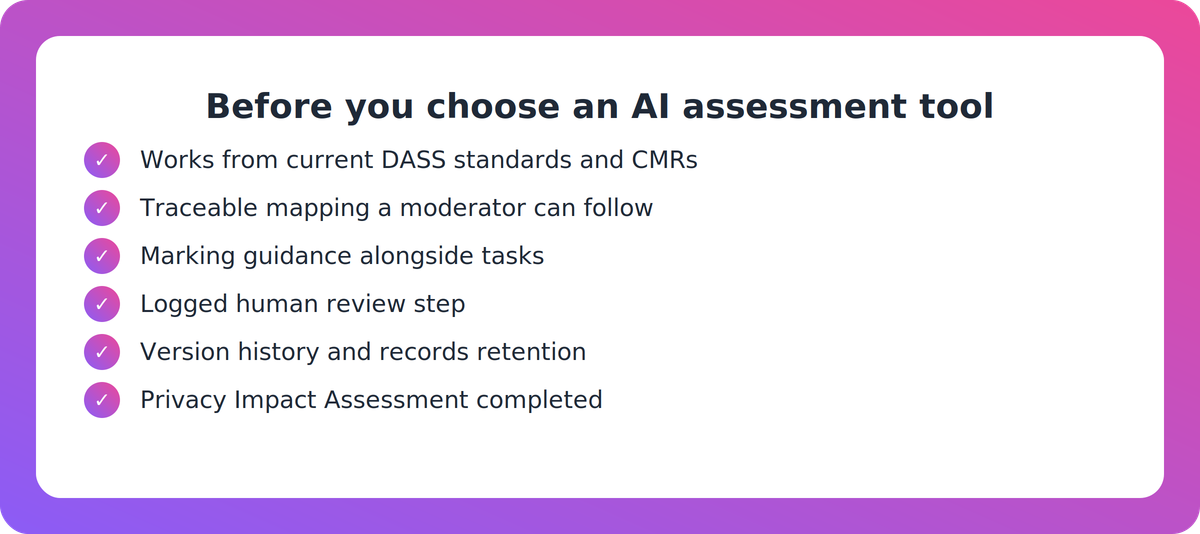
The real buying question isn't "which tool removes the human?" It's "which tool makes the human review easiest to prove?" Use these criteria.
Standards and mapping
- Standards currency. Does it work from current DASS unit and skill standards and the relevant CMRs? Can it update materials when a unit standard is replaced by a skill standard?
- Traceable mapping. Can a moderator see how each task and criterion maps back to the standard? A coverage map helps, but it doesn't prove compliance on its own.
- Marking guidance. Does it produce assessor guides, exemplar responses and marking guidance alongside tasks? NZQA treats both as materials to be moderated.
Human review and records
- Human review built in. Does the workflow route uncertain items to a qualified assessor and log the decision? Or does it offer a bypass?
- Moderation support. Is there somewhere to record pre-assessment moderation that fits your own quality management system? NZQA recommends standardised forms.
- Audit trail. Version history, currency control and retention matter. Several NZQA Rules came into force on 19 January 2026, including the Quality Assurance of Tertiary Education Providers Rules 2026. They cover quality management systems, annual self-reviews and assessment records retention.
Fit, privacy and evidence
- Context fit. Can drafts adapt to your industry, delivery mode (classroom, workplace, distance) and learners, such as ESOL or literacy and numeracy? Plan for your own assessors to check that adaptation.
- Privacy and data handling. Ask where data is hosted and what controls apply. The Privacy Commissioner says the Privacy Act applies to anyone using AI tools in New Zealand and recommends a Privacy Impact Assessment before you start. It matters most if the tool processes learner data. It matters less if it only drafts generic assessment tools. Verify vendor claims directly.
- Evidence quality. Ask what has been tested in actual NZQA moderation, and whether claims are independent or vendor-reported.
Is there independent evidence or NZQA approval for these tools?
We found none. There's no NZQA accreditation of AI assessment-writing tools, no approved-vendor list and no independent benchmark. Treat every time-saving or outcome figure, from any vendor, as self-reported.
A practical test: ask to see the sign-off workflow running, not described on a slide. Then take a draft through your own moderation process.
One regulatory change is worth knowing about when you talk to vendors. Industry Skills Boards (ISBs) replaced Workforce Development Councils from 1 January 2026. Check that any tool's standards and CMR references reflect the current setting.
Where VETos is a fair fit
Supahuman builds VETos, an Auckland-headquartered product positioned for PTEs, polytechnics and wānanga. On its own material, you pull a unit or skill standard into a workspace and build assessment tools against it. It produces standalone, clustered, grouped or integrated tools, plus assessor guides with mapping and moderation instructions. Mapping is regenerated when materials move to a new standard.
The vendor says it doesn't remove professional judgement. A qualified person still reviews and signs off, and its own NZ buyer's guide calls AI output a draft, not a finished compliant instrument. It also describes version history, currency control and audit trails to help answer moderation and consent-to-assess requests from the record.
Some honest caveats:
- The Mast Academy result (about six weeks down to minutes) is a vendor-reported course-authoring figure. It isn't unit standard assessment drafting specifically.
- The vendor's own guide notes that no independent NZQA audit of a specific AI assessment-generator product was found.
- Hosting is described as AWS in Australia. Verify that directly.
- The approval-gate workflow wasn't described in the material we reviewed. Ask for a demonstration.
Whatever you shortlist, run the same pilot. Take one unit standard, generate a draft, put it through your normal pre-assessment moderation, and see whether the record would satisfy a moderator.
Key takeaways
- NZ providers can use AI to draft unit standard assessments. NZQA has no AI-specific rule for this, but its internal moderation expectations still require qualified human review and approval.
- Treat AI drafts like externally sourced material: pre-assessment moderate them before use with learners.
- Choose on evidence of sign-off: traceable mapping, marking guidance, a logged human decision and an audit trail that supports the 2026 records requirements.
- No NZQA approval or independent benchmark exists for these tools. Ask for a live demonstration and treat vendor figures as self-reported.
- Complete a Privacy Impact Assessment if the tool will touch learner data.
Our take
Be wary of any tool whose pitch is speed alone. The risk in AI-assisted assessment writing isn't a slow draft. It's a fast draft that nobody can show was properly checked. We'd put the budget where moderators feel it: mapping they can follow, version history, and a clear record of who approved what and when. The best tool is the one that makes your assessors' judgement visible, not the one that tries to stand in for it.
FAQ
Can a PTE use AI to draft unit standard assessments in New Zealand?
Yes. We found no NZQA tertiary rule that prohibits it or specifically governs it. Accountability stays with the provider, and the material should go through your normal pre-assessment moderation and be approved by a qualified assessor before use with learners.
Does NZQA require human sign-off on AI-generated assessments?
Not in AI-specific wording. NZQA's internal moderation guidance says to pre-assessment moderate new, changed and externally sourced materials before use with learners. AI-generated drafts reasonably fall into that group, so human review and approval is the safe reading.
What should I check before choosing an AI assessment-writing tool?
Check that it works from current DASS standards and CMRs, maps tasks traceably, produces marking guidance, logs human review, keeps version history, and handles data clearly. Complete a Privacy Impact Assessment if learner data is involved, and ask to see the sign-off workflow demonstrated.
Is there independent evidence or NZQA approval for these tools?
We found no NZQA accreditation, approved-vendor list or independent benchmark for AI assessment-writing tools. Vendor time-saving and outcome figures, including ours, should be treated as self-reported until you've tested them in your own moderation process.
Does the Privacy Act apply to AI assessment tools?
The Privacy Commissioner says the Privacy Act applies to everyone using AI tools in New Zealand and recommends a Privacy Impact Assessment before starting. The risk is higher if the tool processes learner data, and lower if it only drafts generic assessment tools.