AI Assessment Writing & NZQA Compliance: Buyer Guide
23 July 2026 · 8 min read

AI can speed up drafting NZQA-aligned unit standard and skill standard assessments, but there's no published NZQA policy that specifically governs provider use of AI to author assessment instruments — NZQA's existing AI guidance covers candidate use of generative AI and its own AI-assisted marking trial, not this. That means the consent-to-assess and moderation obligations your PTE or ITP already carries still apply in full, no matter what tool produced the draft.
What "AI assessment writing" actually means here
When people search for AI assessment writing NZQA compliance, they're usually asking one of two things: is this allowed, and will it hold up under moderation? The honest answer is that AI drafting tools sit in a genuine grey area. NZQA has published guidance on acceptable use of AI and academic integrity, but both are framed around candidates using generative AI in submitted work, and around NZQA's own trial of AI-assisted marking — where human markers double-checked more than a third of results, especially near achievement boundaries, and the human mark was used whenever AI and human scores disagreed. Neither document says anything specific about a training provider using AI to write assessment instruments in the first place.
That gap doesn't mean AI drafting is prohibited. It means the responsibility for compliance hasn't shifted anywhere — it still sits with your organisation and your qualified assessors, exactly as it does today.
Will this put your consent to assess or moderation standing at risk?
No tool changes what NZQA requires. Providers must hold consent to assess against specific standards, granted under the Consent and Moderation Requirements (CMR) set by Standard-Setting Bodies. That consent exists to assure NZQA your organisation has capable assessors and adequate resources — it's a statement about your people and processes, not your software.
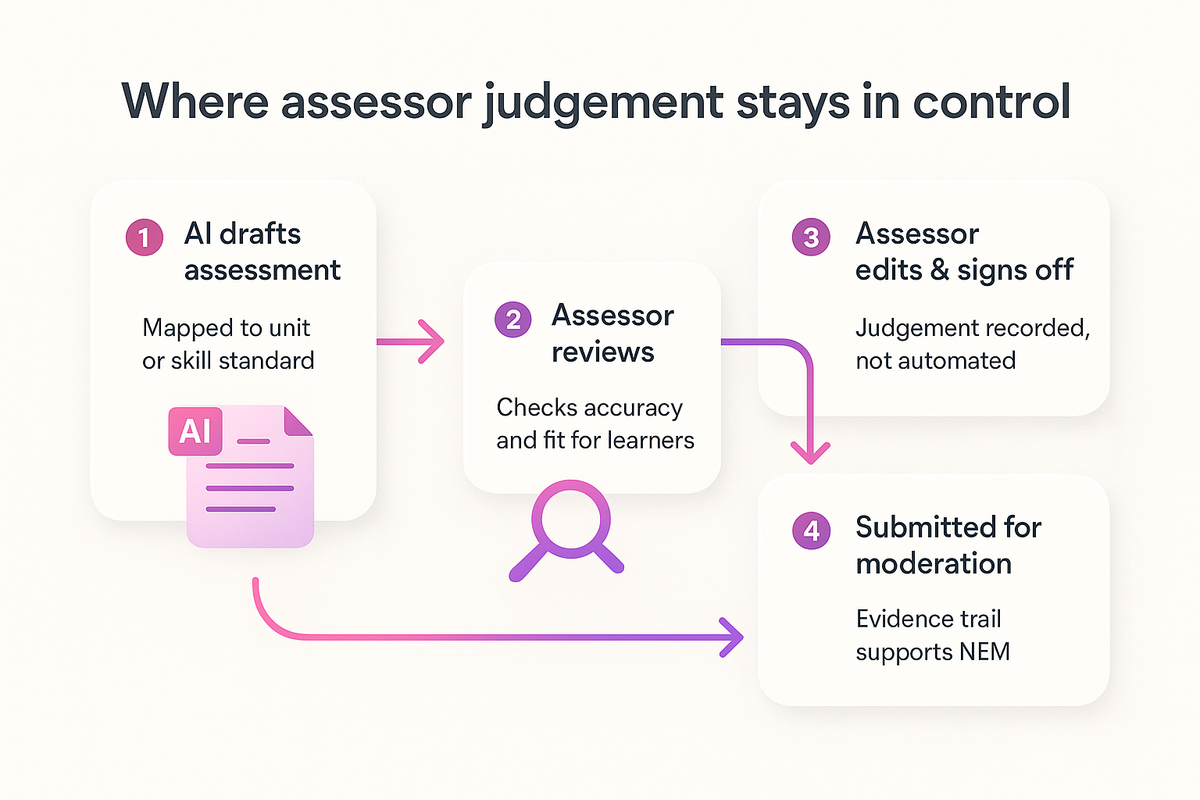
National external moderation (NEM) works the same way. It exists to confirm assessor judgements are fair, valid and consistent with the national standard. An AI-drafted assessment still has to produce evidence a moderator can check against the standard: clear mapping, assessor reasoning, consistent judgements over time. If a tool generates content but no moderation trail, you haven't solved anything — you've just moved the admin problem from "writing it" to "defending it."
It's also worth remembering that NZQA's assessor unit standards — including 4098 (use standards to assess candidate performance), 11551 (moderate assessment), 11552 (design and evaluate assessment materials), and 30421/30422 — formally recognise assessment design and judgement as human competencies. NZQA does run a formal certification pathway for assessment materials through Quality Assured Assessment Materials (QAAM), but it's school/secondary-focused, and even QAAM-certified materials still require post-assessment moderation. Certifying the material never removes the human moderation step.
What to look for in an AI assessment-authoring tool
Buying decisions in this category come down to whether a tool treats AI output as a finished product or as a draft for a qualified assessor to interrogate. A handful of practical checks separate the two.
Human-in-the-loop by design
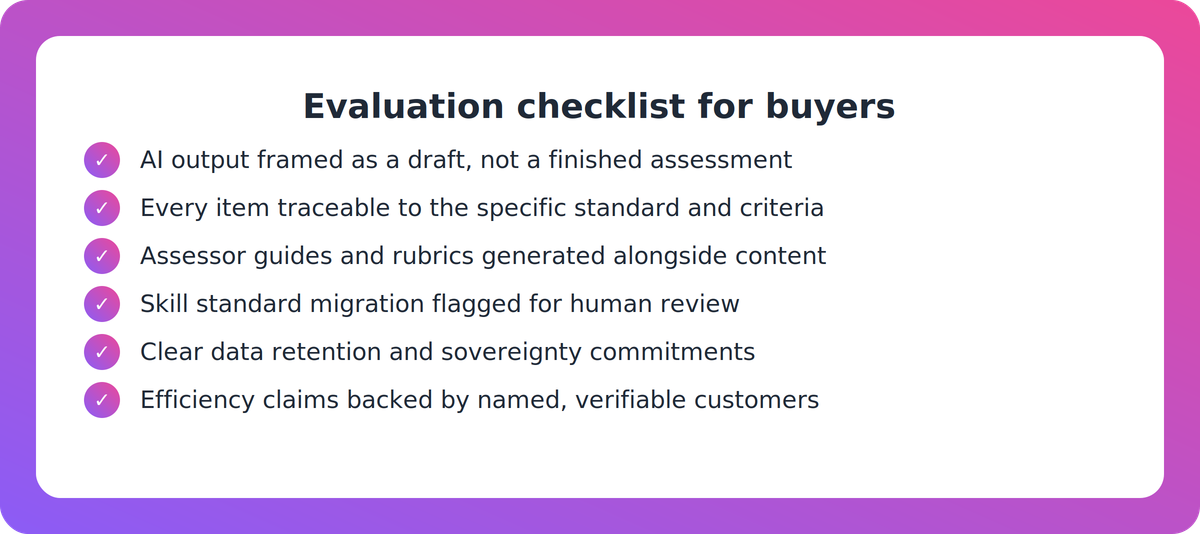
The tool should position every AI-generated assessment, rubric or assessor guide as something a human reviews, edits and signs off — never as submission-ready content. If a vendor's language suggests the assessment is "done" once AI generates it, that's a warning sign, not a feature.
Traceable mapping to standards
Every question or task should trace back to the specific unit standard or skill standard, element and performance criteria it addresses, in a form a moderator can actually check. Generic "aligned to NZQA" claims aren't enough — you need line-by-line traceability.
Moderation-ready evidence, not just content
A good tool produces assessor guides, rubrics, exemplars and version records alongside the assessment itself, so internal and external moderation is easier, not just possible. Content with no supporting evidence trail creates more moderation work, not less.
Handling the shift to skill standards
NZQA is migrating unit standards to skill standards on its directory. Ask any vendor exactly how their tool tracks this migration, and whether it flags affected materials for a human to review rather than silently regenerating them without anyone noticing.
Data handling and sovereignty
NZ's data.govt.nz Algorithm Impact Assessment guidance and Privacy Commissioner guidance both recommend documenting scope, completing a risk assessment, and considering data sovereignty and engagement with Māori around taonga data before adopting an AI tool for decisions that affect learners. Ask what a vendor commits to on data retention and whether your content trains their model.
Evidence behind vendor claims
Time-saving and compliance claims are common in vendor marketing. Ask for named NZ customers and specifics you can verify in your own trial, not just a headline figure.
Key takeaways
- No NZQA policy currently governs provider use of AI to draft assessment instruments — existing guidance covers candidate use and NZQA's own AI-assisted marking trial only.
- Consent to assess and national external moderation obligations are unchanged by AI drafting tools; they still rest on qualified assessor judgement and sign-off.
- NZQA's assessor unit standards (4098, 11551, 11552, 30421, 30422) confirm assessment design and moderation remain formally recognised human competencies.
- Evaluate tools on traceable standards mapping, moderation-ready evidence, transparent handling of the skill standards migration, and clear data commitments — not just speed.
- Treat vendor efficiency claims as things to verify in your own trial, since none currently carry independent NZQA or third-party audit.
Our take
The providers who get value from AI assessment-writing tools are the ones who treat them as a drafting accelerator sitting underneath an unchanged compliance process, not a shortcut around it. The real risk in this category isn't NZQA banning AI drafting — it's a provider assuming a fast draft is a compliant one, and skipping the review a moderator would have caught. If you're evaluating tools, spend more time asking how they support your assessors' judgement than how fast they generate content.
FAQ
Can AI legally be used to draft NZQA-aligned unit standard or skill standard assessments?
There's no NZQA policy that prohibits it, but there's also no published guidance specifically covering provider use of AI to author assessment instruments — NZQA's current AI guidance addresses candidate use and NZQA's own AI-assisted marking trial. Providers should confirm expectations directly with NZQA or their Standard-Setting Body rather than assume existing guidance applies.
Will using an AI drafting tool put our consent to assess or moderation standing at risk?
Only if the resulting assessments and evidence trail don't hold up to moderation. Consent to assess and national external moderation both depend on qualified assessor judgement being demonstrable — an AI tool doesn't change that requirement, and a tool that produces content without moderation-ready evidence adds risk rather than removing it.
What should a PTE or ITP look for so assessor accountability isn't compromised?
Look for human-in-the-loop design, traceable mapping of every item to the standard, generated assessor guides and rubrics that support moderation, transparent handling of the unit-standard-to-skill-standard migration, clear data-handling commitments, and vendor claims backed by named, verifiable NZ examples rather than generic figures.
How do AI assessment tools handle the move from unit standards to skill standards?
Approaches vary by vendor. Ask specifically how a tool tracks NZQA's directory migration and whether it flags affected materials for a human to review and update, rather than regenerating them automatically without oversight. Supahuman/VETos, for example, describes a standards change tracking feature that flags NZQA unit standard updates and generates draft updates for an educator to edit and finalise, alongside audit-ready logs — a design worth comparing against other options rather than taking at face value.
Does certifying assessment materials (like QAAM) remove the need for moderation?
No. QAAM is NZQA's certification pathway for assessment materials, but it's focused on the school/secondary sector, and even QAAM-certified materials still require post-assessment moderation to confirm assessor judgements sit at the national standard. Certification of the material and moderation of the judgement are separate steps.
If you're weighing up AI assessment-authoring tools for your PTE or ITP, the useful next step is a small trial against standards you already hold consent for — checking traceability, moderation-readiness and how the tool behaves once a skill standard supersedes a unit standard. Supahuman/VETos publishes an NZ PTE example (Mast Academy) of this kind of drafting-plus-review workflow if you want a concrete reference point to compare against, alongside your own checklist.