AI Assessor Guide Generator: Will It Pass an ASQA Audit?
7 October 2026 · 8 min read
AI Assessor Guide Generator: Will It Pass an ASQA Audit?
An AI-drafted assessor guide can stand up to an ASQA audit, but the AI isn't what makes it stand up. ASQA hasn't banned or approved AI-written assessment tools. It tests whether your RTO's tools and assessor judgements meet the Standards for RTOs 2025. A guide holds up when your RTO reviews it before use, contextualises it to your cohort and keeps evidence of both.
Does ASQA allow AI-written assessor guides?
There's no published ASQA rule banning or approving AI-generated assessor guides. The research for this guide also found no ASQA-approved vendor list and no certification for AI tools. Accountability stays with the RTO, whatever drafted the document (ASQA FAQs and Practice Guides).
The revised Standards for RTOs came into full regulatory effect on 1 July 2025. ASQA's Assessment Practice Guide covers three standards that matter here:
- Standard 1.3: a fit-for-purpose assessment system consistent with the training product.
- Standard 1.4: the principles of assessment and rules of evidence.
- Standard 1.5: validation.
The benchmark is the principles of assessment (fairness, flexibility, validity, reliability) and the rules of evidence (validity, sufficiency, authenticity, currency). An auditor measures your guide against those, not against the software logo.
ASQA has also published five Principles for the Responsible Use of AI in VET. They don't add new regulatory requirements. They help providers interpret and oversee AI use within existing obligations. Principle 1 calls for strong governance that doesn't undermine VET quality or integrity, and each principle comes with self-assurance questions.
What your RTO still has to do itself
An AI assessor guide generator speeds up drafting. It doesn't take over the parts of the job the Standards put on you. A qualified, accountable person still needs to:
- Review the tool before use. ASQA's 2025 Standards FAQ describes this as a review, not pre-use validation, so no specific credentials are required. You must still be able to evidence that it happened.
- Contextualise it. ASQA names a known risk: relying on purchased assessment tools that aren't contextualised to your student cohort, learning environment or training product.
- Validate it. ASQA's validation guidance says not to rely solely on the tool developer to provide compliant tools.
- Use assessor judgement. The guide supports reliable judgements. It doesn't make them.
One consultancy, Coast Wide Training, reports that ASQA has flagged AI-assisted submissions with generic wording and unsubstantiated claims. It also lists unverified AI-written tools and unchecked mapping as risky. ASQA's original wording wasn't found, so treat that as secondary reporting. It matches the primary guidance, though: generic, unchecked output is the risk.
What to check in an AI assessor guide generator
What does a defensible tool actually look like? Weigh these criteria before you weigh any demo.
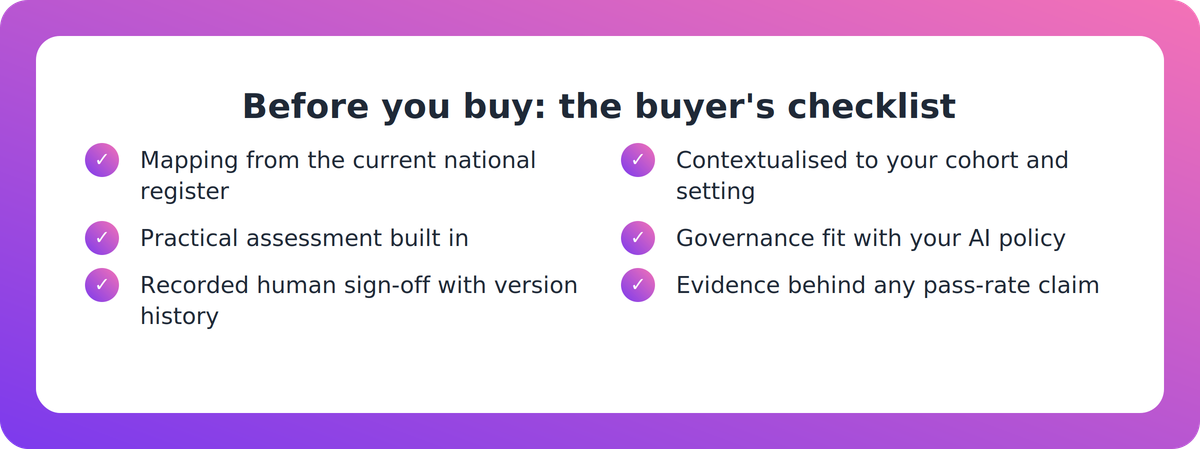
Mapping to the current training product
- Are elements, performance criteria and conditions drawn from the national register (training.gov.au)?
- Are superseded units flagged?
- Does the mapping update when you change a task, or does it go stale the moment someone edits?
Practical assessment, not just questions
Where a unit requires demonstrated skills, the guide needs to support practical assessment. A bank of written questions won't satisfy sufficiency on its own.
Recorded human review and sign-off
Look for a review step with version history. That's how you evidence the pre-use review when an auditor asks for it.
Contextualisation
Can you shape output to your industry, cohort and delivery setting (workplace, classroom, distance, LLN or ESOL support)? Or does every RTO get the same guide with the names changed?
Support for reliable judgements and feedback
Does the guide help assessors reach consistent decisions? Is there a way to feed assessor experience back into improving the tool? ASQA's validation guidance expects that loop.
Governance fit
Check data handling, ownership of outputs and export formats against your own AI policy and ASQA Principle 1. Find out where your content goes and whether you can take it with you.
Pricing and scope
Ask for pricing in writing and match it to your scope. Pricing varies by vendor, so compare like for like.
Can you trust vendor pass-rate claims?
Treat them as a question, not an answer. No independent source has verified any headline "first-time validation pass rate" for AI-generated assessment tools.
That includes ours. Supahuman's own site claims a 95% first-time validation pass rate (against a 68% sector average) and up to 80% less development time. We couldn't find a public methodology or sample size for those figures. They're the vendor's numbers, so weigh them accordingly.
For any vendor, ask:
- How was the figure calculated, and over what period?
- What was validated: whole tools, or individual tasks?
- How many units or RTOs were in the sample?
- Who did the validating, and was it independent of the vendor?
A vendor who can answer plainly is worth talking to. One who can't has told you something too.
Where VETos is a fair fit
We built VETos for Australian VET, so here's what's grounded in our own material, and what isn't.
- It generates a matching assessor guide and mapping document with each assessment, whether standalone, clustered or integrated, linked to your scope items on the national register.
- Mapping is built from live training.gov.au data and updates when a task is adapted. It can be exported for pre-use review, with version history kept as an evidence trail.
- A live view of scope, qualifications and units flags superseded units when they change, which supports the currency requirement.
- A qualified person still validates and signs off. Our site is clear that ASQA doesn't approve AI tools, and we don't claim an AI-written guide automatically passes an audit.
- The signup page shows an estimated annual licence of $42,500 after a 14-day trial for one tier. Pricing is based on scope, with volume discounts, so check it against your own.
One caveat: the "Assessor QA" module listed on our legal page is marked Coming Soon. Don't count it as available today.
VETos isn't the only way to get there. An in-house team with a strong review process, or a mix of tools, can meet the same standard. What matters is that the criteria above are met.
A practical next step
Before you talk to any vendor, write down your own review and sign-off process: who reviews, against what, and where the record lives. Then test every tool against it with a unit you know well. If you'd like to see how VETos handles mapping and review, the assessment mapping overview is a reasonable starting point. The checklist above works for any tool you evaluate.
Key takeaways
- ASQA neither bans nor approves AI-written assessor guides. Your RTO stays accountable for whether its tools meet the Standards for RTOs 2025.
- A defensible guide is reviewed before use, contextualised to your cohort and backed by evidence of that review.
- Choose on current-register mapping, practical assessment, recorded sign-off, contextualisation and governance fit.
- Treat pass-rate claims, including ours, as unverified until you've seen the methodology and sample size.
- AI assists a qualified, accountable person. It doesn't replace validation or professional judgement.
Our take
The question "will AI pass an audit?" is the wrong one, because audits don't test software. They test whether you can show your assessment tools are fit for purpose and your assessors made sound calls. The best AI assessor guide generator is the one that makes that evidence easier to produce: clear mapping, a recorded review, a version trail. Be wary of any tool, ours included, that sells certainty instead of a process you can defend.
FAQ
Can an AI-generated assessor guide pass an ASQA audit?
It can, if your RTO reviews it before use, contextualises it and can evidence that review. ASQA hasn't banned or approved AI-written assessment tools. It assesses whether your tools and assessor judgements meet the Standards for RTOs 2025, regardless of how they were drafted.
Does ASQA approve any AI assessor guide generators?
No. The research found no ASQA-approved vendor list or certification for AI tools. ASQA's five Principles for the Responsible Use of AI in VET add no new requirements. They help providers govern AI use within existing obligations.
What must an RTO still do itself?
Review the tool before use and keep evidence of that review. Contextualise it to your cohort, learning environment and training product, and validate it. ASQA's guidance says not to rely solely on the tool developer. A qualified person stays accountable throughout.
What should I check in an AI assessor guide generator?
Check mapping to the current register with superseded units flagged, and practical assessment where units require it. Look for recorded human sign-off with version history, and for contextualisation to your cohort. Also check data handling, output ownership and export formats against your AI policy.
Can I trust vendor claims like first-time validation pass rates?
Not without evidence. No independent source has verified such figures. Ask how the number was calculated, what was validated, the sample size and who did the validating. Judge the output against the principles of assessment and rules of evidence, not marketing claims.