AI Coached Practice Software: A Buyer's Guide (AU)
4 August 2026 · 8 min read
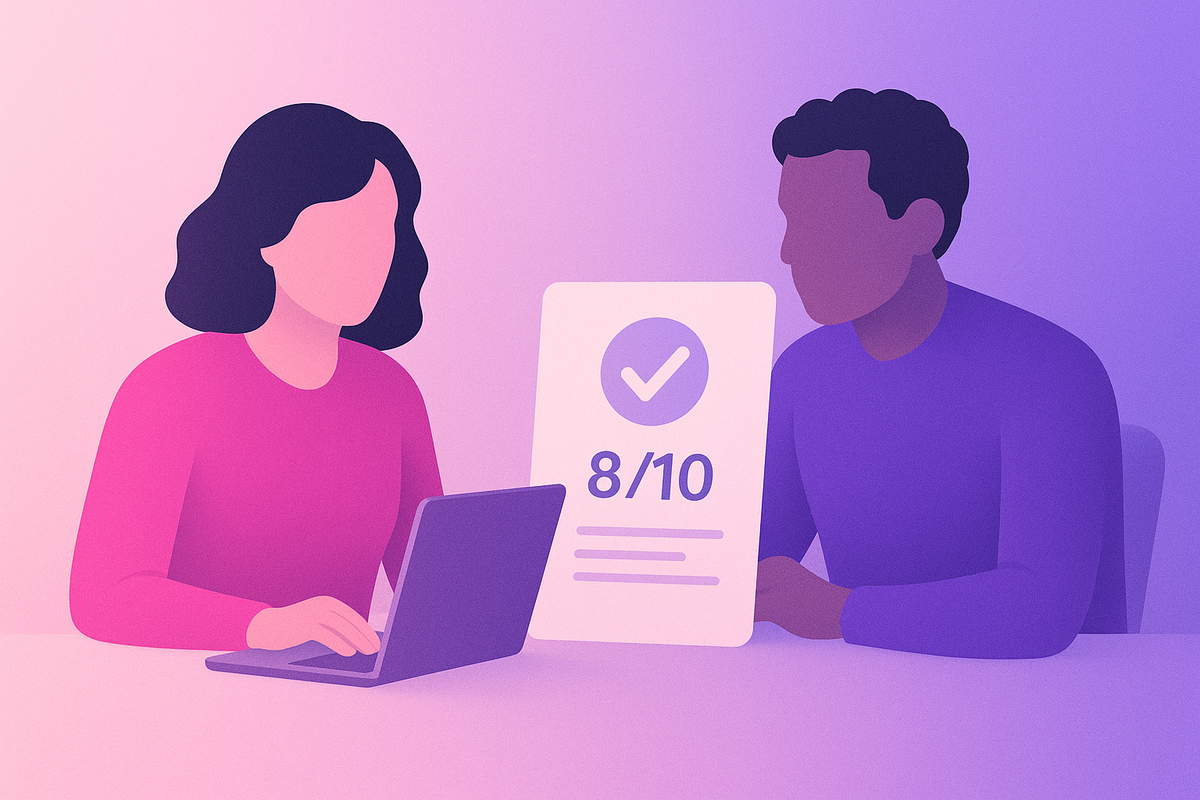
AI coached practice software puts a trainee into a realistic, scored roleplay or simulation with an AI-driven persona, rather than delivering static slides or answering questions like a general chatbot. The category splits into knowledge, behavioural and simulation coaching, and for Australian RTOs, ASQA's Principles for the Responsible Use of Artificial Intelligence in VET require a qualified trainer or assessor to stay accountable for whatever outcome the tool produces.
What AI-coached practice software actually does
A standard e-learning module delivers content and checks recall. A chatbot answers questions on demand. AI coached practice software does something different: it puts a learner into a scenario — a difficult customer call, a workplace safety conversation, a sales objection — and pairs them with an LLM-driven persona that responds in character, in real time.
The session is then scored against criteria, ideally criteria the buying organisation can set and weight itself rather than a fixed, opaque score the vendor controls. Some platforms layer in audio, video and visual cues so the practice feels closer to the real interaction, and let the trainee repeat the scenario until the behaviour sticks — the point being repetition and feedback, not just exposure to content.
The three coaching types — match the tool to the actual gap
Industry comparisons of these platforms (TalentLMS's 2026 review of AI coaching tools is one) generally sort them into three groups:
- Knowledge coaching — reinforces facts and procedures through quizzing and spaced repetition.
- Behavioural coaching — builds habits and soft skills through feedback loops on tone, pacing and communication style.
- Simulation coaching — drops the trainee into a realistic scenario with a persona and scores the interaction against defined criteria.
Buying "an AI coach" without first naming which of these three your organisation actually needs is the most common mistake. A contact-centre team struggling with objection handling needs simulation coaching. A cohort that keeps forgetting compliance steps needs knowledge coaching. Don't let a slick demo of one type sell you on solving a problem it wasn't built for.
Does it meet the Standards for RTOs 2025 and ASQA's AI principles?
The Standards for RTOs 2025, in force since 1 July 2025, don't set out specific AI rules line by line. They do require documented governance, assessment integrity and learner-support frameworks — which means adopting an AI coaching tool without a written governance approach is itself a compliance gap, not a neutral choice.
ASQA has gone further with its Principles for the Responsible Use of Artificial Intelligence in VET, which state plainly that no AI tool should run on autopilot and that a human must stay in the loop on any decision affecting a learner. That principle applies directly to any coaching platform that scores, ranks or assesses trainee performance — the tool can generate the practice and the feedback, but a qualified person still owns the decision.
Worth noting for scope: universities and other higher-education providers answer to TEQSA, while Registered Training Organisations answer to ASQA. If your organisation sits across both, confirm which regulatory lens applies before assuming VET-specific guidance covers everything you do.
There's a privacy layer too. The Office of the Australian Information Commissioner (OAIC) expects a Privacy Impact Assessment before any tool that collects trainee data goes live, and from 10 December 2026, organisations must disclose in their privacy policy where automated decisions significantly affect an individual — relevant if a coaching score ever feeds into progression, certification or employment decisions.
How to evaluate a platform before you buy
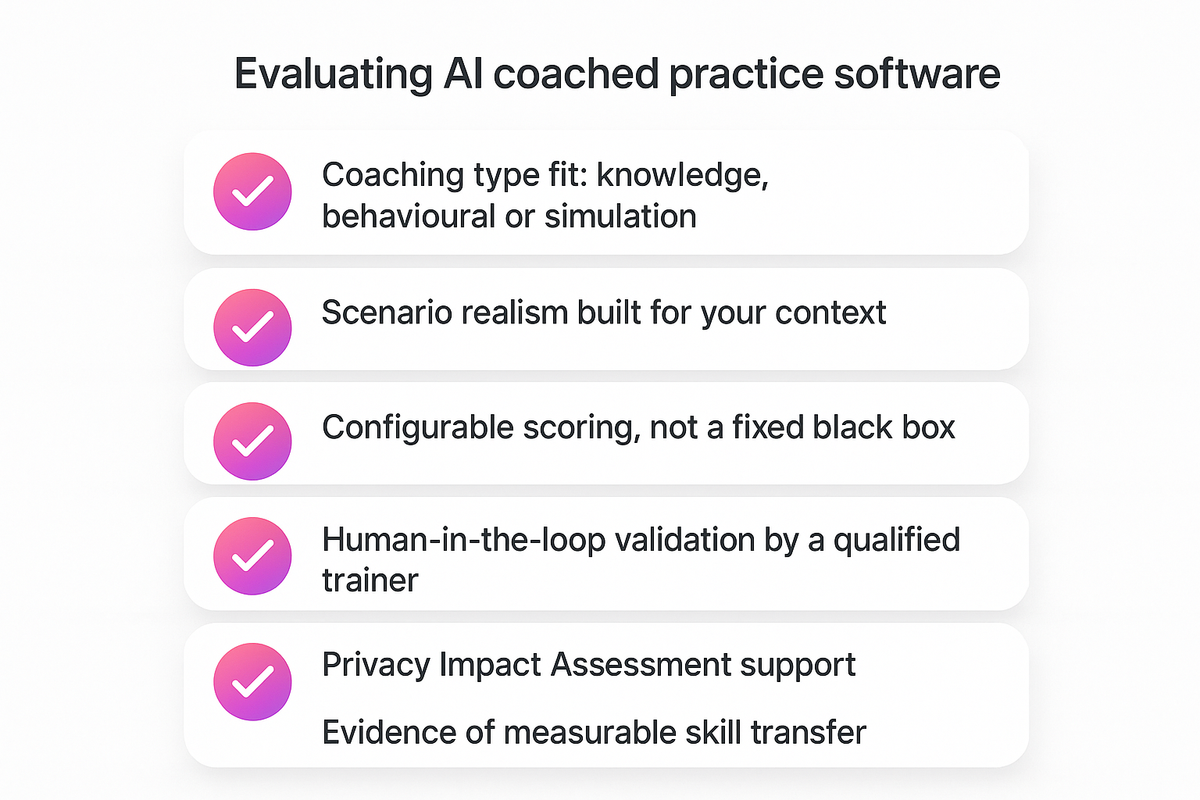
Comparative reviews of AI roleplay and coaching tools (Yoodli's and Outdoo's evaluation guides are useful starting points) tend to assess the same handful of things. Before signing anything, check:
- Coaching type fit — does it do knowledge, behavioural or simulation coaching, and does that match the actual skill gap you're trying to close?
- Scenario realism — is it built for your context, or a generic template reskinned with your logo?
- Configurable scoring — can you set and weight the criteria, or is it a fixed black-box score?
- Human-in-the-loop design — is a qualified trainer or assessor clearly positioned to validate outcomes, not just review a dashboard after the fact?
- Privacy readiness — will the vendor support a Privacy Impact Assessment and help you meet the coming automated-decision disclosure requirement?
- Evidence of skill transfer — ask for outcome data, not adoption numbers. One widely cited sales-training statistic is that over 87% of sales organisations already use some form of AI coaching, yet 39% of staff still say the coaching they get is too generic to build a specific skill. Adoption and effectiveness are not the same thing.
- Integration and pricing — does it sit inside your existing LMS, and is the pricing model actually comparable to alternatives?
Does AI-coached practice replace a qualified trainer or assessor?
No — and any vendor implying otherwise should raise a flag. ASQA's own principle is explicit: a human stays in the loop on decisions affecting learners. AI-coached practice is built to give every trainee more reps — more realistic conversations, more attempts, more specific feedback — but the trainer or assessor still validates whether the demonstrated skill actually meets the unit of competency, still moderates results, and still signs off on the outcome.
Done well, this frees the trainer up rather than sidelining them. Supahuman's VETos platform, for one example, includes a learner-facing AI assistant — its coached-practice module is called Nova — that gives interactive study support and round-the-clock coaching access, built specifically for ASQA-regulated providers rather than bolted on as a generic feature. The company positions it as taking administrative and content-production load off trainers so they have more time for mentoring, pastoral care and industry connections — not as a stand-in for the trainer's judgement when it comes to validating what a learner has actually achieved.
Key takeaways
- AI coached practice software delivers scored roleplay and simulation, not just content delivery — match the coaching type (knowledge, behavioural, simulation) to your real skill gap before comparing vendors.
- ASQA's Principles for the Responsible Use of AI in VET require a human in the loop on any decision affecting learners; the Standards for RTOs 2025 make undocumented AI governance a compliance risk.
- Insist on transparent, provider-configurable scoring rather than a fixed black-box score.
- Check the vendor's privacy posture — a Privacy Impact Assessment now, and readiness for automated-decision disclosure obligations from December 2026.
- High adoption of AI roleplay tools doesn't prove effectiveness — ask for evidence of measurable skill improvement, not just a polished demo.
Our take
The realism of the AI persona gets most of the attention in vendor demos, and it's the least important thing to worry about. The questions that actually determine whether a platform survives contact with an ASQA audit — or simply produces better-trained staff — are about scoring transparency, documented governance and who remains accountable for the outcome. Australian buyers who lead with those questions, rather than "does the roleplay feel real", will end up with a shorter, more honest shortlist.
FAQ
What does AI coached practice software do differently from a standard e-learning module or chatbot? It places a trainee in a scored, interactive roleplay or simulation with an AI-driven persona, giving repeatable practice against defined criteria, rather than delivering static content or answering ad-hoc questions.
Is AI-coached practice compatible with ASQA's Standards for RTOs 2025? Yes, provided it's implemented with documented AI governance and keeps a qualified trainer or assessor in the loop on any decision affecting a learner, consistent with ASQA's Principles for the Responsible Use of Artificial Intelligence in VET.
How should an RTO or L&D team evaluate roleplay or simulation platforms before buying? Check coaching-type fit, scenario realism, configurable (not black-box) scoring, human-in-the-loop design, privacy readiness for a Privacy Impact Assessment, evidence of actual skill transfer, and integration with your existing LMS and pricing.
Does using AI for coached practice remove the need for a qualified trainer or assessor to sign off on outcomes? No. ASQA's own principle states no AI tool should operate on autopilot, and a qualified trainer or assessor must remain accountable for validating and moderating whatever outcome the AI-coached session produces.
Does this apply to universities as well as RTOs? Not directly. Universities and other higher-education providers answer to TEQSA, while Registered Training Organisations answer to ASQA — confirm which regulator applies to your organisation before assuming VET-specific AI guidance covers you.
If you're building a shortlist, start by writing down which of the three coaching types your skill gap actually needs, then ask each vendor to show you their scoring configuration and their governance documentation before you look at a single demo. Supahuman's coached-practice module, Nova, is one option built for ASQA-regulated providers — you can look at how it approaches this at nova.supahuman.com — but the checklist above will serve you just as well with any vendor you're considering.