AI Coached Practice in NZ Vocational Training: Buyer Guide
13 October 2026 · 8 min read
Yes, AI-coached practice can help NZ vocational trainees rehearse before sign-off, but the competency decision stays with the accountable assessor. No NZ regulator defines the category or says outright that AI may not sign off. So buyers should lean on NZQA's fair, valid and consistent principles and check that the tool keeps practice feedback separate from assessor decisions.
What is AI coached practice, and where does it sit in NZ vocational training?
AI coached practice is rehearsal with a coach. A trainee talks through a customer scenario with an AI counterpart, works through a simulation, or gets feedback on a mock assessment. Then they try again. It's closer to a practice partner than a marker.
One point of honesty before we go further. There is no NZ regulator definition, standard or certification for "AI-coached practice". The research behind this guide found no NZ regulator source saying "AI may not sign off". The sign-off principle is inferred from NZQA's moderation and assessment rules, not stated outright. That's a reasonable inference. It's still an inference, and you should treat it that way.
The practical upshot is simple. Coached practice is formative. Sign-off is summative. Keep them apart.
What does NZQA actually expect from assessment decisions?
NZQA says national external moderation exists to give confidence in the reliability and consistency of assessor judgements about learner performance. Two terms matter most:
- Valid: the assessment measures what it aims to measure.
- Consistent: judgements are reliable across learners, assessors and time.
NZQA's 2026 programme approval rules go further. They require assessment methodology that is fair, valid, consistent and appropriate to the learning outcomes, plus an effective system for moderating assessment materials and decisions. A coached-practice tool sits inside that system. It doesn't replace it.
Two adjacent sources are useful parallels, with a caveat. NZQA's AI guidance is aimed at schools and kura. It does say that organisations with consent to assess DASS-listed standards must have an authenticity policy that includes acceptable use of AI. The NCEA misconduct rules on AI-generated content apply to NCEA, not vocational unit standards. And Ministry of Education guidance for schools says AI marking tools should support, not replace, teachers' professional judgement, with human oversight. That's a school document, not a vocational rule, but the direction of travel is clear.
Who sets and moderates standards now?
This changed recently, and some older pages haven't caught up. Ohu Ahumahi reports that Workforce Development Councils were disestablished on 31 December 2025. Eight Industry Skills Boards (ISBs) now provide standard-setting functions. NZQA says ISBs are responsible for national external moderation of industry standards.
Some older NZQA and TEC pages still refer to WDCs. Check current sources before you write a procurement requirement around them.
The consent-to-assess rules also moved. The 2026 rules came into force on 19 January 2026. Consent to assess is approval to assess learners against DASS standards and report achievement to NZQA or TEC. Each DASS standard carries Consent and Moderation Requirements, so a tool should map to the specific standard being signed off, not to a generic skill label.
What should a PTE or polytechnic check before buying?
Use these as your evaluation questions. Ask each vendor to show you, not tell you.
Does the tool keep AI feedback separate from the assessor's decision?
- Does it state plainly that it does not mark work or make competency decisions?
- Is the assessor's decision recorded separately from AI observations?
- Is formative practice clearly separated from summative assessment, and is that boundary written into the vendor's service terms?
Can it trace to the standard and survive moderation?
- Can feedback and activities be traced to the specific unit or skill standard and its Consent and Moderation Requirements?
- Is the assessor's decision and supporting evidence captured in a form that is moderation-ready for NZQA or the relevant ISB?
Is it safe and appropriate for NZ learners?
- Privacy: is there a Privacy Impact Assessment, transparency to learners, human review of outputs and clear limits on vendor data retention, in line with Office of the Privacy Commissioner expectations?
- Cultural fit: can scenarios reflect NZ workplaces, te reo Māori and tikanga where relevant? Research flagged that AI practice partners can be overly agreeable and culturally neutral unless prompted. MIT and ConCoVE research also flagged the need for cultural localisation in AI training data.
Is the vendor current, and can it prove results?
- Does the vendor track DASS skill standards being current, expiring or discontinued, the ISB transition, and the 2027 work-based learning transition? Verify against NZQA and TEC directly.
- Is there independent NZ evidence of outcomes, or only marketing claims? Treat vendor-only claims with caution.
- Does it work on phones, integrate with your LMS, and support workplace mentors and employers in an apprenticeship setting?
How do I keep practice feedback separate from assessor judgements?
Think of two ledgers. One holds practice: transcripts, attempts, coaching comments. The other holds the assessment decision: the assessor's judgement, the evidence they relied on, and their sign-off.
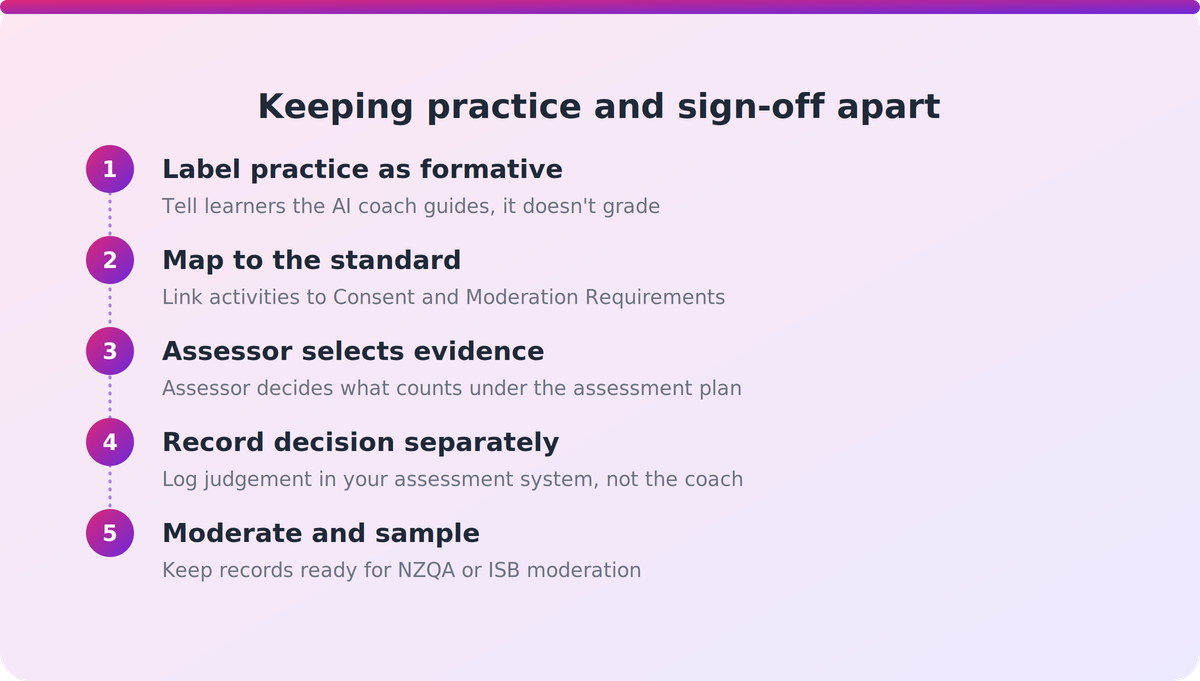
A workable process looks like this:
- Label practice activities as formative, and tell learners so.
- Map each activity to the unit or standard and its Consent and Moderation Requirements.
- Let the assessor choose whether any practice artefact, such as a recording, counts as evidence under the assessment plan.
- Record the assessor's decision in your assessment system, not in the coaching tool.
- Sample decisions through your own internal moderation, and keep records ready for external moderation.
The research on AI practice partners backs this split. Counsellor trainees found ChatGPT a psychologically safe, flexible place to practise. They saw AI as a supplement to live practice, not a replacement. The evidence is encouraging but modest.
Where does Supahuman's Nova fit?
We'll be brief and fair. Nova by Supahuman is the delivery companion to VETos. It generates role plays, simulations, narrated video and coached practice from a provider's own training products, and it's built in Aotearoa New Zealand and Australia. Supahuman states that Nova is formative: the AI coach guides rather than grades, and it does not mark work or make competency decisions. Assessors do that.
Coached practice includes voice role play against session objectives, responsive simulations with a debrief, and a 24/7 training advisor giving criterion-by-criterion feedback on uploaded mock assessments. Supahuman says each comment traces to a specific requirement of its unit, and lists outcome and competency mapping for the NZQF. Verify that against your own standards.
There are gaps to test. Supahuman's pages don't mention workplace-based trainee sign-off, particular NZ standards or unit-standard sign-off workflows. We found no outcome data for Nova coached practice. So run a pilot on one standard before you commit. You can read more at supahuman.com.
Key takeaways
- AI-coached practice helps trainees rehearse. The accountable assessor still makes the competency decision.
- No NZ regulator defines the category. Rely on NZQA's fair, valid and consistent principles and the 2026 consent-to-assess and programme approval rules.
- Insist on a clear boundary: AI observations in one place, the assessor's decision and evidence in another.
- Check who moderates now. Industry Skills Boards have replaced Workforce Development Councils, though some older pages still say otherwise.
- Ask for privacy safeguards, NZ cultural fit and independent evidence. Pilot before you buy.
Our take
The best use of AI coaching is volume of safe practice, which most training budgets can't otherwise afford. The worst use is blurring practice with judgement, because that is exactly what moderation is built to catch. We'd buy on the strength of the boundary, not the novelty of the scenarios. If a vendor can't show you where the AI stops and the assessor starts, keep looking.
FAQ
Can AI-coached practice be used to prepare trainees for sign-off in NZ?
Yes, as formative rehearsal. The competency decision stays with the accountable assessor. No NZ regulator source found says outright that AI may not sign off, so rely on NZQA's moderation principles of fair, valid and consistent judgements.
What should I check before buying an AI coached practice tool?
Check that it states it doesn't make competency decisions, traces to the specific standard and its Consent and Moderation Requirements, and records assessor decisions separately. Also ask about privacy safeguards, NZ cultural fit, current standards and independent outcome evidence.
Who moderates standards now that Workforce Development Councils have closed?
Ohu Ahumahi reports the WDCs were disestablished on 31 December 2025, with eight Industry Skills Boards taking over standard-setting. NZQA says ISBs are responsible for national external moderation of industry standards. Some older pages still mention WDCs, so check current sources.
Do NZQA's AI rules for NCEA apply to vocational training?
No. The NCEA misconduct rules on AI-generated content apply to NCEA, not vocational unit standards. But NZQA's AI guidance says organisations with consent to assess DASS-listed standards must have an authenticity policy that includes acceptable use of AI.