AI Practical Skills Training for RTOs: A 2025 Guide
14 September 2026 · 7 min read

AI tools genuinely help RTOs deliver practical skills practice under the Standards for RTOs 2025 when they generate auditable, competency-mapped evidence — recorded roleplay, simulation logs, coached feedback tied to units of competency — while leaving the actual competency decision with a qualified, accountable assessor. Tools that just produce documents or generic content, with no link to training package requirements and no human sign-off, won't satisfy an auditor looking for demonstrated practice.
What ASQA is actually auditing for
The Standards for RTOs 2025 commenced 1 July 2025 and are made up of Outcome Standards, Compliance Requirements and a Credential Policy, regulated by ASQA under the National Vocational Education and Training Regulator Act 2011 (ASQA; DEWR). The shift that matters for this buying decision is away from paper-based training and assessment strategies and toward outcomes-focused performance.
A few clauses do the heavy lifting here:
- Standard 1.1 requires training to be "engaging and well structured" — static PDFs and slide decks are a harder sell than they used to be.
- Standard 2.2 requires effective industry and employer engagement, which pushes RTOs toward practice that's contextualised to real workplaces, not generic scenarios.
- Standards 2.3–2.4 require a "fit for purpose" assessment system, with validation of assessment practices and judgements at least once every five years per training product (ASQA FAQ v3, October 2025).
None of this says AI must be used. But it does mean an RTO relying on AI for practical skills practice needs to be able to show an assessor and an auditor real evidence of practice — not just a claim that learners "did some roleplay somewhere."
Does ASQA allow AI-generated roleplay, simulation or feedback?
Yes, with governance attached. ASQA has published 5 Principles for the Responsible Use of AI in VET. These don't create new regulatory requirements — they're a lens for interpreting existing obligations, including Standard 1.4 (training and assessment), Standards 3.2–3.3 (VET workforce) and Standard 2.2 (student support).
The governance principle is specific: RTOs must know which AI systems are in use, why, who's accountable, and how risks are managed, proportionate to the risk level of the use case. Providers remain responsible for due diligence on any third-party AI tool — including privacy and data handling — even if the tool is off-the-shelf.
This matters because ASQA has already flagged real compliance risk from unreviewed AI output. Coast Wide Training, citing ASQA IQ, reports a case where a provider submission literally retained chatbot text. The lesson isn't "don't use AI" — it's that every AI-assisted output has to be reviewed, tailored and verified by a person before it's used in a training or assessment context.
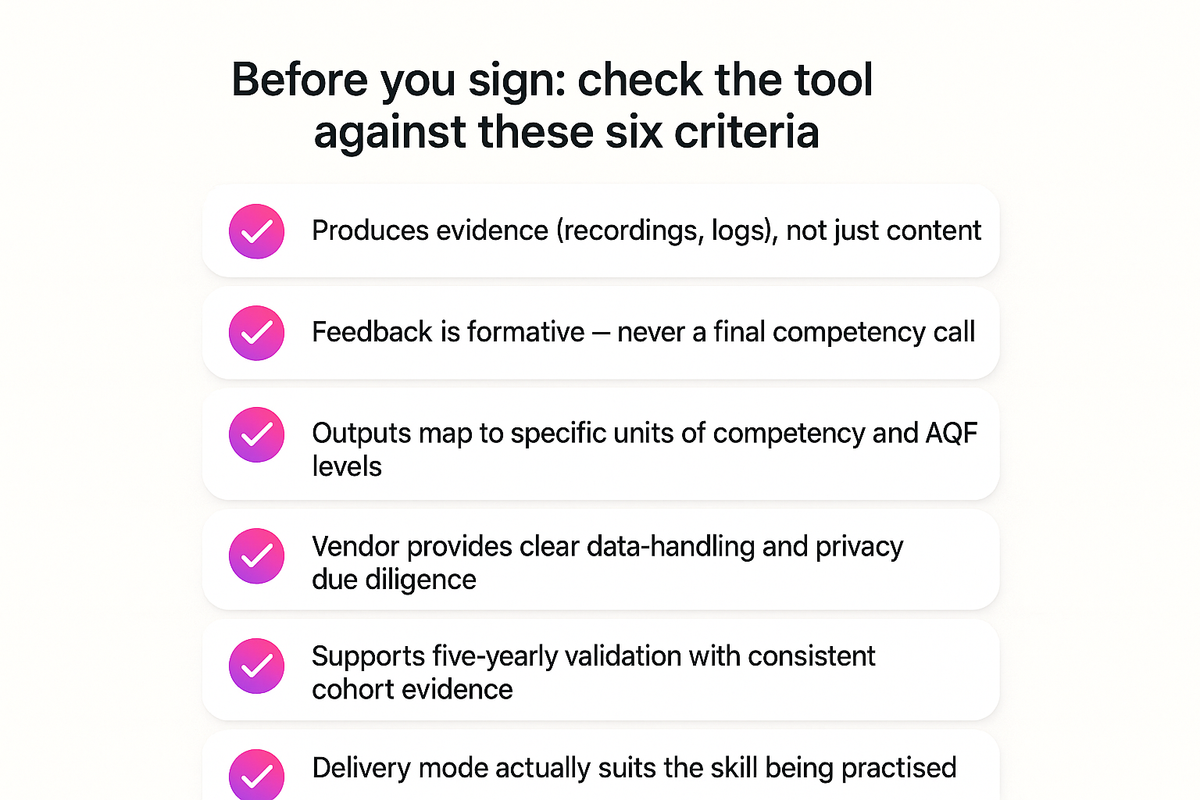
How to evaluate a tool against Standard 1.1 and Standards 2.3–2.4
Most vendors will tell you their tool is "engaging" and "compliant." Here's what to actually check before you sign anything.
- Does it produce evidence, not just content? Recorded roleplay, simulation logs and coached-feedback transcripts you can show an auditor — versus a tool that just generates a script or a worksheet.
- Is the feedback formative, not final? Coaching and scoring against criteria is useful; a tool that outputs a pass/fail competency call is a governance problem.
- Can outputs be mapped to specific units of competency and AQF requirements? Contextualised practice is only useful if it stays anchored to the training package, not drifting into generic content.
- What's the vendor's due-diligence story on data and privacy? You need answers on data handling and security before you can meet the governance principle, not after.
- Does it support your five-yearly validation cycle? Can you pull consistent evidence across cohorts to validate assessment judgements under Standards 2.3–2.4?
- Is roleplay or simulation actually the right mode for this skill? Per WA Government guidance, delivery mode is the RTO's call, but it has to factor training product requirements, cohort characteristics, staff and technology capability, and how authenticity and AI use are managed — not every practical skill suits a screen-based simulation over supervised workplace practice.
Can AI mark or make competency decisions?
No — and no source in the current regulatory or sector guidance suggests it should. The recurring theme across ASQA's material and the broader VET/education literature is that AI can assist practice and feedback, but a qualified, accountable assessor must still validate outputs against the Rules of Evidence and Principles of Assessment and make the final competency call.
What AI does well, according to the sector literature reviewed, is letting learners rehearse scenario-based skills repeatedly and privately, with the system collecting performance data — accuracy, procedural compliance, repeated errors — to surface strengths and gaps. Combined with VR or simulation, this is increasingly used for hands-on or safety-critical technical skills where real equipment is costly or mistakes carry real risk. That's a genuine gap AI can close. It's not a substitute for the human judgement the Standards require.
Key takeaways
- The Standards for RTOs 2025 push providers toward demonstrated evidence of practice, not paperwork — Standard 1.1 (engaging, well-structured training) and Standards 2.3–2.4 (fit-for-purpose, validated assessment) are the clauses that matter most for this decision.
- ASQA's 5 Principles for Responsible AI Use don't add new rules; they clarify that governance, accountability and due diligence on any AI tool — including data handling — remain the RTO's responsibility.
- ASQA has flagged real cases of unreviewed AI output landing in provider submissions, so every AI-generated practice or feedback artefact needs human review before use.
- No credible source suggests AI should mark or make competency decisions — that stays with a qualified assessor validating against the Rules of Evidence and Principles of Assessment.
- Evaluate tools on whether they produce auditable, competency-mapped evidence of practice, not on how automated or slick the marketing sounds.
Our take
The AI practical-skills category is genuinely useful for RTOs, but it's also where marketing claims run furthest ahead of what the Standards actually allow. The honest test isn't "does it look impressive in a demo" — it's whether you could hand an auditor the evidence it produces and explain, in plain terms, who reviewed it and who made the competency call. Nova, the instructional design engine inside VETos, is one Australian-built example built around that constraint: it generates roleplay, simulation and coached-practice content mapped to units of competency, and gives criterion-by-criterion formative feedback on learner practice — but it doesn't mark, and it doesn't make the competency decision. That division of labour is what the Standards expect, whichever tool an RTO ends up using.
FAQ
What AI tools help RTOs deliver practical skills practice that satisfies the Standards for RTOs 2025? Tools that generate auditable practice evidence — recorded roleplay, simulation logs, coached feedback — mapped to specific units of competency, with governance covering data handling and human review, as required by ASQA's Standard 1.4 and its 5 Principles for Responsible AI Use.
Does ASQA allow AI-generated roleplay, simulation or feedback to be used in training and assessment? Yes, provided the RTO applies governance: knowing which AI systems are in use, why, who's accountable, and reviewing all AI-assisted outputs before use, consistent with ASQA's Responsible Use of AI in VET guidance and its governance principle.
Can AI mark student work or make the competency decision? No. Every source reviewed — regulatory and sector literature alike — is consistent that AI can support practice and feedback, but a qualified, accountable assessor must validate outputs against the Rules of Evidence and Principles of Assessment and make the final call.
How does an AI practical-skills tool fit into the five-yearly validation cycle? Standards 2.3–2.4 require validation of assessment practices and judgements at least once every five years per training product. A useful tool should let you pull consistent, cohort-level evidence of practice and feedback to support that validation, not just individual transcripts.
Is simulation or roleplay always the right delivery mode for practical skills? Not always. WA Government guidance is clear that delivery mode is the RTO's choice, but it must be matched to the training product's requirements, the cohort, staff and technology capability, and how authenticity and AI use are managed for that specific skill.