AI Role-Play Generators for Training: A NZ Buyer's Guide
4 August 2026 · 8 min read

An AI role-play generator for training takes a short brief — target learners, the skill being practised, the scenario type — and turns it into an interactive simulation: an AI persona, branching dialogue, and trainer notes, ready for a learner to practise against. In New Zealand, no accreditation applies to the software itself; what matters is whether the content feeding NZQA-recognised assessment aligns with current, ISB-endorsed standards, and whether a qualified trainer still reviews and signs off every scenario before it's used.
What is an AI role-play generator, and how does it build a scenario?
The mechanics are fairly consistent across vendors. You give the tool a brief — who the learner is, what skill or situation you want them to practise, how difficult it should be — and generative AI drafts a scenario: a persona for the AI to play, a rough conversation structure with branches, and instructions or marking notes for the trainer. An AI avatar or chat interface then runs the live exchange with the learner, adapting its responses using natural language processing as the conversation unfolds.
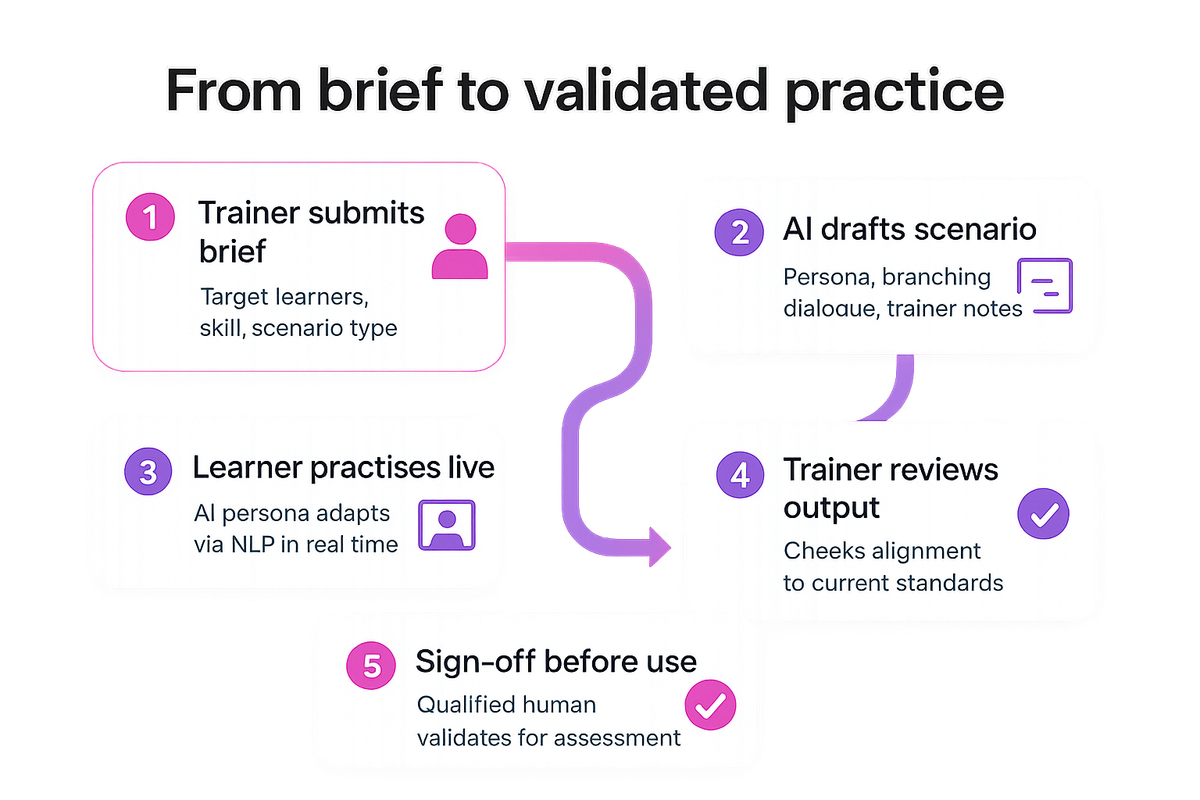
This is the latest step in a longer shift. Vocational and corporate training has moved from live-facilitated role-play, to scripted digital scenarios, to AI-generated and AI-run practice. Each step adds scale and speed. But industry commentary is consistent on one point: meaningful personalisation still needs pedagogical design input, not just AI output — a raw prompt-to-scenario pipeline without instructional design behind it tends to produce generic, low-value practice.
What should a NZ vocational trainer or L&D buyer look for?
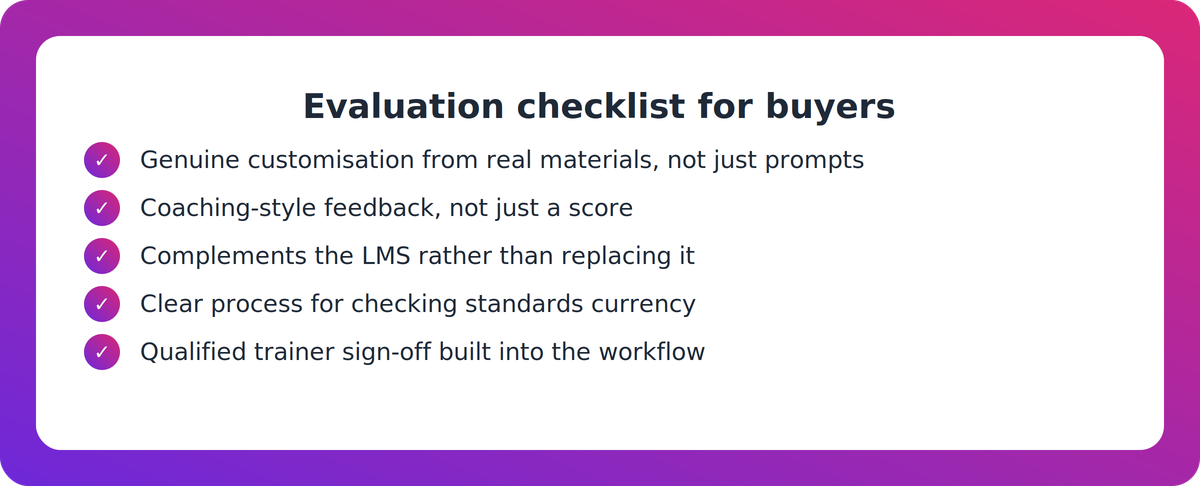
The category is broad enough that two tools calling themselves "AI role-play generators" can produce very different value. Before you buy, weigh these criteria:
- Depth of customisation. Can you upload real workplace materials, transcripts or standards documents, or does it only work from a generic prompt template? A tool that stays contextual to your actual industry, role and real scenarios is doing more than one that spits out a stock customer-service script.
- Quality of feedback. Does the learner get a bare score, or coaching-style prompts that build reflection across repeated attempts? Feedback that develops behaviour is worth more than feedback that just grades it.
- Fit with your existing systems. Does the tool sit alongside your LMS and compliance record-keeping, or try to replace it? Most buyers are better served by a tool that complements existing infrastructure rather than fragmenting it.
- Currency with standards. If any role-play output will feed into assessment judgements, is there a clear, checkable process for confirming alignment with current, non-discontinued skill standards?
- Human oversight built into the workflow. Does a qualified trainer or assessor validate and sign off scenarios and any related judgements, or is AI output treated as final?
None of this is exotic. It's the same due diligence you'd apply to any new training system — just applied to a category that moves fast and markets itself with confident claims.
Do AI-generated role-plays need to align with NZQA and Industry Skills Board requirements?
There is no NZQA accreditation scheme for role-play software itself. Regulation attaches to the programme and the assessment standards used, not to the tool that helped produce practice content. But if a role-play (or its outputs) feeds into anything tied to NZQA-recognised learning, the underlying content should be checked against current standards on the Directory of Assessment and Skill Standards.
This matters more than usual right now because the system it sits under is mid-change. Vocational education legislation passed in October 2025 disestablished Te Pūkenga, created ten regional polytechnics and Industry Skills Boards from 1 January 2026, and renamed Te Pūkenga the New Zealand Institute of Skills and Technology (NZIST) as a transitional entity. NZQA's own programme approval rules, reflecting the shift from Workforce Development Councils to Industry Skills Boards, take effect from 19 January 2026. Industry Skills Boards now set standards, endorse programmes and moderate assessments.
The accountability question has a simple answer: it sits with the training provider and the qualified trainer or assessor, not with the software vendor. AI can generate a scenario in minutes. It cannot certify that the scenario reflects current standards, and it should never be treated as the final check on assessment validity.
What privacy safeguards should apply when learner conversations go through an AI tool?
An AI role-play tool processes learner speech, text or video in real time, which puts it squarely inside Privacy Act 2020 territory. The Office of the Privacy Commissioner's AI guidance recommends organisations run a privacy impact assessment before adopting a generative AI tool, get senior leadership sign-off, be transparent with learners about how and why the tool is used, and engage properly with any Māori data or taonga considerations. Legal commentary is blunt about the risk that matters most: generative AI can produce confident but incorrect content, and using an automated tool does not remove an organisation's existing Privacy Act obligations. Human review before acting on AI output isn't optional — it's the safeguard the regulator expects.
For a buyer, this translates into practical questions for any vendor: where is learner data stored and processed, who can access recorded conversations, and what does the vendor's own documentation say about human review before outputs are used for anything consequential?
Key takeaways
- An AI role-play generator drafts a scenario, persona and trainer notes from a brief, then runs the live conversation via an AI avatar or chat interface — but personalisation quality still depends on instructional design behind the prompt.
- Compare tools on depth of customisation, coaching-quality feedback, fit with your LMS, and whether human sign-off is built into the workflow — not just on how polished the demo looks.
- No NZQA accreditation applies to the software; what matters is whether role-play content feeding assessment aligns with current, ISB-endorsed standards, effective as programme approval rules change from 19 January 2026.
- Under the Privacy Act 2020, expect a privacy impact assessment, transparency with learners and human review of AI outputs — this is regulator expectation, not vendor marketing.
- A qualified trainer or assessor remains accountable for any role-play content used in NZQA-recognised assessment — AI assists the process, it doesn't replace professional judgement.
Our take
The category is genuinely useful — practising a hard conversation against a responsive AI persona beats reading a script, and doing it repeatedly beats doing it once. But buyers should be sceptical of any vendor implying the tool understands your industry out of the box; contextual depth is earned through real materials and design work, not just a clever prompt. In a system moving through the biggest structural change New Zealand vocational education has seen in years, the safest posture is to treat AI role-play output the same way you'd treat any draft: useful, fast, and not finished until a qualified person has checked it against current standards. Tools like VETos aren't built specifically as role-play generators — their documented strength is compliant assessment and lesson content with built-in QA and standards-tracking — so if role-play simulation is your core need, test any vendor's actual capability directly rather than assuming it.
FAQ
Is an AI role-play generator the same as an e-learning simulation? Not quite. A static e-learning module follows a fixed script; an AI role-play generator produces a persona that responds dynamically to what the learner says, using generative AI and natural language processing to adapt in real time.
Does NZQA accredit AI role-play software? No. Regulation attaches to programmes and assessment standards, not to the software itself. Any content used in NZQA-recognised assessment should be checked against current standards on the Directory of Assessment and Skill Standards.
Who is accountable if an AI-generated role-play doesn't match current standards? The training provider and the qualified trainer or assessor remain accountable — not the software vendor. AI-generated content should be validated and signed off by a suitably qualified person before it's used for anything tied to recognised learning.
What privacy steps should a New Zealand training provider take before adopting one of these tools? The Office of the Privacy Commissioner recommends a privacy impact assessment, senior leadership sign-off, transparency with learners about how the tool works, attention to Māori data considerations, and human review before acting on any AI output.
Does an AI role-play tool replace an LMS? It shouldn't. The stronger buys sit alongside your LMS and compliance record-keeping, feeding practice data into existing pathways rather than becoming a parallel system you have to reconcile.
If you're evaluating options, start by asking each vendor for a live demo built from your own materials — not a generic template — and ask them directly how their workflow keeps a qualified trainer in the sign-off loop.