AI Simulation Design for RTOs: A Buyer's Guide
5 October 2026 · 7 min read
Yes. An RTO can use AI to design workplace simulations under the Standards for RTOs 2025 and ASQA's AI Principles, as long as qualified trainers and assessors keep making and evidencing every decision that affects learners. ASQA doesn't approve or certify AI tools, so the RTO owns the choice. Buy for human oversight and traceability first, realism second.
Can an RTO use AI-generated role plays and simulations under the Standards for RTOs 2025?
"AI simulation design" is a market label, not a regulated category. There's no ASQA approval scheme for these tools, which means no badge you can buy to make the risk go away.
The 2025 Standards for RTOs came into effect on 1 July 2025. ASQA's 5 Principles for the Responsible Use of AI in VET add no new requirements. They give you a structured way to read the obligations you already have.
ASQA names two relevant opportunities for AI: creating immersive learning experiences and enhancing performance-based assessment. It also lists the risks:
- data privacy and security
- algorithmic bias
- generic or inaccurate content
- academic integrity
So the answer is permissible, with conditions. Those conditions are where your buying criteria come from.
How do you keep trainers and assessors accountable when AI builds the simulation?
Principle 2 is the anchor. Human oversight and accountability must be maintained in all AI-supported activities, and decisions affecting students remain the responsibility of qualified trainers, assessors and staff.
In practice, check three things in any tool:
- Where the competency decision sits. The tool should support practice and feedback. The assessor makes the judgement. If a product's output reads like a result, ask who signs it.
- Whether feedback is formative. Coaching a learner through practice is one thing. Marking the assessment is another. Keep them visibly separate.
- Whether review is built in. A qualified person should be able to review, edit and approve each simulation before a learner sees it, with version history and an audit trail.
That third point is the one that fails most often. A tool can be careful about the first two and still release content with no recorded human sign-off.
How do you check a simulation against the unit's Assessment Requirements?
A plausible storyline isn't evidence. Start with whether the training package allows simulation for that unit at all. Where it does, ASQA's online training and assessment guidance says simulated assessment must meet the package's assessment conditions. That includes realistic workplace conditions and the equipment and resources stated in the Assessment Requirements.
ASQA's Facilities, Resources and Equipment Practice Guide adds that RTOs should be able to demonstrate how simulated environments reflect current industry settings. So ask for:
- Traceability. Can each simulation be mapped to its unit of competency and its Assessment Requirements?
- Industry currency. Can someone with current industry experience validate the scenarios, and can you show that they did?
- Change handling. What happens to the simulation when the unit or workplace practice changes?
Then test it against the Principles of Assessment and Rules of Evidence: validity, sufficiency, authenticity and currency. Don't assume the tool has done this for you.
Two limits to know up front
Mandatory work placement requires time in the workplace and can't be done online. A simulation can't substitute for it.
Some units also need real human interaction. Consultancies report that ASQA has flagged AI acting as an avatar for role-play assessment in those cases (Coast Wide Training). We couldn't confirm that on an ASQA page, so read each unit's requirements directly. Don't assume an AI role-play partner satisfies them.
What should you ask an AI simulation vendor before you buy?
Here's a working list you can take into any demo.
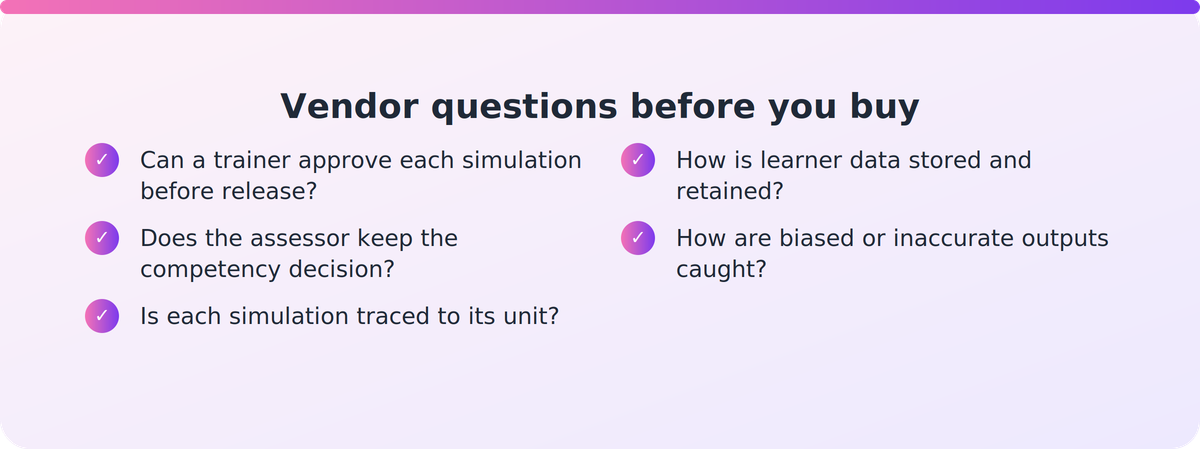
- Review and sign-off: Show me how a trainer reviews, edits and approves one individual simulation before release. Where is that recorded?
- Human decision point: What does the tool decide, and what does it leave to the assessor?
- Alignment: How is each simulation traced to the unit and its conditions, resources and any required human interaction?
- Bias and accuracy: How are generic, inaccurate or biased outputs caught before learners see them?
- Learner data: Where is it stored and shared? How is it collected, used and retained against your privacy and record-keeping obligations (Principle 3)?
- Accessibility and cohort fit: How does it support equity, inclusivity, accessibility and wellbeing (Principles 4 and 5)?
- Governance evidence: Can you show which AI systems you use, why, who is accountable and how risks are managed? Secondary sources summarising ASQA's expectations point this way.
- Transparency: Independent evaluations, security certifications, data-hosting location and pricing.
- Delivery fit: Does it work with your LMS?
ASQA's principle-linked self-assurance questions and case studies are the closest thing to an official evaluation method. Use them as your scoring sheet.
Where do Supahuman's VETos and Nova 5 fit?
We build these, so weigh this section accordingly. Nova 5 is the learning engine inside VETos. It generates role plays, simulations, narrated video and coached practice from an RTO's own training products. VETos handles design and validation, and Nova 5 delivers.
Our sites state that Nova doesn't mark work or make competency decisions. Learners get formative, criterion-by-criterion feedback on practice tests or mock assessments, and assessors decide as they do today. The sites also describe mapping to the relevant unit, assign-review-approve-lock steps, and a version history and audit trail. Simulation types include voice role plays with an AI counterpart, branching scenarios and turn-based sim games.
The limits are plain. Our sites don't set out a step-by-step process for a trainer to review and approve an individual Nova simulation. We also haven't published named case studies or quantified outcomes for Nova simulations. The claim that it's built for ASQA compliance, AQF Levels 1–6 and Australian training packages is a vendor claim. Test it against your own scope.
The practical way to do that is the one we'd suggest for any vendor. Ask for a demonstration on a unit you deliver, or use the 14-day free trial, and watch exactly how review and sign-off work.
Key takeaways
- AI-built simulations are permissible under ASQA's principles-based approach, but ASQA doesn't approve AI tools. The RTO carries the responsibility.
- Principle 2 is the test: qualified trainers and assessors keep the decisions that affect learners, and you can evidence that.
- Every simulation should trace to its unit of competency and Assessment Requirements, with proof of industry currency.
- Simulation can't replace mandatory work placement, and units needing real human interaction need checking directly.
- Ask any vendor to show how a trainer reviews and approves an individual simulation before release.
Our take
Most buying conversations start with how lifelike the simulation is. We think that's the wrong first question. A very realistic scenario that no qualified person has reviewed, mapped and signed off is a liability, not an asset. Choose the tool whose review trail you'd be comfortable showing an auditor, then judge realism. Speed matters too, but only after the accountability is sorted.
FAQ
Can an RTO use AI-generated simulations for assessment under the 2025 Standards?
Yes, where the training package allows simulation and the simulation meets the unit's assessment conditions. ASQA's position is that decisions affecting students stay with qualified trainers, assessors and staff. ASQA doesn't approve or certify AI tools, so the RTO is responsible for its choice.
How do we keep assessors accountable for competency decisions?
Use AI for practice, formative feedback and content design. Keep the competency judgement with the assessor, and require a recorded review and approval of each simulation before release. Version history and an audit trail make that defensible.
Can AI role-play avatars replace human interaction in a unit?
Not confirmed. Consultancies report that ASQA has flagged AI avatars where a unit needs real human interaction, but we couldn't verify this on an ASQA page. Check the unit's Assessment Requirements directly before relying on an AI counterpart.
Can a simulation replace mandatory work placement?
No. ASQA states that mandatory work placement requires time in the workplace and can't be done online.
What should we ask an AI simulation vendor about learner data?
Ask where learner data is stored and shared, how it's collected, used and retained, and how that meets your privacy and record-keeping obligations. Also ask about data-hosting location and security certifications, which aren't always published.