AI Simulation Training Software: A UK Buyer's Guide
30 July 2026 · 7 min read

UK L&D buyers should judge AI simulation and role-play software on two things: whether scenarios are built around the specific decisions that drive a named business outcome, not pulled from a generic content library, and whether the vendor's data handling holds up under UK GDPR, ICO guidance and the Data (Use and Access) Act 2025.
What AI simulation and role-play software actually does
These platforms let an AI counterpart take the role of a customer, an employee, or a difficult stakeholder. It asks questions, raises objections, and gives feedback in real time, so a learner can practise a conversation repeatedly without needing a live human role-play partner (elmLearning, 2026; Jenova, 2026).
What started as sales-call rehearsal has broadened. Vendors now pitch the same underlying tech for customer service conversations, leadership feedback discussions, and compliance rehearsal for sensitive scenarios such as harassment or ethics situations — the common thread is safe, repeatable practice before the real thing (AI Tools Bakery, 2026).
What to look for before you sign a contract
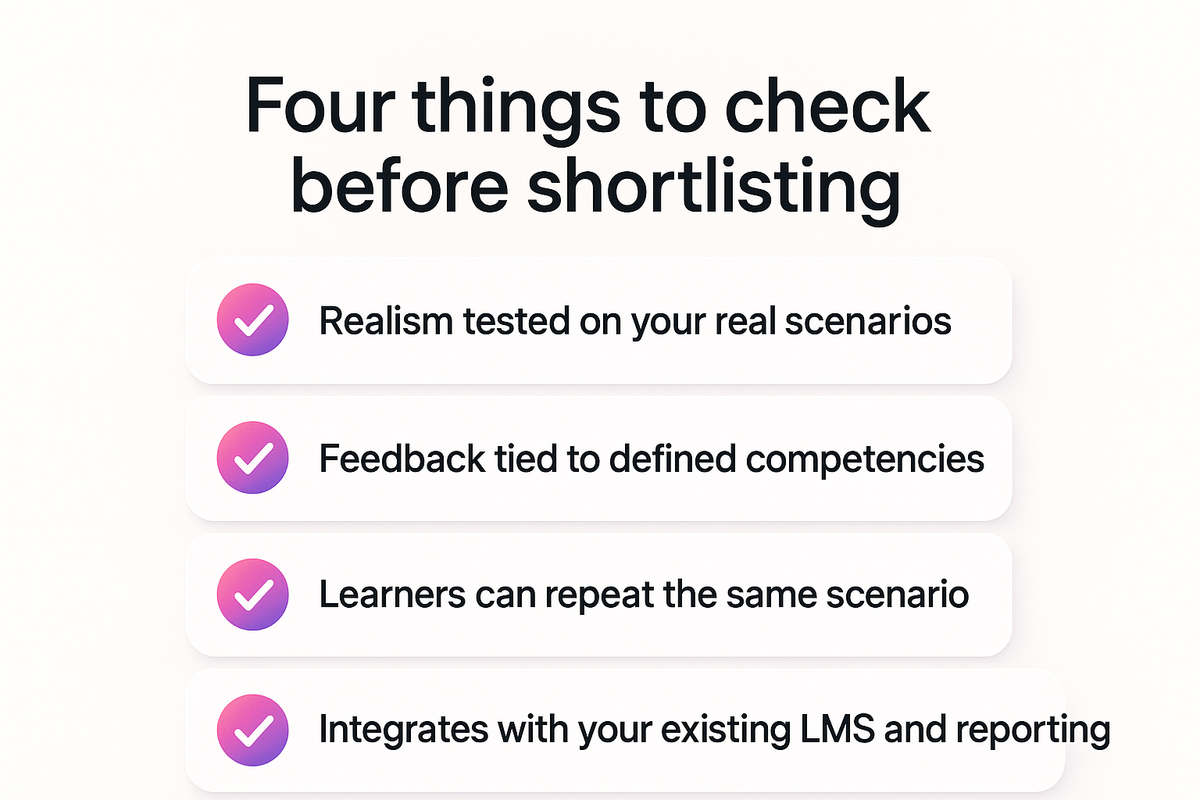
Most buyer guides converge on four evaluation themes:
- Conversational realism — tested against actual workplace scenarios your teams face, not a scripted demo (Easygenerator, 2026; Mindtickle, 2026).
- Feedback specificity — is scoring tied to defined competencies, or a vague "great job" summary?
- Repeatability — can a learner run the same scenario several times to build confidence, or is each session a one-off?
- LMS and reporting integration — how easily does the analytics surface in the systems your L&D team already uses (elmLearning, 2026)?
These four are worth insisting on. But they're not sufficient on their own.
Does it change behaviour, or just sound realistic?
A more demanding lens, raised by simulation specialist Blueline Simulations, is worth applying to every shortlist: is the scenario designed backward from the specific decisions and behaviours that separate strong performers from weak ones, or is it simply selected from a polished content library with no structural link to a business metric (Blueline Simulations, 2026)?
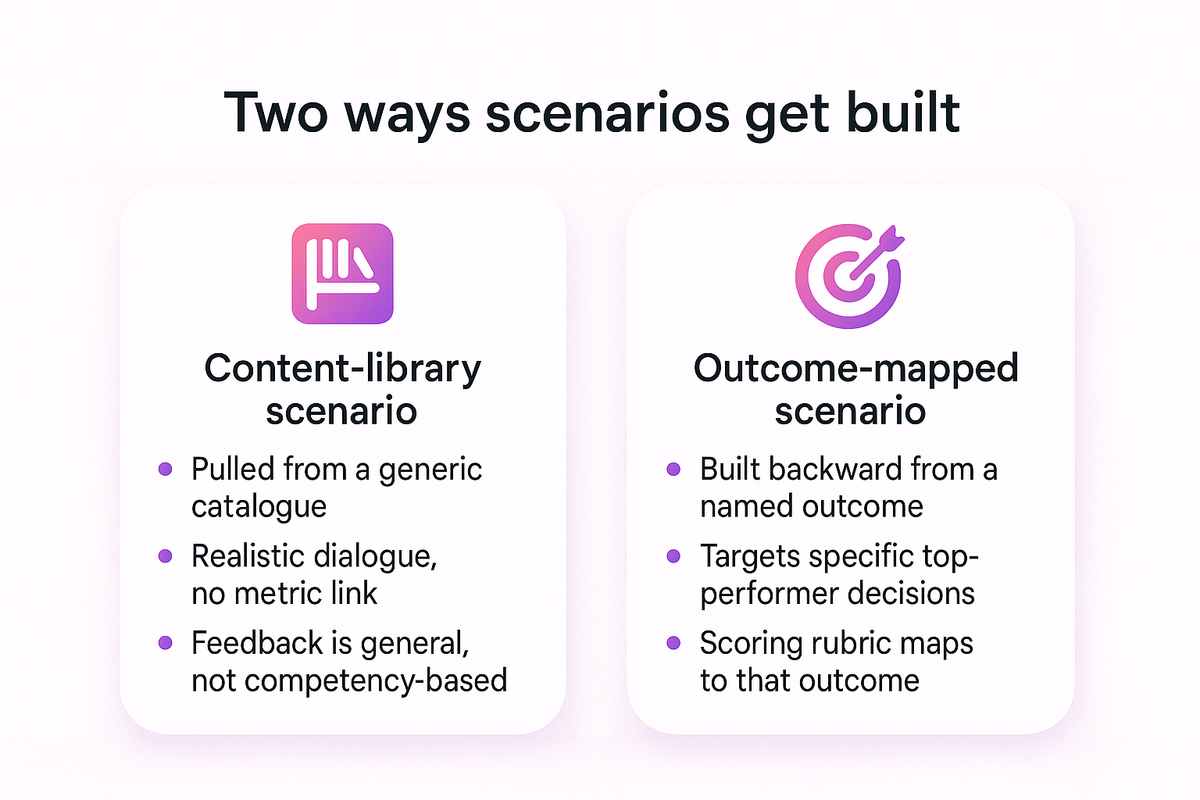
A conversation can sound completely natural and still teach nothing measurable. Ask each vendor to show you, in plain terms, which named outcome a given scenario is built to move — a conversion rate, a de-escalation rate, a compliance pass rate — and how the scoring rubric maps to it.
Industry figures on AI adoption in learning, such as LinkedIn Learning's 2025 Workplace Learning Report finding 71% of L&D professionals exploring or integrating AI, are worth noting as context. But treat them as vendor and analyst estimates rather than official UK statistics (cited via Easygenerator, 2026) — they tell you adoption is happening, not that any particular tool works.
UK data protection: UK GDPR, ICO guidance and the Data (Use and Access) Act
Any tool that records, transcribes or scores an employee's conversation is processing personal data, and the Information Commissioner's Office (ICO) regulates how AI systems handle that data under UK GDPR (ICO, ico.org.uk). That applies whether the platform is scoring a sales pitch or a difficult conversation rehearsal.
The Data (Use and Access) Act became law on 19 June 2025 and eases some of the previous restrictions on automated decision-making, giving organisations more scope to use AI-driven tools in areas like employee performance review (GDPR Local, 2026; Clarkslegal, 2025). That matters directly here: if a roleplay platform's AI-generated score ever feeds into a formal appraisal, this is the law that governs whether — and how — that's permitted.
UK compliance commentary generally expects a Data Protection Impact Assessment (DPIA) before rolling out a new AI tool that processes employee data, along with a clear privacy notice telling staff that AI is involved and how (TESS Group, 2026). Ask any shortlisted vendor to walk you through both before you sign, not after.
A statutory ICO Code of Practice on AI and automated decision-making is expected around summer 2026 (GDPR Local, 2026; ModelCharter, 2026). Treat current ICO AI guidance as provisional rather than final, and build a contract review point into your rollout plan for when that code lands.
Wherever AI-generated transcripts or scores are used for formal appraisal, disciplinary process, or compliance sign-off, they should support a qualified human's review — not replace it. A manager or assessor still needs to look at the evidence and make the call.
Certification signals: ISO/IEC 42001 and AI governance maturity
ISO/IEC 42001, the international AI management system standard, is voluntary but increasingly used as a trust signal for how seriously a vendor governs its AI systems. BSI is the first UKAS-accredited body certifying against it. A vendor working towards or holding this certification, or one that can clearly answer your DPIA and privacy-notice questions without hedging, is telling you something real about how mature its AI governance actually is.
Key takeaways
- Judge scenarios on whether they're built backward from a named business outcome, not just on how natural the AI sounds.
- Insist on feedback tied to defined competencies, repeatable practice, and clean LMS/reporting integration.
- Confirm the vendor supports a DPIA and provides a clear staff privacy notice before any rollout involving employee conversations.
- Remember the Data (Use and Access) Act 2025 changed the rules on automated decisions — relevant if AI scores ever touch an appraisal.
- Treat current ICO AI guidance as provisional; a statutory code is expected around summer 2026.
- AI-generated scores and transcripts should support, never replace, a qualified human's sign-off on real performance or compliance decisions.
Our take
The category has matured past "does the avatar sound human" — most decent platforms now clear that bar. The harder, more useful question is whether a vendor can show its working: which decisions a scenario is built to change, and how they'd survive a DPIA conversation with your data protection lead. We'd weight those two things well above production polish. On the data side specifically, UK buyers are in a slightly awkward window — the rules are real and enforceable now, but a statutory AI code is still coming, so build a contract review checkpoint into your rollout rather than treating today's guidance as the final word. For context: Supahuman's own AI work in vocational training is focused on compliance authoring for New Zealand and Australian training providers, not on UK role-play delivery, so we're not positioning ourselves as a fit for this specific category here — evaluate vendors on the criteria above instead.
FAQ
What should UK L&D buyers actually look for in AI simulation and role-play training software before signing a contract? Look past conversational realism to whether scenarios are built around the decisions that drive a named business outcome, whether feedback is tied to defined competencies, and whether the vendor can support a DPIA and clear privacy notice for employee data (Blueline Simulations, 2026; TESS Group, 2026).
How does UK data protection law apply to AI roleplay tools that record or score employee conversations? The ICO regulates this under UK GDPR, a DPIA is generally expected before rollout, and the Data (Use and Access) Act 2025 has changed the rules on automated decisions — relevant if AI scores feed into performance reviews (ICO, ico.org.uk; GDPR Local, 2026).
Does AI roleplay training genuinely change workplace behaviour, or just produce realistic-sounding conversations? It can do either. The difference is whether the scenario is designed backward from the specific behaviours that separate strong performers from weak ones, or simply pulled from a generic content library with no link to a business metric (Blueline Simulations, 2026).
What certifications indicate a vendor's AI is governed responsibly? ISO/IEC 42001, the international AI management system standard, is a voluntary but increasingly cited signal of governance maturity. BSI is the first UKAS-accredited certifier of it (BSI Group; ISO Cert UK).
Is a statutory ICO code of practice on AI already in force? No. A statutory ICO Code of Practice on AI and automated decision-making is expected around summer 2026, so current ICO AI guidance should be treated as provisional rather than final (GDPR Local, 2026; ModelCharter, 2026).
If you're shortlisting, the most useful test is a practical one: run the same scenario through two or three vendors, ask each to show you the DPIA and privacy notice they'd hand your data protection lead, and see which one can actually explain how a session score maps back to a real outcome. That conversation tells you more than any spec sheet.