AI Strategy for RTOs: A CEO's Governance Test
6 September 2026 · 7 min read

The AI question sitting on your desk isn't whether to adopt it — someone in your organisation already has. It's whether you can show, at your next audit, that adoption is governed. ASQA has made AI a named compliance theme for 2026, and a CEO who can't evidence oversight is carrying regulatory risk, not banking an efficiency win.
Why this lands on your desk
You already own governance risk under the Standards for RTOs 2025. Quality Area 4 requires you — or your delegate — to demonstrate active oversight of risk management, systematic monitoring and continuous improvement. That's not new. What's new is that AI use inside your RTO now sits inside that same governance test, whether or not you've written a policy for it.
On 3 March 2026, ASQA announced its 2026 Standards Workshop series would centre on whether RTOs' use of AI complies with the 2025 Standards. It shared draft AI Principles and flagged revised practice guides on non-compliant AI use for mid-year. There's no finalised AI-specific rulebook yet — but the absence of one doesn't buy you time. It means auditors are testing AI use against the governance requirements you're already meant to be meeting.
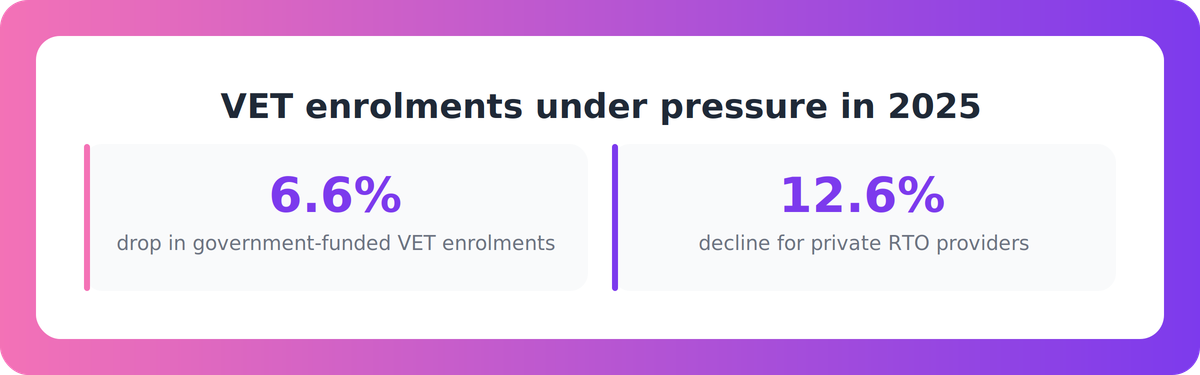
Layer on the commercial picture. Government-funded VET enrolments fell 6.6% nationally in the first nine months of 2025, according to NCVER data, with private providers down 12.6%. You're under real pressure to find efficiency and differentiation. AI is one of the more obvious levers. But it's now a lever regulators are watching you pull.
From paperwork compliance to proof of practice
The 2025 Standards, which commenced 1 July 2025, changed what ASQA actually tests for. Audits are increasingly framed as performance assessments — checking whether your systems operate effectively in real delivery and assessment contexts, not whether your policy folder looks tidy. A governance framework that exists only on paper, with no evidence of it running, is exactly the kind of gap this shift is designed to expose.
This matters for how you think about AI specifically. If a trainer is using a generative AI tool to draft assessment feedback, or your admissions team is using it to triage enrolment queries, that's now a live example an auditor can ask about: who approved it, what oversight exists, how you know it's working as intended. "We didn't have a formal policy" is not much different, in audit terms, from having no risk management system at all.
Standard 1.3 and the assessment tool you didn't build
Here's the trap a lot of leadership teams walk into without realising it. Standard 1.3 requires assessment tools to be reviewed before use — a separate obligation from validation under Standard 1.5. That review requirement doesn't disappear because a tool was purchased, or because an AI system generated it.
A purchased or AI-generated assessment tool still needs your RTO's review, contextualisation and sign-off before it goes anywhere near a learner. Assuming a vendor's tool — or an AI system's output — is "compliant out of the box" is an assessment-integrity risk that sits with governance, not with IT. Generative AI adds a further wrinkle here: written knowledge evidence and portfolio-style tasks are exactly the assessment formats most vulnerable to authenticity questions when AI is involved on either side of the exchange — learner or assessor.
It's worth noting that ASQA's own Artificial Intelligence Transparency Statement confirms it doesn't currently use AI in regulatory decision-making and keeps a human in the loop for final calls. That's a reasonable governance posture to mirror in your own organisation: AI can assist, but a documented, accountable human still needs to own the decision.
Margin pressure is forcing the decision now
This isn't a debate you get to defer until margins ease. Enrolment declines are already squeezing operating margin and cost per student across the sector, and ASQA's 2025–26 risk priorities put integrity of qualifications and competency outcomes at the top of the list — backed by an extra $4.8 million in government funding for 2026–27 enforcement work on qualification fraud. Growth ambition without governance evidence is precisely the profile regulators are primed to scrutinise this year.
The providers in the best position heading into 2026 are treating AI as a board-level governance decision — documented, owned, and reviewed — rather than something IT rolled out quietly or something leadership is quietly anxious about and hasn't addressed at all. Both of those postures leave the same gap at audit: no evidence of oversight.
What genuine oversight looks like
You don't need to wait for ASQA's finalised AI-specific guidance to act. The existing Quality Area 4 and Standard 1.3 requirements already tell you what evidence you need:
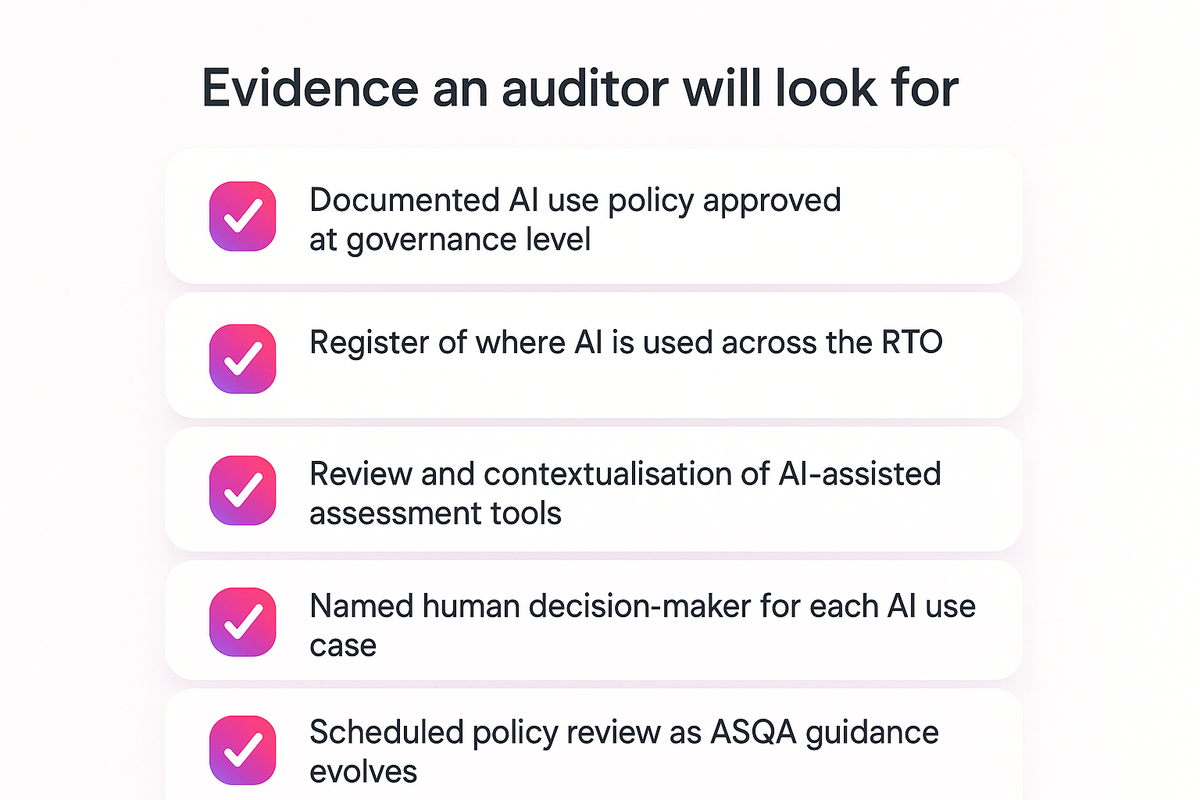
- A documented AI use policy, approved and reviewed at governance level — not left to individual trainers or teams to interpret.
- A register of where AI is actually used across the organisation — assessment support, marketing, admissions, learner communications — so you're not discovering informal use for the first time in an audit interview.
- Explicit review and contextualisation of any AI-assisted or AI-generated assessment tool before it's used with learners, satisfying Standard 1.3 separately from validation.
- A human decision-maker named against each material AI use case, mirroring the human-in-the-loop posture ASQA applies to its own regulatory processes.
- A cycle for revisiting the policy as ASQA's draft AI Principles and revised practice guides land through 2026.
None of this requires slowing down. It requires making the decision visible and owned, rather than assuming good intentions will read as governance.
Key takeaways
- ASQA named AI compliance as the theme of its 2026 Standards Workshops (announced 3 March 2026), sharing draft AI Principles ahead of any finalised AI-specific rules.
- Quality Area 4 of the Standards for RTOs 2025 already requires documented, operating oversight of risk and continuous improvement — informal AI use is a gap under this existing requirement, not a future one.
- Standard 1.3 requires review and contextualisation of assessment tools, including AI-generated ones, separate from validation under Standard 1.5 — a purchased tool is not automatically compliant.
- Government-funded VET enrolments fell 6.6% nationally in the first nine months of 2025, with private providers down 12.6%, sharpening the pressure to find efficiency without weakening governance.
- Treating AI adoption as a board-level governance decision — documented, owned and reviewed — is the position that holds up at audit.
Our take
We think the sector conversation has been too binary — AI as either the obvious growth lever or the risk to avoid until the rules are clearer. Neither serves you. ASQA isn't waiting for finalised AI rules to start asking governance questions, and the enrolment numbers say margin pressure isn't waiting either. The RTOs that come out of 2026 in good shape will be the ones that made AI a named line item in their governance framework months before an auditor asked about it — not the ones with the most AI, or the least.
FAQ
Does ASQA have specific AI rules for RTOs yet? Not finalised ones. ASQA shared draft AI Principles at its March 2026 Standards Workshops and flagged revised practice guides on non-compliant AI use for mid-2026, but current audits already test AI use against the existing governance requirements in Quality Area 4 and Standard 1.3.
If we buy an AI-powered assessment tool, is it automatically compliant? No. Standard 1.3 requires every assessment tool — purchased, AI-generated or otherwise — to be reviewed and contextualised by your RTO before use. That obligation sits separately from validation under Standard 1.5 and applies regardless of the tool's source.
Who's accountable if AI is being used informally across the business without a policy? You are, or your delegate is, under Quality Area 4. The Standards for RTOs 2025 test whether governance and risk management systems actually operate, not just whether policy documents exist — informal, undocumented AI use is a gap an auditor can point to directly.
Given enrolment declines, shouldn't we prioritise growth over AI governance right now? The two aren't in competition. Government-funded enrolments fell 6.6% nationally in the first nine months of 2025, which is exactly why efficiency gains from AI matter — but ASQA's 2025–26 risk priorities put qualification and assessment integrity at the top, so growth pursued without governance evidence is the profile most likely to attract scrutiny.