AI Strategy for RTO Boards: Capability vs Hype
6 October 2026 · 6 min read
Your board doesn't need an AI strategy so much as an AI governance test. ASQA's principles, according to sector reporting, add no new regulatory requirements. They sit inside the 2025 Standards you already answer for. So the useful question isn't how much AI to adopt. It's where AI may help, and where a human must stay accountable.
Why this lands on your desk
AI won't stay with IT or the compliance team. Under the 2025 Standards, governing persons must ensure an acceptable financial position and cashflows. One consultancy source describes the CEO as the person who signs the Annual Declaration on Compliance. If AI touches a regulated process, your name is near it.
The commercial backdrop is not generous. NCVER reports government-funded students fell by 72,225 (6.6%) from January to September 2025, and the domestic participation rate edged down to 26.4%. Growth isn't coming to you. Cost-to-serve is one of the few levers you control, which is why the AI conversation matters.
Then there's capacity. Jobs and Skills Australia reports VET teacher shortages nationally, a workforce with almost 50% over 50, and high casualisation. The Productivity Commission found VET teachers leaving exceeded those joining in eight of nine reference years. Scarce people are your key-person risk. The strategic question is which work AI can lift off them, and which work it must never replace.
What ASQA has actually said
Sector reporting (The Sector, Coast Wide Training) says ASQA's AI principles help providers manage AI within existing obligations, rather than creating new ones. That matters because the 2025 Standards have three parts: the Outcome Standards, the Compliance Standards (including the Fit and Proper Person Requirements) and the Credential Policy. ASQA records compliance and non-compliance at the standard or performance indicator level.
In practice, AI-assisted work is judged against the same standards as everything else. There is no separate AI pass mark, and no safe harbour for "the tool did it".
A board test for any AI claim
The research found no independent data on AI adoption rates, productivity gains or cost-per-student impacts in RTOs. Vendor claims, including slick ones, are therefore unproven by default. Put three questions to every proposal before it reaches a board paper:
- Which standard does this touch? Name the Outcome Standard or performance indicator. If nobody can, the risk hasn't been assessed.
- Who is accountable for the output? A named person, with authority to reject it, must review and sign off.
- What independent evidence supports the claim? Not a case study written by the seller. Ask for a reference you can call, and a measure you can check against your own numbers.
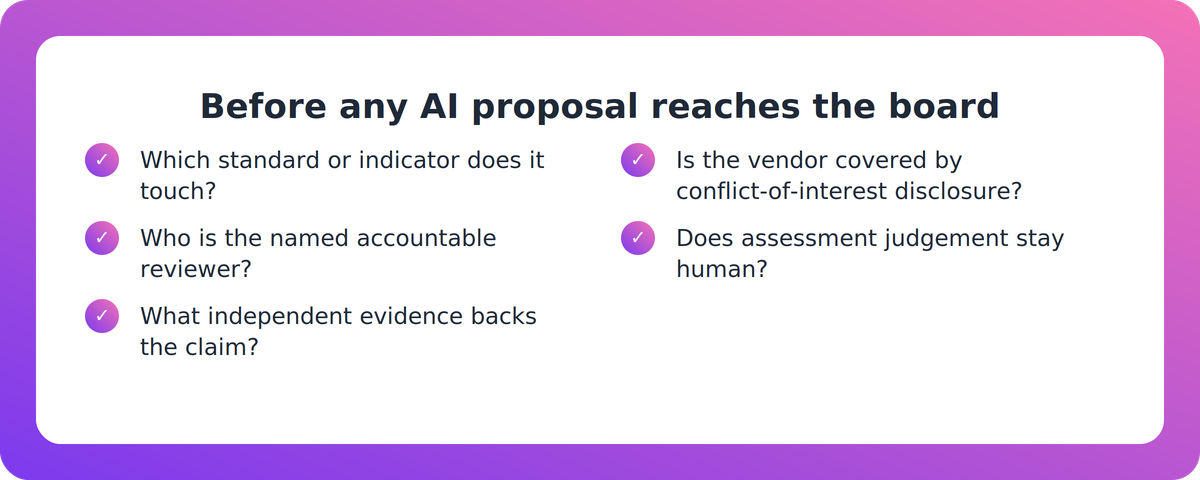
Add a fourth for the board's own hygiene. The 2025 Standards require a system to identify, manage and disclose conflicts of interest. Vendor relationships and AI tool selection belong inside that frame.
Keep humans where the regulator looks hardest
Assessment judgement stays human. Per the ASQA assessment practice guide as summarised by The Sector, assessors must be satisfied evidence is sufficient, current and genuinely the student's work. AI-generated evidence is one authenticity issue to consider. ASQA's own case study had an RTO reposition an AI tool as a support resource rather than a primary source of instruction.
Attention is also on integrity. Secondary sources report ASQA targeted reviews of workplace assessment in Individual Support, Carpentry and Early Childhood Education and Care, and place integrity of qualifications and competency outcomes at the top of its risk priorities. One workshop note recorded 89 performance reviews from July 2025 to 30 January 2026, with a 62% compliance rate. Both are secondary and unverified against ASQA, so check them before you quote them to your board.
The same sources report ASQA is seeing weak AI-assisted submissions: generic wording, unsubstantiated claims and inaccurate corrective actions. Check the original ASQA IQ edition before citing this. The implication holds anyway. Speed without review becomes regulatory exposure.
One secondary source says ASQA's transparency statement says it does not currently use AI in regulatory decision-making, and that a human makes final decisions. Verify that with ASQA. If it's right, your evidence will be read by a person, and generic text will look generic.
Buy back capacity where the risk is lower
The sensible split follows from this. Aim AI at the compliance and back-office work that squeezes margin: drafting, formatting, collating, first-pass checking, internal reporting. Keep human accountability over assessment judgement, evidence authenticity and anything you submit to the regulator.
That isn't timidity. It's matching the tool to the consequence. A slow internal report costs you a day. A weak regulator submission or an unauthentic competency outcome costs you standing.
It also answers the single-view problem. If you can't see performance across your portfolio today, ask whether the fix is better-governed data and process first. Automating a messy process gives you a faster mess.
Key takeaways
- ASQA's AI principles, per sector reporting, add no new rules. Accountability sits inside the 2025 Standards, with governing persons and the CEO.
- Assessment judgement, evidence authenticity and regulator submissions stay human-accountable.
- Treat productivity and cost-per-student claims as unproven. The research found no independent data on either.
- Target AI at back-office and compliance capacity, where scarce trainers and assessors are being stretched.
- Bring AI vendor selection under your conflict-of-interest and financial governance systems.
Our take
Most RTO AI conversations start with the tool. They should start with the declaration you sign. A modest, evidence-led approach fits the data: enrolments are down, workforce supply is tight, and nobody has published independent proof of AI savings in RTOs.
We'd go further. The RTOs that look best in two years won't be the ones that adopted fastest. They'll be the ones that can show a regulator, in plain terms, what AI did, who checked it and why they trusted it. Write that down this quarter. A one-page register of where AI is used, who signs off and what evidence you hold would put you ahead of most boards.
FAQ
Does ASQA have specific AI rules RTOs must follow?
According to sector reporting, ASQA has issued principles for AI use in VET, but they are not new regulatory requirements. They help providers manage AI within existing obligations, including the 2025 Standards. Confirm the current wording with ASQA directly.
Who is accountable if AI-assisted work fails an audit?
The RTO. Sector reporting says accountability for AI use stays with governing persons and the CEO. ASQA assesses compliance at the standard or performance indicator level, whoever or whatever produced the work.
Where is AI lowest-risk for an RTO?
In back-office and compliance capacity work with a human reviewer, such as drafting, collating and first-pass checks. Assessment judgement, evidence authenticity and regulator submissions should stay firmly human-accountable.
Can I trust vendor claims about cost-per-student savings?
Treat them as unproven. The research found no independent data on AI productivity or cost-per-student gains in RTOs. Ask for referenceable results you can test against your own numbers.
If ASQA asked tomorrow where AI touches your operation and who signed it off, could you answer in five minutes?