AI at the Board Table: What PTE CEOs Must Decide, Not Delegate
16 September 2026 · 8 min read

The compliance safety net PTE leaders have leaned on for years is being dismantled. NZQA is replacing External Evaluation and Review with self-review and monitoring, which means the evidence trail proving your quality and standards coverage is no longer someone else's job to check — it's yours to own. That change lands at the exact moment AI has become capable enough to touch assessment and moderation work directly, which makes this a governance decision, not a tooling one.
Why this lands on your desk now
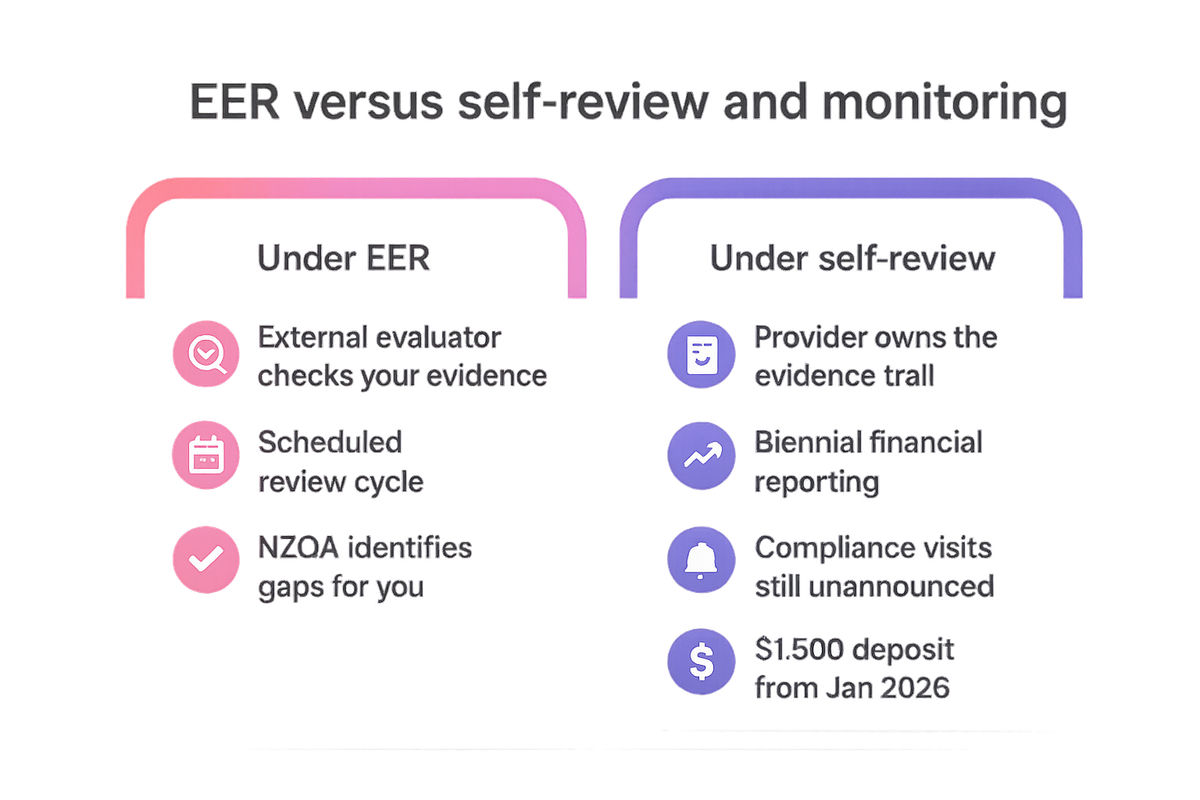
Up until now, an external evaluator periodically checked your evidence and told you where the gaps were. From 19 January 2026, when the Private Training Establishment Rules 2026 come into force, that external check softens into self-review — a lighter reporting cadence, but a heavier onus on you to have provider-owned evidence ready at any time. At the same moment, the Industry Skills Boards are taking over standard-setting and moderation from Workforce Development Councils, changing who you answer to on curriculum alignment. And your international enrolment pipeline is growing fast enough to strain delivery and compliance capacity without careful planning. None of these three shifts is something a compliance manager or curriculum lead can resolve on their own — each one changes what the organisation is accountable for, which puts it in your lane.
The safety net just changed shape
The Private Training Establishment Rules 2026 remove the annual PTE fee and move most financial returns from annual to biennial. On paper that sounds like less admin. In practice, it means NZQA is checking in less often — but still retains real enforcement teeth. Compliance visits, scheduled or unannounced, are charged at $190 per staff member per hour. Validation visits cost $3,150 plus GST. Non-compliance can still escalate to compliance notices, conditions on registration, withdrawal of approval, or cancellation. The PTE registration deposit itself rises to $1,500 from 1 January 2026. Fewer scheduled check-ins does not mean lower risk — it means the cost of being caught without evidence is now entirely on you, discovered on NZQA's schedule, not yours.
Who sets the standard now
The Vocational Education and Training legislation passed in October 2025 disestablished Te Pūkenga, transitioning via NZIST over two years, and established 10 regional polytechnics alongside new Industry Skills Boards from 1 January 2026. The Industry Skills Boards now set standards, endorse programmes and moderate assessment by sector — work previously done by Workforce Development Councils. If your PTE delivers against qualifications in a sector undergoing this handover, your moderation relationships and standard-setting contacts have effectively changed owners. Deciding how your organisation re-establishes those relationships, and how quickly, is a strategic call about where you sit in the new sector map — not an administrative update to a contacts list.
Growth you can't staff your way through
Government-funded PTEs saw a 33% increase in international enrolments between January and August 2025 compared with the same period in 2024, reaching 12,060 students, within a national total of 92,580 international enrolments for 2025 — up 11% on 2024 and back to 80% of the pre-COVID peak. Momentum has continued into 2026, with growth of 8% in the first four months, against a government target of 105,000 enrolments and a $7.2 billion sector value by 2034. That's genuine upside. It's also a direct threat to your margin if delivery and compliance capacity don't scale with it, because assessment and moderation work doesn't get cheaper just because volume goes up.
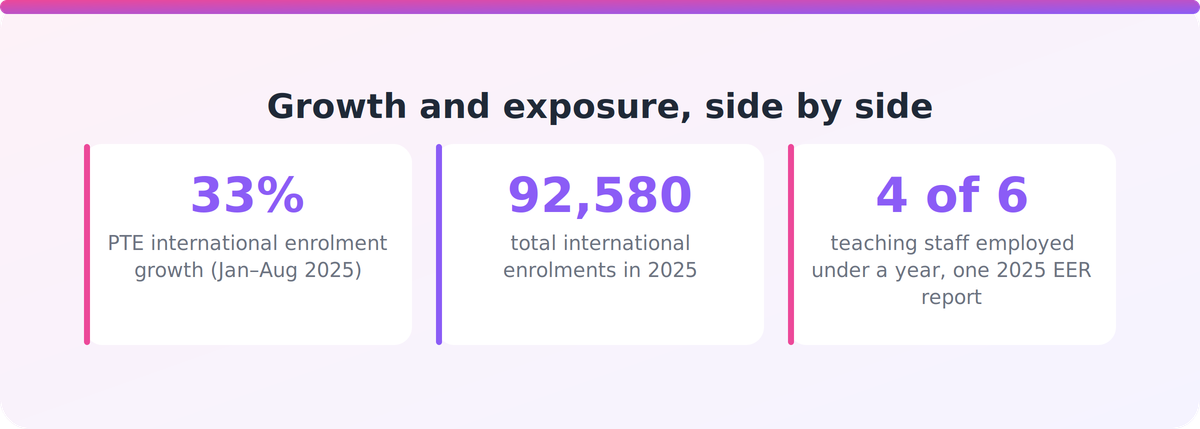
At the same time, NZQA's own EER reporting has flagged workforce attrition in compliance-facing roles as a named risk. One 2025 report noted that four of six teaching staff in the relevant programme area had been employed for a year or less — a documented illustration of key-person exposure sitting precisely in the roles responsible for assessment quality and moderation readiness. Growth without a plan for that exposure is how a strong enrolment year turns into a rough EER-equivalent finding.
Is AI-assisted assessment a defensible strategy or an open question?
This is where AI stops being a productivity nice-to-have and becomes a compliance question. A November 2025 study by Manukau Institute of Technology, done with the Construction and Infrastructure Centre of Vocational Excellence, was the first comprehensive New Zealand examination of whether AI-designed assessments can pass the national moderation system. That the question needed a formal study at all tells you the sector doesn't yet have a settled answer — sector commentary through 2025 and 2026 continues to describe AI adoption in New Zealand vocational education as slow despite the momentum. New Zealand's 2025 Strategy for Artificial Intelligence explicitly aims to reduce regulatory uncertainty and remove unintended barriers to AI adoption in sectors including education, aligned to OECD AI Principles — a signal that using AI in compliance-sensitive work is a live, government-sanctioned question, not a fringe experiment to leave to whoever's keenest on the technology internally.
What actually belongs at board level
Several decisions here are not curriculum or IT calls, however they get framed:
- What your organisation's risk appetite is for AI involvement in assessment design, moderation-readiness and evidence-of-coverage work.
- Who owns the provider-side evidence trail now that external review has softened, and how it's audited internally before NZQA ever asks for it.
- How your PTE re-establishes standard-setting and moderation relationships with the relevant Industry Skills Board.
- What your mitigation plan is for key-person risk in assessment and moderation roles, given NZQA has already flagged this pattern in EER reporting.
- How you scale delivery capacity against enrolment growth without compliance quality becoming the variable that gives.
Key takeaways
- Self-review under the Private Training Establishment Rules 2026 shifts evidence ownership onto providers even as scheduled NZQA oversight becomes less frequent from 19 January 2026.
- NZQA's enforcement powers remain intact: compliance visits at $190 per staff member per hour, $3,150 (+GST) validation visits, a $1,500 registration deposit from 1 January 2026, and an escalation path to cancellation.
- Industry Skills Boards replace Workforce Development Councils for standard-setting, programme endorsement and moderation from 1 January 2026 — a strategic relationship shift, not an admin update.
- International enrolment growth (33% for government-funded PTEs, 92,580 total in 2025) is real upside that will strain compliance capacity without deliberate planning.
- Whether AI-assisted assessment work holds up under national moderation is an active, researched question in New Zealand as of late 2025 — worth a considered position now rather than an accidental one later.
Our take
We think the sector is at a genuine inflection point, and CEOs who treat this as "something the compliance manager will sort out" are taking on more risk than they realise. The regulatory settings have changed in a way that concentrates accountability at the top of the organisation, right as enrolment growth is tempting everyone to move faster on delivery. Setting a deliberate position now — on evidence ownership, on key-person risk, on where AI is and isn't appropriate in compliance-critical work — is cheaper than discovering your position by accident during an unannounced compliance visit.
FAQ
Does the shift from EER to self-review actually lower my compliance risk? No. It changes the cadence of external checking, not the underlying risk. NZQA retains compliance visits (at $190 per staff member per hour), validation visits ($3,150 plus GST), and an escalation path to compliance notices, conditions on registration, or cancellation. Less frequent review means more responsibility for having your own evidence audit-ready at any time.
How does the disestablishment of Te Pūkenga affect my PTE's standard-setting relationships? From 1 January 2026, Industry Skills Boards take over standard-setting, programme endorsement and moderation by sector, replacing Workforce Development Councils, following the October 2025 legislation that disestablished Te Pūkenga via a two-year NZIST transition. If your programmes sit in an affected sector, your moderation and endorsement contacts have changed, and re-establishing those relationships is worth doing early.
Is AI-generated assessment content actually defensible under national moderation? It's an open, actively researched question rather than a settled one. Manukau Institute of Technology's November 2025 study with the Construction and Infrastructure Centre of Vocational Excellence was the first comprehensive New Zealand examination of whether AI-designed assessments pass moderation — a strong signal that this deserves a considered governance position, not silence or a blanket ban made without evidence.
What decisions here genuinely need to sit with me rather than my compliance or curriculum team? Risk appetite for AI in assessment and moderation-readiness work, ownership of the provider-side evidence trail under self-review, your organisation's plan for key-person exposure in compliance-critical roles (a risk NZQA has already named in EER reporting), and how you scale compliance capacity against enrolment growth without letting quality become the trade-off.