AI Training Scenario Generator NZ: A Buyer's Guide
27 August 2026 · 8 min read

An AI training scenario generator worth buying for NZQA-aligned training is one that maps the roleplay, simulation or coached practice it generates directly back to a unit standard's performance criteria, keeps the exercise clearly formative, and leaves the competency call with a qualified assessor. No NZQA-issued checklist exists yet for evaluating these tools specifically, so buyers are weighing vendor claims against general standards-fidelity and evidence questions — which is exactly what this guide sets out to help with.
What an AI training scenario generator actually does
At a technical level, these tools take source material — a unit standard, an assessment, a programme document — and convert it into a persona-based practice exercise. That usually means a briefing for the learner, behaviour rules for an AI character to stay in role, and a rubric the AI uses to give feedback (EducateMe). That's a meaningfully different thing from a static PDF or e-learning module: the learner practises a conversation, a calculation, or a procedure, gets feedback, and can try again.
The category spans several formats. Some tools are narrow roleplay generators built for sales or customer-service conversations. Others aim wider — simulation, narrated video, guided calculation practice — sequenced so a learner moves from learning a concept to trying it to demonstrating it. For vocational training tied to unit standards, format variety matters: a plumbing unit standard and a workplace communication unit standard need different practice shapes, not the same script template stretched to fit.
How it should map back to a unit standard
This is where a lot of vendor claims get vague. NZQA unit standards are built from specific parts: a title describing the outcome, performance criteria stating the critical evidence a learner must demonstrate, and — where used — range statements clarifying the conditions of assessment (NZQA). A credible mapping claim references these elements by name. If a tool says it "covers customer service skills" without naming which performance criteria a scenario evidences, that's a topic match, not a standards match.
It also matters that unit and skill standard assessment in NZ is typically graded Achieved or Not Achieved (NZQA). Any AI-generated feedback or rubric needs to sit comfortably alongside that binary compliance outcome — a five-star sliding score that doesn't connect to Achieved/Not Achieved criteria is a UX flourish, not evidence.
Does AI replace the assessor's judgement?
No — and any tool that implies otherwise should be treated cautiously. Coached practice, roleplay and simulation generated by AI are formative: they give a learner a safe place to try something before it counts. The decision that a learner has met a unit standard's performance criteria is, and should remain, a judgement made by a qualified, accountable assessor, who reviews evidence and signs off competency. A generator that produces well-mapped practice scenarios is doing useful preparatory work; it is not doing the assessor's job, and no tool in this category should be bought or used on the assumption that it is.
Unit standards moving to skill standards — what happens to your content
NZQA is progressively transitioning unit standards to skill standards on its Directory of Assessment and Skill Standards, with skill standards and unit standards developed by Workforce Development Councils (Hanga Aro Rau). That's a live, ongoing process, not a one-off event — which matters for anyone investing in AI-generated practice content now.
Before buying, ask the vendor directly: when a unit standard your content is built on converts to a skill standard, does existing generated material get remapped and upgraded, or does it need to be rebuilt from scratch? A tool with no answer to this is asking you to redo work every time NZQA moves a standard.
What to check before you buy
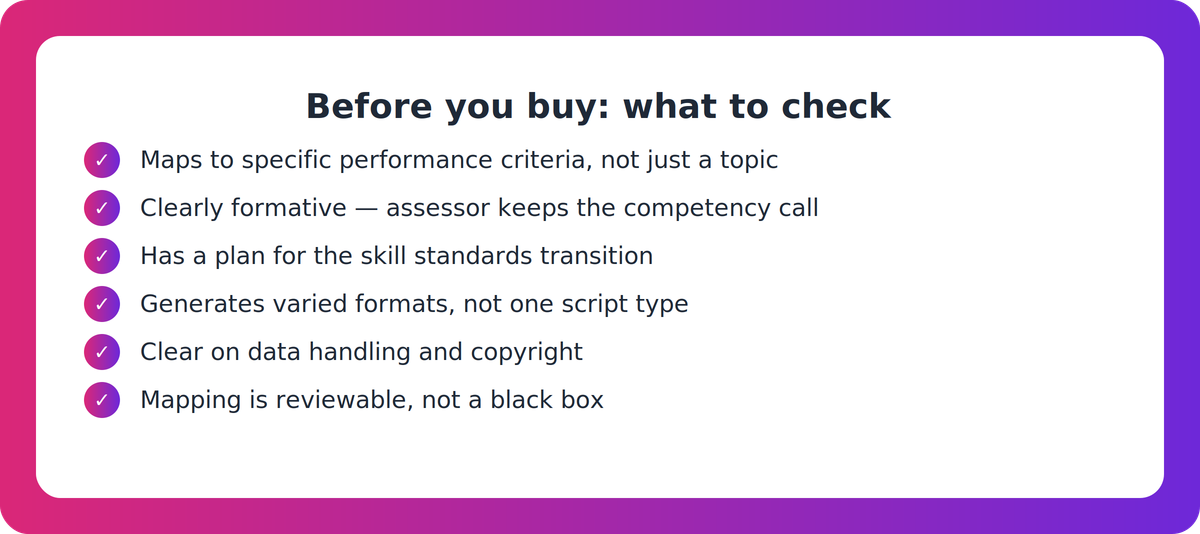
Buyer-guide themes across this category — from sales-roleplay vendors to education-focused tools — are fairly consistent (JoySuite, Jenova, EducateMe). Before committing, work through:
- Standards fidelity — does it name the specific performance criteria (and range statements, where relevant) a scenario evidences, or just a topic area?
- Formative framing — is it explicit that outputs are practice and feedback, with the competency decision left to a human assessor?
- Skill standards readiness — how does the vendor handle NZQA's unit-to-skill-standard transition for content already built?
- Format variety — does it generate roleplay, simulation, video and calculation-style practice suited to what's being taught, or one script type stretched everywhere?
- Data handling and copyright — is there clarity on what happens to uploaded programme and assessment material?
- Reviewability — can a programme team see and check the standards-mapping before it's used, rather than trusting a black box?
- Real NZ evidence — is there a named provider and a stated scope (qualifications, unit standard count), not just marketing language?
One documented NZ example worth knowing about is MAST Academy, a marine and composites training provider, which entered a 2025 partnership building AI tooling that understands the structure of NZQA unit standards across a stated scope of 22 qualifications and more than 400 unit standards (MAST Academy). That case centred on course and assessment content generation rather than the coached-practice roleplay engine specifically, which is a useful reminder to ask exactly what scope a vendor's evidence actually covers.
Key takeaways
- A genuine AI training scenario generator converts source material into persona-based practice — roleplay, simulation, guided calculation — with a briefing, behaviour rules and a rubric, not a static module.
- Credible standards-mapping names specific unit standard elements (performance criteria, range statements), not just a topic.
- AI-generated practice is formative. The competency decision — Achieved or Not Achieved — stays with a qualified human assessor.
- NZQA's unit-to-skill-standard transition is ongoing; ask any vendor how existing generated content is upgraded, not rebuilt, when a standard converts.
- Ask for named NZ evidence and a stated scope before treating any vendor claim as proven at scale.
Our take
The honest state of this category in New Zealand is early: there's no regulator checklist yet, and most of what's published is vendor material dressed up as guidance. That's not a reason to wait it out — coached practice genuinely helps learners rehearse before high-stakes assessment — but it is a reason to ask pointed, specific questions rather than accepting a demo. Nova, from Supahuman, sits in this category: it reads uploaded unit standard and programme material, generates a sequence of practice activities across roleplay, simulation and other formats, maps them back to unit standards for moderation, and is explicit that it doesn't mark — assessors keep the competency call. That's a fair example of the shape a credible tool should take, but it's still worth pressure-testing against your own unit standards rather than taking any vendor's word for it, ours included.
FAQ
What is an AI training scenario generator, and can one actually turn a unit standard into a coached practice scenario? Yes, in principle. These tools convert source material into a practice scenario with a briefing, in-character AI behaviour and a rubric. Whether it actually reflects a specific unit standard depends on whether the tool maps to that standard's title, performance criteria and range statements — not just a related topic.
Does AI-generated roleplay or simulation practice replace the assessor's judgement on NZQA competency decisions? No. NZQA assessment for unit and skill standards is typically graded Achieved or Not Achieved by a qualified assessor. AI-generated roleplay and simulation are formative practice tools that help a learner prepare — the competency decision itself stays with the human assessor.
How do these tools handle NZQA's move from unit standards to skill standards? This varies by vendor and isn't governed by any published NZQA guidance on tooling specifically. Ask directly whether existing generated content is remapped and upgraded as a standard converts on NZQA's Directory of Assessment and Skill Standards, or whether it needs to be rebuilt.
What should a PTE, ITP, wānanga or corporate L&D team check before buying one of these tools? Check standards-mapping fidelity, clear formative framing, a plan for the skill standards transition, genuine format variety, clarity on data handling and copyright for uploaded material, reviewability of the mapping before use, and real NZ evidence — a named provider and a stated scope — rather than general marketing claims.
Is there an NZ example of this category being used against actual unit standards? MAST Academy, a marine and composites training provider, is a documented example — a 2025 partnership building AI tooling that understands NZQA unit standard structure across 22 qualifications and 400+ unit standards. That case focused on course and assessment content generation rather than coached-practice roleplay specifically, so it's worth confirming the exact scope with any vendor citing it.