AI VET Assessment Writing: Keep Validator Sign-Off
20 September 2026 · 7 min read
Yes — an AI-drafted assessment can pass validation under the Standards for RTOs 2025, but only if the draft arrives in a form a validator can actually trace against the unit of competency. The Standards haven't changed the underlying obligation: every training product on scope still needs independent validation at least once every five years, checked against the Rules of Evidence and Principles of Assessment, with a qualified assessor making the competency call.
What "AI VET assessment writing" actually means
Most tools in this category work the same way. You upload or select a unit of competency, and the software generates an assessment — tasks, instructions, a marking guide — plus a matrix mapping that content back to elements, performance criteria and evidence requirements. Some tools go further and generate matching training or learning material at the same time, so the assessment and the resource sit together instead of drifting apart over time.
The speed gain is real. Manually drafting and mapping a single unit of competency can run to dozens of hours; a well-built tool cuts that to a fraction. But speed at the drafting stage is only half the story. What happens next — validation — is where a lot of AI-drafted work quietly falls over.
Validation doesn't disappear under the Standards for RTOs 2025
The 2025 Standards for RTOs, which took effect 1 July 2025, still require RTOs to validate their assessment practices and judgements at least once every five years for each training product on scope, using an independent validator who isn't employed or subcontracted by the RTO delivering the training (ASQA; DEWR). At least two units per qualification must be sampled, with more added if risk factors or inconsistent assessor judgements show up — ASQA publishes a sample size calculator to help RTOs work out how many.
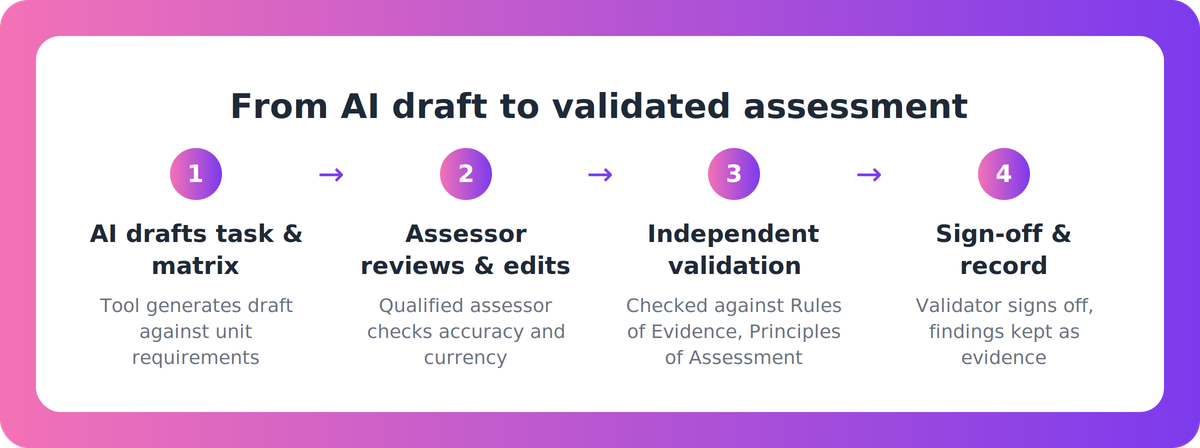
Validation itself hasn't changed shape. A validator checks the assessment evidence against the Rules of Evidence (valid, sufficient, authentic, current) and the Principles of Assessment (fairness, flexibility, validity, reliability), regardless of whether AI touched the draft (ASQA Appendix 6; Appendix 7). ASQA's own 5 Principles for the Responsible Use of AI in VET confirm this: they don't create new rules, they explain how existing obligations — including the 2025 Standards — apply when AI sits inside your operations.
So the honest answer to the core buyer question is: AI can draft the assessment, but it cannot validate it, and it doesn't shrink the five-yearly independent validation cycle or the need for a qualified assessor to sign off the competency decision.
What to check in the mapping matrix before you buy
The mapping matrix is the artefact that decides whether validation is quick or painful. If a validator has to reverse-engineer how a task connects to a performance criterion, you've just moved the 40-hour drafting problem into the validation meeting instead of solving it.
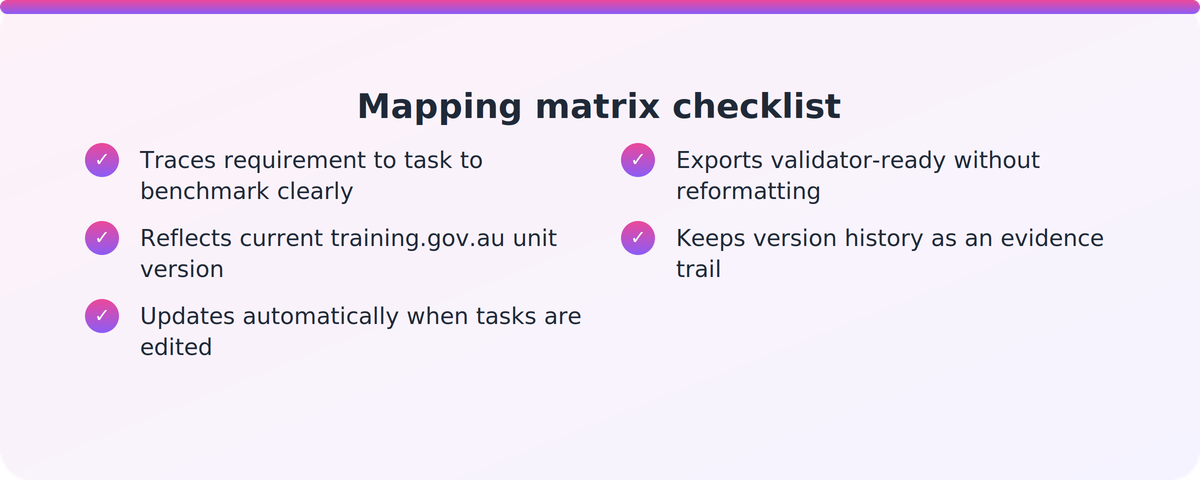
Before you commit to a tool, check that its matrix:
- Traces cleanly from requirement to task to benchmark, so a validator can follow the logic without cross-referencing three documents
- Reflects the current version of the unit on training.gov.au, not a cached or outdated copy
- Updates automatically when a task is edited, so the matrix and the assessment can't quietly drift apart
- Exports in a format ready to hand to an independent validator, without reformatting first
- Keeps a version history — what changed, when, and why — so re-validation after edits has an evidence trail
Traditional units vs the new ASK format under TPOF 2025
TPOF 2025 has introduced a new Application of Skills and Knowledge (ASK) unit format on training.gov.au, running alongside the traditional elements-and-performance-criteria structure. Most RTOs will be holding a mix of both formats for years as training packages transition. Ask any vendor directly whether their tool maps to ASK-format units the same way it maps to traditional ones, or whether you'll end up running two separate workflows. A tool that only handles one format is a partial answer, not a full one.
Who's accountable for the competency call
This is worth stating plainly, because it's easy to blur in a sales conversation: AI drafts, a qualified assessor and an independent validator decide. Nothing about using AI to generate a task, a matrix or supporting material shifts that accountability. Vendor and independent guidance across this category are consistent on this point — AI output should be reviewed by qualified staff before use, not treated as a finished, moderation-ready instrument. If a tool or a vendor implies otherwise, that's a red flag, not a feature.
Data governance: the question ASQA guidance keeps raising
ASQA's guidance on AI is explicit that adopting an AI tool doesn't reduce an RTO's existing responsibilities around privacy, data protection, data sovereignty and record-keeping. Before you sign anything, find out what data the tool collects, where it's stored, and who can access it. This matters more than it might seem — unit content, learner data and assessment records are all sensitive, and "the vendor said it's fine" isn't a due-diligence answer an auditor will accept.
Key takeaways
- AI can legitimately speed up drafting assessment tasks and mapping matrices, but the Standards for RTOs 2025 still require independent validation of every training product at least once every five years.
- Validation checks against the Rules of Evidence and Principles of Assessment apply the same way whether a human or an AI tool drafted the assessment.
- The real buyer test is the mapping matrix: is it traceable, current and export-ready enough for a validator to check quickly, or does it just look plausible?
- Confirm any tool maps both traditional and the newer ASK-format units introduced under TPOF 2025 — don't assume it covers both.
- Ask about data storage, access and sovereignty before adopting any AI tool; ASQA guidance treats this as an ongoing RTO responsibility, not something AI use resolves.
Our take
The category has largely solved the drafting speed problem — most tools can produce a plausible-looking assessment quickly. Fewer have solved the harder problem: making that output genuinely traceable for a validator, across both unit formats an RTO is now likely to hold. We built VETos around that second problem specifically — generating the assessment and its mapping matrix together from live training.gov.au data, hosted in Australia, so edits stay synchronised rather than drifting. But the platform's role stops at making what's being validated accurate and current; the validation and sign-off still sit with your qualified assessor, as they should.
FAQ
Can an AI-drafted assessment still pass ASQA validation and sign-off requirements under the Standards for RTOs 2025? Yes, provided the draft is reviewed by a qualified assessor and independently validated against the Rules of Evidence and Principles of Assessment, as required at least once every five years per training product on scope. AI drafting doesn't change or shorten this validation obligation.
What should an RTO check in AI assessment-writing software to keep the mapping matrix audit-ready? Check that the matrix traces clearly from unit requirement to assessment task to benchmark, reflects the current training.gov.au version, updates automatically when tasks are edited, and exports in a form a validator can use without reformatting.
Does the software need to handle both traditional units and the new ASK-format units introduced under TPOF 2025? Most RTOs will hold a mix of traditional and ASK-format units for years as training packages transition, so it's worth confirming a tool maps both formats natively rather than forcing separate workflows for each.
Who is legally accountable for the competency decision when AI has drafted the assessment tool? The qualified assessor and, at validation, an independent validator remain accountable for the competency judgement. AI use doesn't shift this responsibility — it sits inside existing obligations under the Standards for RTOs 2025, not outside them.
Does using an AI tool reduce an RTO's data privacy or record-keeping obligations? No. ASQA guidance is explicit that AI use doesn't reduce existing responsibilities for privacy, data protection, data sovereignty and record-keeping — buyers should confirm data storage and access arrangements before adopting any tool.
If you're evaluating options, ask a vendor to walk through a real mapping matrix for one of your own units — in both traditional and ASK format if you hold both — rather than relying on a feature list or a generic demo. That single test will tell you more about validator readiness than any spec sheet.