Closing NZ's Apprentice Practical Assessment Gap
27 July 2026 · 7 min read

New Zealand's apprentice practical assessment system is entering 2026 with a structural handover it hasn't fully prepared for. Eight new Industry Skills Boards take over responsibility for arranging assessment and supporting on-job learning from Te Pūkenga's disestablished structure, landing on top of an existing split where workplace trainers coach apprentices but separate assessors sign them off. The fix isn't more paperwork — it's more consistent, scalable coaching before the formal assessment moment arrives.
What's changing in NZ apprenticeships from January 2026
The Education and Training (Vocational Education and Training System) Amendment Act, passed in 2025, disestablished Te Pūkenga and re-established ten regionally governed polytechnics from 1 January 2026 (Ministry of Education; Beehive.govt.nz). Alongside them, eight new Industry Skills Boards have stood up to take over functions that used to sit inside Te Pūkenga's centralised structure.
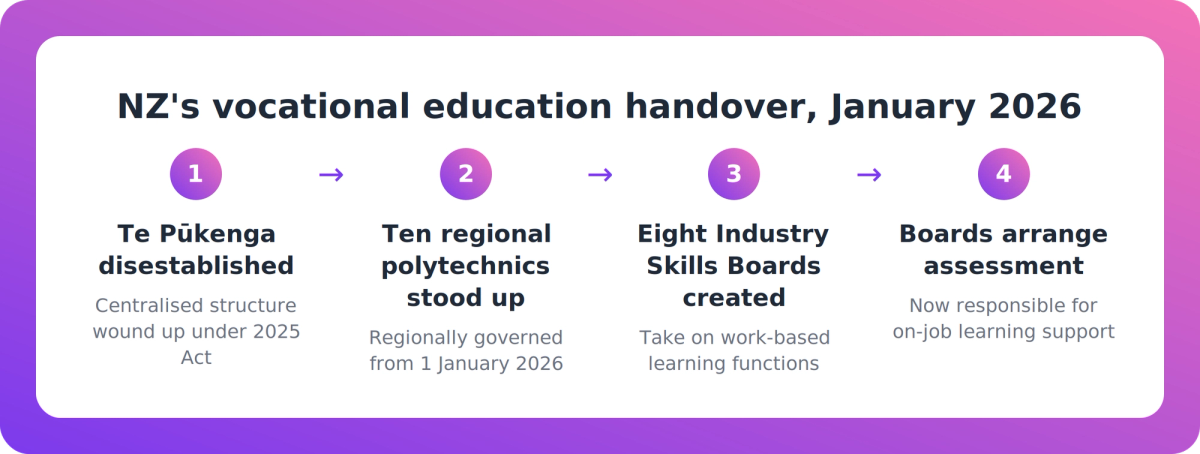
TEC's own consultation documentation is explicit about what these boards now own:
- Training agreements for work-based learners
- On-job learning support
- Arranging assessment (TEC, Consultation on Industry Skills Boards' Coverage)
This isn't a minor administrative reshuffle. Roughly half of New Zealand's vocational learners train on-the-job through apprenticeships and traineeships, so the handover affects a very large cohort at a single moment of regulatory upheaval (Ministry of Education).
Why on-job assessment already splits coaching from sign-off
Here's the part that predates the reform and makes it harder: coaching and formal assessment were never one continuous process in New Zealand apprenticeships. Competenz's own apprentice guidance lays it out plainly — a workplace trainer or supervisor coaches the apprentice and judges day-to-day readiness, but the final assessment decision sits with a separate Competenz assessor (Competenz, Apprentice guide to success).
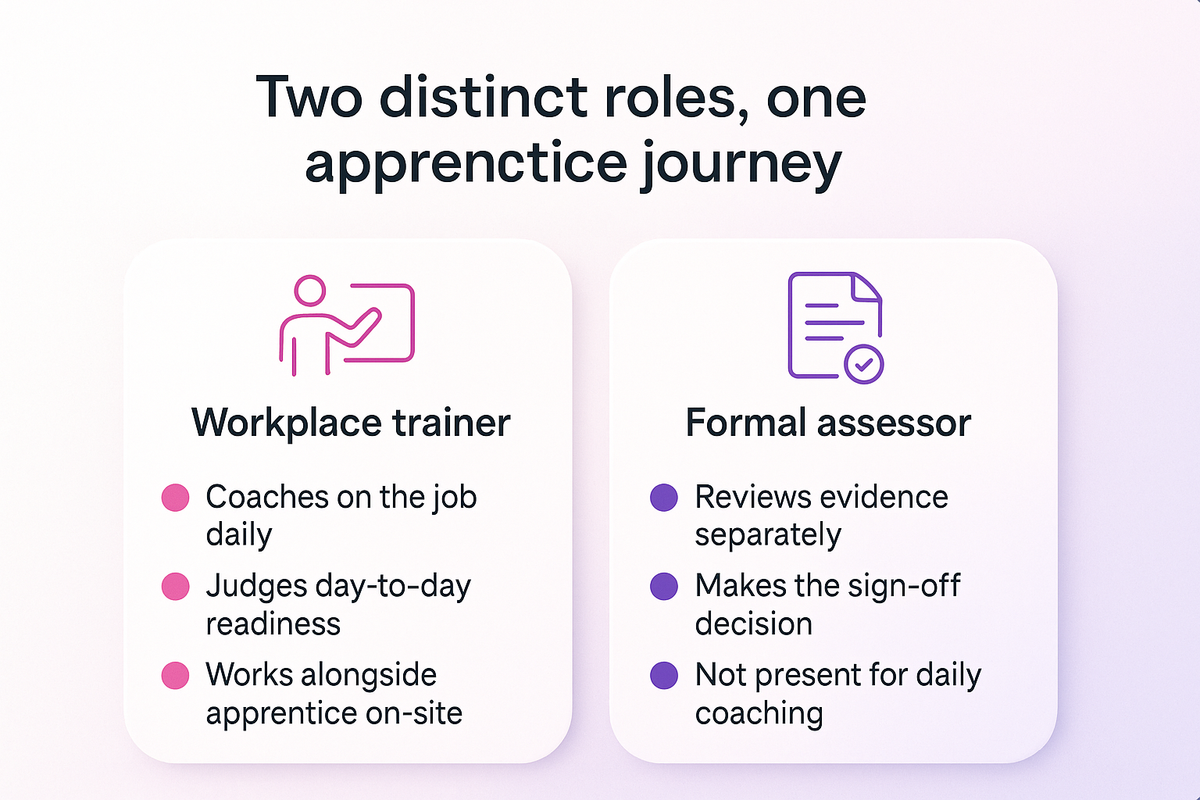
That split has always created room for inconsistency. A trainer's read on "ready" depends on their own experience, workload, and how much time they can give any one apprentice on a busy site. The assessor arrives later, working from whatever evidence and preparation the apprentice has managed to build up in between.
Minister Penny Simmonds has framed the reform as handing industry the wheel: industry will now decide which qualifications apprentices need, who delivers programmes, and how quality is assured (RNZ). That's a genuine shift toward industry-led training. It also means the boards now carry direct responsibility for a coaching-to-assessment gap they didn't design and haven't yet built capability to manage consistently.
Why the timing makes this harder, not easier
The electrotechnology warning
Industry reaction has been mixed rather than uniformly welcoming. Master Electricians chief executive Alexandra Vranyac-Wheeler welcomed the industry-led direction but flagged a specific risk: grouping electrotechnology under a shared Industry Skills Board could under-serve a trade with its own distinct training needs (RNZ). If one board is responsible for arranging assessment across several trades at once, the depth of role-specific coaching support each trade actually needs is easy to flatten out.
Migration pathway adds throughput pressure
A new Skilled Migrant Residence pathway for trades and technician occupations opens from August 2026, adding further pressure on domestic training pipelines to produce assessment-ready apprentices faster, not slower (New Zealand Shores). Providers and boards don't get a quiet transition year to bed in new processes — they get a transition year with rising demand for qualified trades output layered on top.
What providers and Industry Skills Boards can do now
The practical question for training organisations and boards isn't whether the reform is right in principle. It's how to keep on-job coaching consistent while assessment responsibilities are still being reorganised. A few things worth prioritising during the transition:
- Document what "ready" looks like, per trade. Don't let readiness judgement stay purely tacit knowledge held by individual workplace trainers.
- Give apprentices repeatable practice before the real assessment moment. A single walkthrough on-site isn't the same as rehearsed, coached repetition.
- Separate coaching capacity from assessor capacity. The Competenz model already treats these as different roles — resourcing them as if they're the same thing is where consistency breaks down.
- Watch trade-specific coverage closely, especially where a board spans multiple trades with different practical assessment demands, as the electrotechnology concern illustrates.
This is exactly the kind of gap that scalable, role-specific coached practice is built to close — apprentices getting repeated, realistic rehearsal of the scenarios an assessor will actually test them on, without needing a trainer physically present every time. Tools built for this, such as Nova, point at where the sector is heading: contextual practice environments that sit between the workplace trainer's coaching and the assessor's formal sign-off, rather than replacing either.
Key takeaways
- From 1 January 2026, ten regional polytechnics replace Te Pūkenga and eight new Industry Skills Boards inherit responsibility for arranging assessment and on-job learning support (Ministry of Education; TEC).
- New Zealand's apprenticeship model already separates workplace coaching from formal assessor sign-off — this reform doesn't create that split, it hands its management to newer, less-established bodies (Competenz).
- About half of NZ's vocational learners train on-the-job, meaning the assessment handover touches a large cohort during a single transition window (Ministry of Education).
- Industry voices, including Master Electricians' Alexandra Vranyac-Wheeler, have flagged that shared boards risk under-serving trade-specific coaching needs like electrotechnology (RNZ).
- A new Skilled Migrant Residence pathway for trades opens August 2026, adding throughput pressure just as boards are still building assessment capability (New Zealand Shores).
Our take
The reform is a reasonable bet on industry knowing its own trades better than a centralised polytechnic structure did. But handing "arranging assessment" to eight boards that haven't run this function before is a capability build, not a light switch — and it lands during the exact period when demand for qualified trades output is rising. The providers and boards that treat consistent, repeatable on-job coaching as core infrastructure now, rather than an afterthought once governance settles, will be the ones whose apprentices aren't caught in the gap between a trainer's verbal thumbs-up and an assessor's formal decision.
FAQ
What changed in New Zealand's apprenticeship system from January 2026? Te Pūkenga was disestablished under the Education and Training (Vocational Education and Training System) Amendment Act 2025, replaced by ten regionally governed polytechnics, with eight new Industry Skills Boards taking on responsibility for arranging assessment and supporting on-job learning (Ministry of Education; Beehive.govt.nz).
Who is responsible for apprentice practical assessment in NZ now? Industry Skills Boards now arrange assessment and support on-job learning, per TEC's consultation documentation, while workplace trainers continue to coach apprentices day-to-day and separate assessors make the formal sign-off decision, as described in Competenz's apprentice guidance.
Were workplace coaching and formal assessment always separate in NZ apprenticeships? Yes. Competenz's own guidance confirms a workplace trainer or supervisor judges readiness on-site, but a separate Competenz assessor makes the final assessment decision — this structural split predates the current reform.
Why are some industry groups concerned about the new Industry Skills Boards? Master Electricians chief executive Alexandra Vranyac-Wheeler welcomed the industry-led shift but warned that grouping trades like electrotechnology under a shared board risks under-serving that trade's specific training needs (RNZ).
How does the new skilled migrant pathway affect domestic apprentice training? A Skilled Migrant Residence pathway for trades and technician occupations opens from August 2026, adding pressure on domestic training pipelines to produce assessment-ready apprentices at pace, right as the assessment handover is still bedding in (New Zealand Shores).