ASQA Audit Risk Indicators: A Compliance Manager's Guide
7 September 2026 · 7 min read

ASQA's audit model has quietly rewritten your job description. Under the 2025 Standards for RTOs, a performance assessment doesn't ask if your policy exists — it asks if you can prove your system catches problems before they compound. The first audit wave under the new framework: a 62% compliance rate, 212 serious matters under investigation. Most of that gap sits inside self-assurance, not paperwork.
Why this lands on your desk
You own the Annual Declaration on Compliance every year, and the 2026 version is due 31 March. It's one date on a crowded calendar, but a missed or unsupported declaration can trigger an immediate High Risk rating — not a warning letter, not a please-explain. That deadline sits on your desk, not your CEO's.
The bigger shift is what "compliant" now means day to day. Performance assessments explicitly test whether self-assurance — Outcome Standard 4.4 — is a continuous pulse of monitoring, review and improvement, or a once-a-year exercise finished just before an audit. If your evidence of internal monitoring is a single annual document, you're being judged against a standard it was never built to meet.
You're also, in practice, the single point of failure for evidence traceability. When proof lives across shared drives, inboxes and spreadsheets, you're the only person who can reliably locate it — precisely the blind spot ASQA's evidence-led model is designed to expose. The pressure is rising from both directions: enforcement funding climbs to $4.8 million in 2026-27, on top of $4.7 million the year before, and ASQA's tip-off line, running since October 2024, has already logged more than 3,200 tip-offs, over half providing actionable intelligence.
What a performance assessment actually checks
ASQA structures a performance assessment around three questions: does practice align with the Standards, is there a system for ongoing compliance, and can the provider demonstrate self-assurance through monitoring, review and continuous improvement. The third question is where most providers under-invest.
It's worth being precise about ASQA's guidance itself. Practice Guides don't carry legal force — RTOs are regulated against the underlying legislative instruments, and the Practice Guides only offer self-assurance questions and example approaches. You can't outsource interpretation to a checklist. Your compliance framework has to be your own defensible reading of the Standards, applied to your scope and delivery model, not a copy-paste of someone else's policy pack.
The self-assurance blind spot inside Outcome Standard 4.4
The clearest trap for 2026 is treating self-assurance as a once-a-year task. Providers are being caught with policies that read perfectly, but no evidence of ongoing internal monitoring behind them. A policy is a statement of intent. Self-assurance is proof the intent is actually operating: dated review logs, corrective action trails showing issues found and closed, trend data across periods — not a single snapshot.
If an assessor asked today for evidence that you caught and fixed a compliance issue last quarter, before they flagged it, could you produce it in under ten minutes? That's the real test hiding inside 4.4.
What the first 2026 audit wave found
Between July 2025 and January 2026, ASQA completed 89 performance reviews at a 62% compliance rate, with 212 serious matters under investigation. Enforcement funding is rising to $4.8 million in 2026-27.
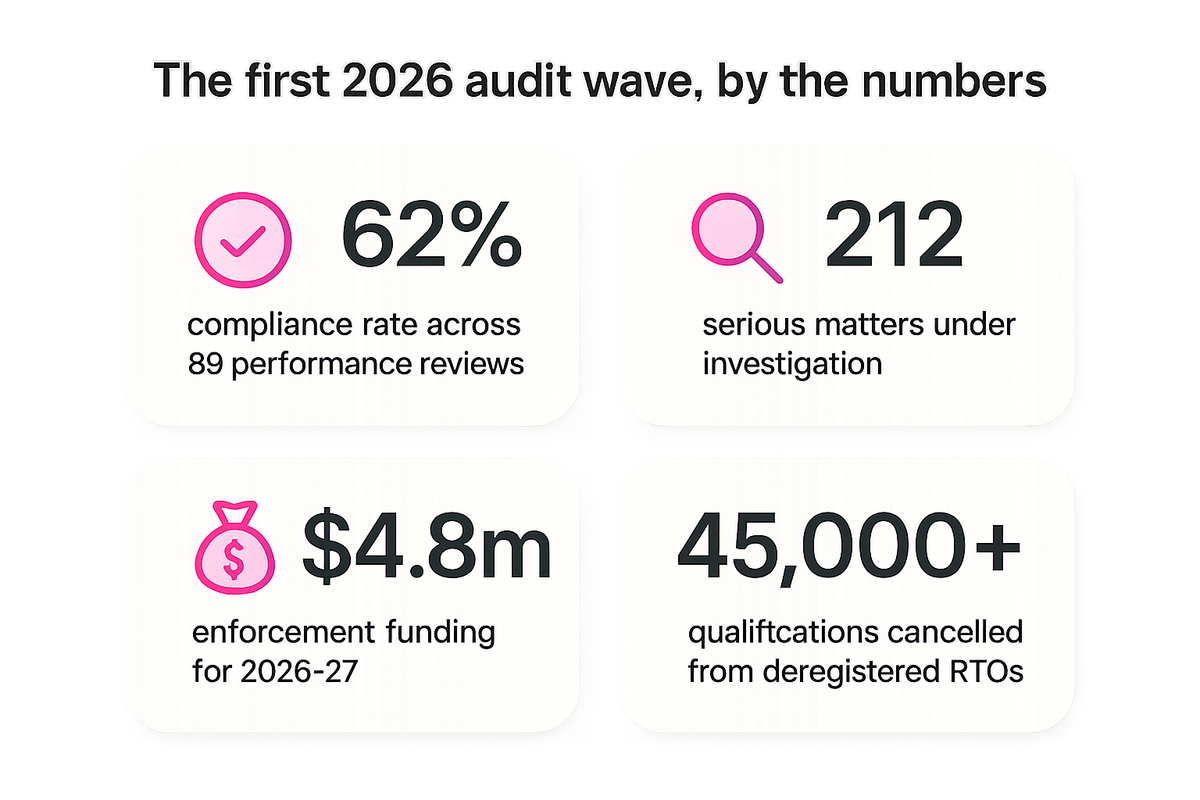
The longer pattern is more sobering. More than 45,000 VET qualifications and statements of attainment have already been cancelled from students of deregistered RTOs. Analysis of these cases shows the pattern that should worry every compliance manager: many of these providers held valid registration and interacted with ASQA through standard channels for years before the failures that triggered cancellation surfaced. Risk doesn't announce itself. It sits quietly inside an apparently compliant provider until something forces it into view — and by then, students carry the cost.
The deadlines that don't wait for an audit cycle
Audits are episodic. Your statutory calendar isn't. Regardless of when your next performance assessment lands, these apply:
- Annual Declaration on Compliance — 31 March 2026
- AVETMISS/Total VET Activity reporting to NCVER — 28 February 2026
- Quality Indicator data — closes 30 June 2026
- Annual Registration Charge — due 31 July 2026
None of these is negotiable, and none cares whether you're mid-validation cycle or short a trainer. Treat this as a fixed operational load, not a set of milestones that flex around everything else.
Building a weekly pulse instead of an annual scramble
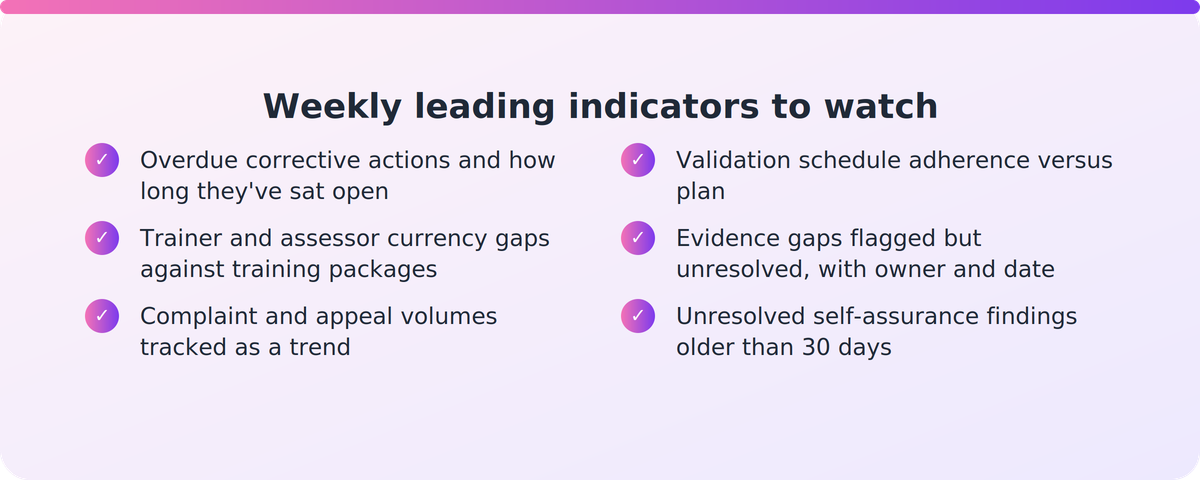
If self-assurance now has to be continuous, the practical question is what you look at each week to know risk is building. A few genuine leading indicators, drawn from what performance assessments actually probe:
- Overdue corrective actions from the last internal review, and how long they've sat open
- Trainer and assessor currency gaps against training package requirements
- Complaint and appeal volumes, tracked as a trend rather than a running tally
- Validation schedule adherence — sessions completed on time versus planned
- Evidence gaps flagged but unresolved, with an owner and a date attached
- Any unresolved self-assurance finding older than 30 days
None of these require new documents. They require a habit of checking the same signals often enough to catch drift before it becomes a serious matter.
Key takeaways
- Performance assessments under the 2025 Standards for RTOs test whether you catch and fix problems before they compound, not whether a policy document exists.
- The first 2026 audit wave returned a 62% compliance rate with 212 serious matters under investigation; enforcement funding rises to $4.8 million in 2026-27.
- Self-assurance under Outcome Standard 4.4 must be evidenced as ongoing monitoring — dated logs, closed corrective actions, trend data — not a single annual review.
- More than 45,000 qualifications have been cancelled from deregistered providers who held valid registration for years before failures surfaced, showing how long risk can sit undetected.
- Statutory deadlines (Annual Declaration 31 March, NCVER reporting 28 February, Quality Indicator data 30 June, Registration Charge 31 July) apply regardless of your audit cycle.
Our take
The instinct in most compliance teams is still to prepare for an audit: gather the evidence, tidy the folder, rehearse the narrative. That instinct made sense under the old model, where an assessor mostly checked whether documents existed. It doesn't hold up against a performance assessment built to test whether monitoring is real and ongoing.
The harder, more useful shift is to stop treating compliance as something produced for a point in time, and start treating it as an operating rhythm you can show evidence of at any moment an assessor — or a tip-off — asks. That's a genuine change in how the role works, not just what it monitors. Providers who make that shift early will spend 2026 with fewer surprises. Providers who don't will find out which of their "perfect" policies were never actually running.
FAQ
What is a performance assessment under the 2025 Standards for RTOs? It's ASQA's audit model under the new Standards, built around three questions: whether practice aligns with the Standards, whether there's a system for ongoing compliance, and whether the provider can demonstrate self-assurance through monitoring, review and continuous improvement — rather than a simple check that required documents exist.
Are ASQA's Practice Guides legally binding? No. Practice Guides don't carry legal force. RTOs are regulated against the underlying legislative instruments, and the Practice Guides only offer self-assurance questions and example approaches, meaning compliance teams need their own defensible interpretation of the Standards rather than a checklist copied from guidance material.
What happens if the Annual Declaration on Compliance is missed or unsupported? A missed or unsupported Annual Declaration on Compliance can trigger an immediate High Risk rating, with consequences up to suspension and penalties. The 2026 declaration is due 31 March 2026.
How is ASQA finding compliance issues outside scheduled audits? Partly through its tip-off line, running since October 2024, which received more than 3,200 tip-offs in its first year, with more than half assessed as providing actionable intelligence — a sign that external signals of risk are rising alongside ASQA's internal self-assurance expectations.