ASQA Evidence of Competency: Beyond Attendance Records
13 October 2026 · 6 min read
ASQA doesn't ask for an attendance roll, and a Statement of Attainment on its own proves little. Under the Standards for RTOs 2025, auditors want to see what each learner actually demonstrated, how it was judged against the unit, and why competency was awarded. That is the core of ASQA evidence of competency.
Does ASQA require attendance records under the 2025 Standards?
No. ASQA's 2025 Standards FAQs (Version 3) confirm the Standards do not prescribe a requirement to record student attendance.
That doesn't mean participation stops mattering. Providers must still ensure the structure of the training is appropriate. So you need some way to show learners took part in training that was properly designed. A roll is one option. It's not proof of competency.
What is ASQA focused on right now?
Qualification integrity. The question is whether a learner demonstrably became competent, not whether they showed up or a certificate was issued.
RTO Resource Australia reports that ASQA's July 2026 regulatory risk priorities put the integrity of qualifications and competency outcomes first. The questions it describes are:
- Is the evidence genuine?
- Was assessment conducted properly?
- Can the decision be relied on?
- Do the records reflect real training activity?
eSkills Australia, summarising ASQA's 2026 Environmental Scan, reports that more than 43,000 qualifications or statements of attainment had been cancelled through qualification-integrity work as at 31 March 2026. Both items are secondary reporting. Check them against ASQA's own publications before you quote them in your own documents.
What does the student evidence chain look like?
Enrolment, training delivered, participation, authentic assessment evidence, and directly assessed practical skills. eSkills Australia lays out the chain in roughly that order.
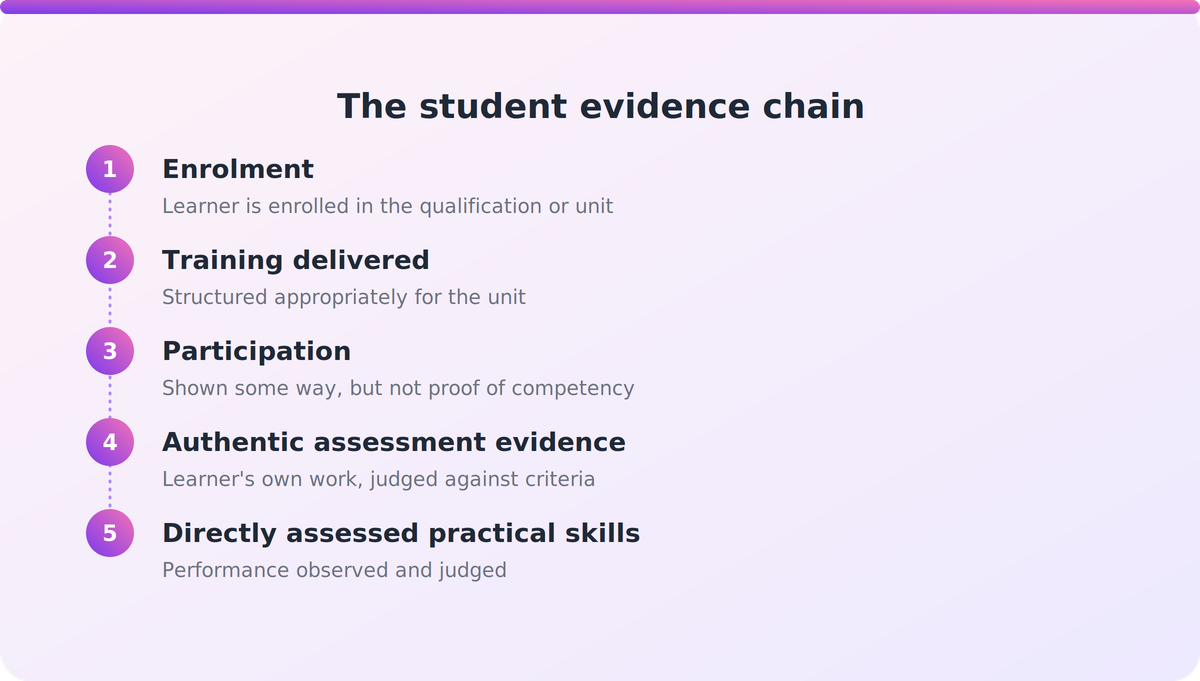
Participation is one link. It doesn't stand in for the last one. A file can have a perfect attendance record and still fail if nobody watched the learner do the task.
What do auditors test in a file?
The rules of evidence from ASQA's Assessment Practice Guide:
- Validity. Does the evidence show the skills and knowledge in the unit of competency?
- Sufficiency. Is there enough quality, quantity and relevance of evidence to make an informed judgement of competency?
- Authenticity. Is it the learner's own work?
- Currency. Does it show current skills?

Sufficiency is where practical units tend to come unstuck. RTO Pilot names over-reliance on written knowledge questions for practical units as a common failure. A learner who can describe a procedure hasn't shown they can perform it.
Where do files fall over in practice?
Coastwide Training describes audit findings where attendance and a certificate both exist, but competency isn't credibly evidenced:
- Rostering whichever trainer is available, rather than one competent in the unit.
- The same trainer then completing the assessment so a Statement of Attainment can be issued.
- AI-generated assessments and off-the-shelf kits that aren't mapped to the unit.
RTO Resource Australia adds that resource quality and assessment sufficiency remain among the most cited non-compliance findings.
VET Advisory Group says auditors are expected to test whether learners genuinely acquire the skills and knowledge in the training package, not simply complete assessments. It suggests being ready to show learner progression, completion rates and graduate outcomes. Some consultant commentary also says auditors may check that records can't be altered after the fact, and that the enrolled student is the one who submitted the work. That last point doesn't come from ASQA directly, so treat it as good practice rather than a stated rule.
Why is practice-based evidence easier to defend?
Because it records what the learner did, not just where they were.
When a learner performs a task, whether on the job or in a realistic simulation, and an assessor judges it against the unit's performance criteria, the file answers the auditor's three questions on its own. What did the learner demonstrate? How was it judged? Why was competency awarded?
That's the appeal of coached practice and scenario-based assessment. Role plays and simulations, if they're mapped to the unit and judged against clear criteria, leave a trail of observable performance. Tools such as Nova are built around that idea: context-specific practice scenarios generated quickly, so practical evidence doesn't depend on rostering scarce facilitators. The mapping and the assessor's judgement still have to be sound. Technology doesn't remove that obligation.
A quick file check
Pick one completed learner file at random. Could someone who never met the learner see what they demonstrated, who judged it, and why? If the answer relies on "they attended and passed", the file is thinner than it looks.
Key takeaways
- ASQA's 2025 Standards FAQs confirm there's no prescribed requirement to record attendance, but training structure must still be appropriate.
- Auditors are testing whether competency is credibly evidenced, using validity, sufficiency, authenticity and currency.
- Written questions alone rarely cover practical units.
- Trainer-to-unit match and mapped assessment tools are common weak points.
- Several figures and priorities in this area come from secondary commentary. Verify them against ASQA's own documents.
Our take
Most RTOs don't have an evidence problem. They have an evidence-of-the-wrong-thing problem: plenty of paperwork about presence, not enough about performance. We think the smart move is to stop defending attendance records and start building files where every competency decision can be traced to something the learner visibly did. That's also better teaching, since practice is how skills stick.
FAQ
Does ASQA require RTOs to keep attendance records?
No. ASQA's 2025 Standards FAQs (Version 3) say the 2025 Standards don't prescribe a requirement to record student attendance. RTOs must still ensure the structure of training is appropriate, so participation needs to be evidenced in some way.
What are the rules of evidence ASQA auditors look for?
Validity, sufficiency, authenticity and currency, as set out in ASQA's Assessment Practice Guide. Sufficiency means enough quality, quantity and relevance of evidence to make an informed judgement of competency.
Can written questions alone prove competency in a practical unit?
Usually not. RTO Pilot names over-reliance on written knowledge questions for practical units as a common failure. Practical skills generally need direct assessment, such as observed performance in the workplace or a realistic simulation.
What are common audit findings about evidence of competency?
Coastwide Training reports mismatched trainers, trainers who both deliver and assess so a Statement of Attainment can be issued, and assessment tools not mapped to the unit. RTO Resource Australia says resource quality and assessment sufficiency remain among the most cited findings.