ASQA Interpretation Guidance: A Compliance Manager's Guide
1 October 2026 · 7 min read
ASQA says its Practice Guides are not prescriptive, so nobody is going to hand you the one correct reading of the 2025 Standards for RTOs. Your job is to build a documented, repeatable way of reading guidance. Anchor each interpretation to the legislative instrument, record your reasoning, and test it against outcomes you can evidence.
Why this lands on your desk
The interpretation call is yours, and so is the audit risk that comes with it. ASQA released its final Practice Guides on 17 June 2025, after first publishing them in draft so providers could ask questions and give feedback. ASQA describes them as a way to reflect on operations for quality outcomes, continuous improvement and ongoing compliance. That is a prompt for reflection, not a checklist.
The ground also keeps moving. The 2025 Standards have been in full effect since 1 July 2025, building on changes to the 2015 Standards that took effect on 1 March 2024. ASQA has since published a revised Regulatory Assessment and Monitoring Approach, 2026–27 risk priorities, a Cost Recovery Implementation Statement 2026–27, and new data provision requirements effective 1 October 2026. Each one raises the same question: what does this change in practice, and for whom?
Without a method, every one of those questions comes back to you as a one-off ruling. That is how a compliance manager becomes the bottleneck for every document review.
Know what is binding and what is not
Start with the hierarchy. The Department of Employment and Workplace Relations (DEWR) lists three parts to the 2025 Standards: the Outcome Standards, the Compliance Standards and the Credential Policy. DEWR also says the policy documents do not impose legal obligations.
ASQA-regulated RTOs are regulated against two instruments on the Federal Register of Legislation: the Outcome Standards Instrument 2025, and the Compliance Standards/Fit and Proper Person Requirements Instrument 2025. The Credential Policy sits on the National Training Register.
That gives you an order of authority to work in:
- The instrument is the obligation.
- DEWR's policy intent explains what the Outcome Standards are for, to support consistent understanding and application.
- ASQA's Practice Guides help you reflect on how you meet that obligation.
When the wording is open to more than one reading, policy intent is a legitimate reference point. A Practice Guide on its own is not.
A repeatable method: four steps
This is a suggested approach, not an ASQA requirement. It is built from the hierarchy above, and it is meant to be quick enough to use every time.
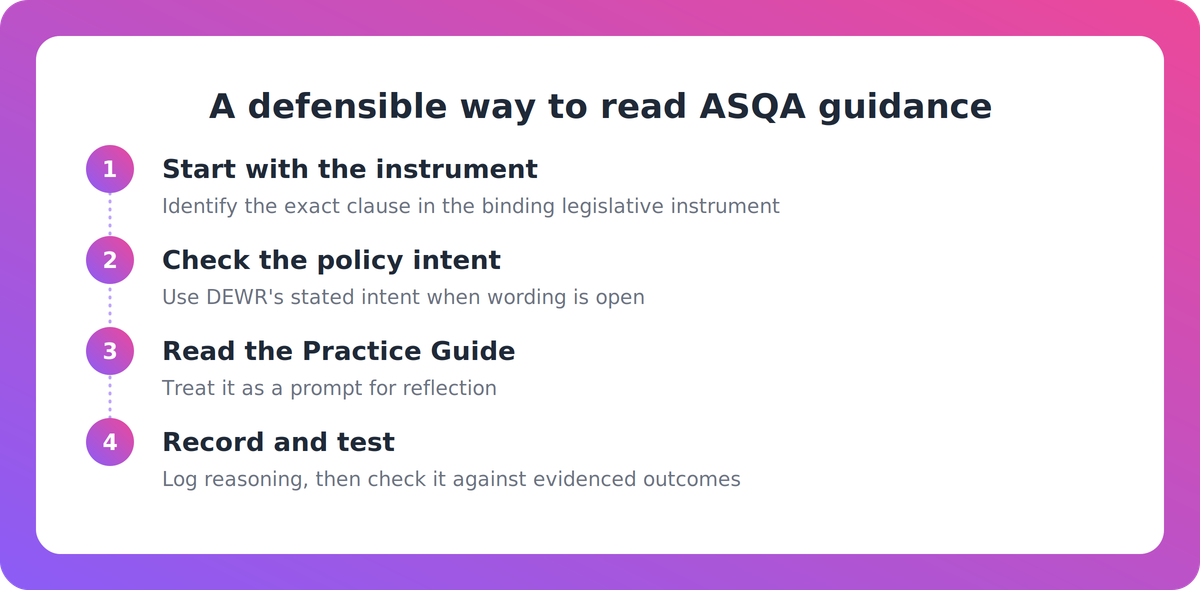
Write the interpretation down once
For each judgement call, keep a short record with these fields:
- The clause of the instrument you are interpreting
- The policy intent you relied on
- The Practice Guide or ASQA material you read
- Your decision, in a sentence or two
- Your reasoning, including readings you considered and rejected
- The evidence that shows the decision produces the intended outcome
- An owner and a review date
A one-page record is enough. The point is that someone else can follow your thinking without you in the room.
Test it against outcomes, not documents
The last test is the one that matters. If your reading of a standard is correct, what should be visible in learner results, assessment evidence and complaints data? If the answer is "a policy exists", the interpretation is weak. If the answer is "graduates can do the work and we can show it", it is strong.
Aim your hardest thinking at ASQA's risk priorities
You cannot document every judgement to the same depth, so prioritise. ASQA's 2026–27 risk priorities show where interpretive choices will be looked at hardest:
- Provider governance, market conduct and non-genuine operations
- Quality, sufficiency and fitness-for-purpose of training
- Integrity of qualifications and competency outcomes
- Transparency, accountability and assurance in complex and international delivery models
ASQA sets these through an annual environmental scan that consults key stakeholder groups.
The Corporate Plan adds context. ASQA notes an increased threat from fraudulent qualifications, often linked to 'cash for quals' schemes and the exploitation of RPL pathways. It is cancelling critically non-compliant providers and pursuing cancellation of qualifications issued without appropriate training or assessment. If you have interpretive discretion around RPL or competency decisions, those records deserve your best reasoning.
Use ASQA's interpretive support, and keep a record of it
ASQA runs a monthly ASQA IQ publication. It also ran a May 2026 webinar covering its revised regulatory approach, cost recovery from 1 July 2026, progress against the 2025 Standards and responsible AI use in VET delivery, plus 17 face-to-face workshops across Australia in March and April 2026.
Attending is useful. Writing down what you learned, who attended and what changed as a result is better. That note becomes part of the trail showing how you reached your reading.
What we could not verify
Some things are outside what this post can responsibly tell you. The research behind it did not confirm how the 2025 Standards treat training and assessment strategies specifically. It did not find an official 2026 Annual Declaration on Compliance date. It did not retrieve the detail of the revised Regulatory Assessment and Monitoring Approach or the cost recovery amounts.
Go to ASQA directly for all of these. Be wary of commercial commentary on how audits are "really" run in 2026 unless it points back to an ASQA source.
Key takeaways
- ASQA's final Practice Guides (17 June 2025) are not prescriptive, so the RTO owns the interpretation and must be able to justify it.
- Work in order of authority: the instrument, then policy intent, then the Practice Guide.
- Record each interpretation with its reasoning, evidence and review date, and test it against outcomes you can show.
- Prioritise depth by ASQA's 2026–27 risk priorities, especially competency integrity and RPL.
- Confirm specifics such as the Regulatory Assessment and Monitoring Approach and cost recovery directly with ASQA.
Our take
The search for the "right" reading of ASQA guidance is a trap. It makes every ambiguity feel like a personal risk, and it sends the same questions back to you again and again.
ASQA separates non-genuine operators from genuine providers who may fall short in capability. Those are different problems, and your paper trail is how you show which one you are. A visible, reasoned interpretation process will not make every call correct. It does show a regulator that decisions are deliberate, tied to the law and tested against results.
There is a practical dividend too. Once a decision is logged with its reasoning, your trainers and course coordinators can apply it without queuing for your review. You stop being the bottleneck and become the author of the precedent.
A first step for this week: pick the one interpretation you made in the last month that you would find hardest to explain to an auditor. Write the one-page record for it. Notice what you cannot support.
FAQ
Are ASQA's Practice Guides legally binding?
No. ASQA describes the final Practice Guides as not prescriptive. They help providers reflect on their operations for quality outcomes, continuous improvement and ongoing compliance. DEWR also says the policy documents do not impose legal obligations. ASQA-regulated RTOs are regulated against the Outcome Standards Instrument 2025 and the Compliance Standards/Fit and Proper Person Requirements Instrument 2025.
What should I anchor an interpretation to first?
The instrument itself, on the Federal Register of Legislation. Then use DEWR's policy intent for the Outcome Standards, which exists to support consistent understanding and application. Treat the Practice Guides as help in reflecting on how you meet the obligation, not as the obligation.
Which interpretations will ASQA look at hardest?
ASQA's 2026–27 risk priorities point to provider governance and market conduct, the quality and fitness-for-purpose of training, the integrity of qualifications and competency outcomes, and transparency in complex and international delivery models. RPL is a particular concern: ASQA's Corporate Plan notes the threat of fraudulent qualifications and the exploitation of RPL pathways.
Where do I get official clarification on changes I'm unsure about?
Go to ASQA directly. It publishes the monthly ASQA IQ and runs webinars and workshops. For the revised Regulatory Assessment and Monitoring Approach, cost recovery amounts and any Annual Declaration on Compliance date, check ASQA's own pages rather than relying on third-party summaries.