ASQA Non-Compliance Risk Indicators for Compliance Managers
14 October 2026 · 6 min read
ASQA already runs an early-warning model on your RTO. It weighs your history, your delivery approach and your past findings, then analyses risk against indicators, thresholds and trends. The most defensible move a compliance manager can make is to run that same logic internally, so you see the drift before the regulator does.
Why this lands on your desk
You are judged on whether anything surprises the RTO. ASQA's Cost Recovery Implementation Statement 2026-27 says it considers each provider's history, delivery approach and past assessment findings, and analyses risk against indicators guided by thresholds and trends. In practice, someone is already watching your signals. The only question is whether you are watching them first.
The rulebook has also moved under you. The Standards for RTOs 2025 came into effect on 1 July 2025 under the National Vocational Education and Training Regulator Act 2011. Providers must demonstrate compliance against the Standards in effect when a decision is made. If a performance assessment under the 2015 Standards runs past that date, you may need to submit extra evidence against the revised Standards.
Then there is the Corporate Plan 2026-27. It includes a KPI on providers demonstrating effective self-assurance through self-assessment and transparent reporting. Monitoring you can show is becoming part of what good looks like.
The annual scramble is the real risk indicator
Many RTOs treat self-assurance as an event. The Annual Declaration on Compliance window opens (in 2026 it ran from 3 to 31 March), or an audit notice lands, and the hunt begins through drives, inboxes and spreadsheets.
If you have to hunt for evidence, you already have a finding about traceability. ASQA's 2026-27 Regulatory Risk Priorities include delivery models whose complexity may limit transparency, accountability and traceability. Scattered evidence and unclear task ownership are exactly what that theme exposes.
So the shift is from reviewing compliance once a year to monitoring it continuously. That is a discipline, not a project.
Build your own indicators, thresholds and trends
You do not need a hundred metrics. You need a short list that is owned, traceable and reviewed on a schedule. Each one needs three things: a named owner, a threshold that triggers action, and a trend line so you can see direction rather than a single snapshot.
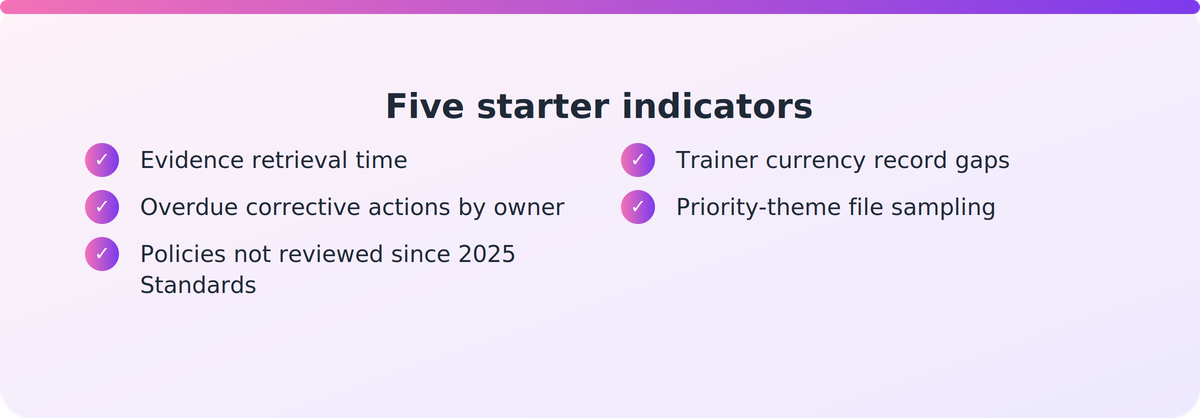
Five indicators worth owning
These are my suggestions, not ASQA's list. Adapt them to your scope and risk profile:
- Evidence retrieval: how long it takes to produce a complete evidence trail for a randomly chosen learner.
- Overdue actions: open corrective actions and continuous improvement items past their due date, by owner.
- Policy currency: documents not reviewed since the 2025 Standards took effect.
- Trainer and assessor currency records: records that are missing, ageing or unverified.
- Priority-theme sampling: a small, regular sample of files against the current ASQA risk priorities.
Note what these have in common. None needs a new framework. Each one tells you whether evidence exists, whether someone owns it, and whether it is getting better or worse.
Let ASQA's own materials set your agenda
ASQA's Practice Guides cover key concepts, example activities for compliance, risks to avoid and self-assurance questions. Those questions are a ready-made basis for internal check-ins. Turn them into a rotating monthly review rather than reading them once.
Track the sources that signal shifting interpretation: the Practice Guides, DEWR policy guidance and the ASQA IQ newsletters. Assign someone to read them, and record what changed and who acted.
Priorities also move. The 2026-27 risk priorities cover provider governance, market conduct and non-genuine operations; the quality, sufficiency and fitness-for-purpose of training delivery; the integrity of qualifications and competency outcomes; and delivery models that limit traceability. The previous year's themes included shortened course duration, student work placement, RPL and academic integrity. Expect your indicator list to change every year.
Where drift shows up first
On ASQA's webinar, an ASQA director said fundamentals such as the clauses, Compliance Requirements and Credential Policy should already be embedded in RTO practice. The new Outcome Standards, such as wellbeing and diversity and inclusion, will take longer for providers to become proficient in. That makes them natural places to watch for early drift.
Trainer currency is another plausible weak signal, with a caveat. Industry Skills Australia reports that digital change is raising the time and cost for trainers to maintain vocational currency. The Jobs and Skills Australia VET Workforce Study (October 2024) describes a workforce that is ageing and highly casualised. That is context for watching your currency records closely, not evidence that your RTO is non-compliant.
Key takeaways
- ASQA analyses each RTO's history, delivery approach and past findings against indicators, thresholds and trends. Mirror that logic internally.
- Evidence you cannot retrieve quickly is itself a traceability risk, which is an explicit 2026-27 priority theme.
- Use a short list of owned indicators, each with a threshold and a trend line.
- Turn ASQA's Practice Guide self-assurance questions into a regular internal review cycle.
- Expect risk priorities to shift annually, and watch the new Outcome Standards for early drift.
Our take
The compliance manager who becomes the bottleneck for every review is usually the one running compliance as a series of heroic rescues. We think the better position is to make the signals visible to the whole organisation, with owners attached, so you stop being the only early-warning system.
Self-assurance you can show is now part of the regulator's own definition of good. Start small and keep it honest. A five-indicator review that happens every month beats a perfect framework that appears every March.
This week, pick one indicator, name its owner, set a threshold, and check it again in thirty days. If the number surprises you, that is the system working.
FAQ
What are ASQA non-compliance risk indicators?
ASQA's Cost Recovery Implementation Statement 2026-27 says it analyses risk using indicators guided by thresholds and trends, alongside each provider's history, delivery approach and past assessment findings. ASQA does not publish a full list in the sources reviewed here, so build your own internal set around the Standards and current risk priorities.
How is internal early-warning monitoring different from self-assessment?
Self-assessment is often a periodic exercise. Early-warning monitoring is continuous: named owners, defined thresholds and trend lines, reviewed regularly. The aim is to catch drift between reviews rather than discover it at the Annual Declaration on Compliance or at audit.
Which Standards for RTOs 2025 areas should I watch most closely?
ASQA has said the fundamentals, such as the clauses, Compliance Requirements and Credential Policy, should already be embedded. The new Outcome Standards, including wellbeing and diversity and inclusion, will take longer to master, so they are natural areas to monitor for early drift.
Do the 2015 Standards still matter?
Potentially, yes. Providers must demonstrate compliance against the Standards in effect when a decision is made. If a performance assessment under the 2015 Standards continues past 1 July 2025, you may need to submit extra evidence against the revised Standards.