Assessment Consistency Across Trainers: A Head of Training Guide
6 August 2026 · 7 min read
Two trainers can look at the same portfolio of evidence and reach different calls — one signs it off, one sends it back for more work — and both can be acting entirely in good faith. That gap isn't a footnote about training quality. Under NZQA's national moderation principles, it's the exact thing your consent to assess depends on.
Why this sits on your desk, not NZQA's
NZQA sets the standard for consistency. Your team delivers it, or doesn't. Every provider holding consent to assess has to keep participating in national external moderation through the current reform period, supplying assessment materials and learner evidence that show judgements are fair, valid and consistent — not as a best-practice gesture, but as a stated compliance obligation under NZQA's guidelines for teaching and education organisations.
That obligation was written for a system that's now mid-restructure. Workforce Development Councils, which coordinated moderation and interpreted standards across industries, are being replaced by new Industry Skills Boards. Te Pūkenga has been disestablished in favour of ten reinstated regional polytechnics. None of that changes what NZQA expects of your trainers' judgement. It does change who's issuing the guidance your trainers calibrate against — and there's a real risk that teams anchored to older interpretations drift further apart while the new bodies bed in.
What "consistent" actually means under NZQA's rules
NZQA's national external moderation principles define assessment practice as fair, valid and consistent, and they're specific about what consistent means: assessor judgements should be "reliable and accurate across all learners, regardless of who does the assessing or when the assessment occurs." Read that carefully. It's not asking whether your best trainer marks well. It's asking whether your newest trainer and your most experienced one, looking at the same evidence six months apart, land in the same place.
That's a harder bar than most quality systems admit to reaching. It's also the bar national external moderation actually tests, because it samples across trainers and across time, not just across a single cohort's paperwork.
The reform layer: Industry Skills Boards and the 2026 DASS Rules
From 19 January 2026, the Directory of Assessment and Skill Standards Listing and Operational Rules — the DASS Rules 2026 — come into force. They update terminology for the reformed vocational system and remove the previous five-year maximum period for standard reviews. If you've built your moderation and review calendar around that five-year cycle, it's worth checking now whether the assumption still holds, rather than discovering it during a moderation visit.
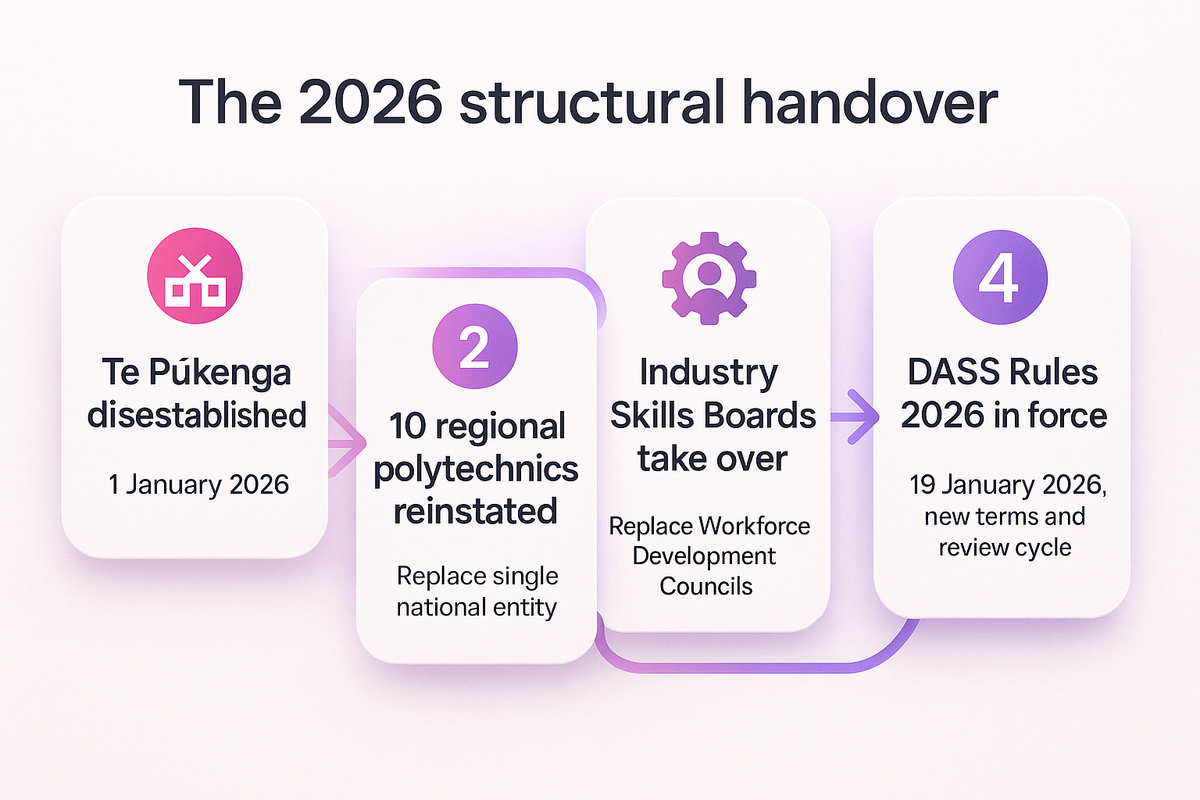
Combined with the shift from Workforce Development Councils to Industry Skills Boards for standard-setting and moderation coordination, this is a genuine structural handover, not a rebadge. Expect a period where guidance on how specific unit standards should be interpreted is less settled than usual — which is precisely when trainer judgement tends to drift, quietly, unit standard by unit standard.
Progress, not just completion: a sharper test of judgement
The Tertiary Education Strategy 2025–2030 raises the bar further. It argues that completion metrics alone can mask real progress made by disadvantaged learners, and proposes measuring progress from a learner's starting point as a fairer indicator of provider performance. The same strategy names uneven completion rates for Māori, Pacific and disabled learners as a persistent, system-wide problem.
That framing only works if your trainers are judging the starting point as reliably as the finishing point. If two trainers disagree about where a learner began, "progress" becomes just as unreliable a metric as completion ever was. Consistency of judgement isn't only a moderation compliance question anymore — it's becoming an equity measurement question too.
The workforce reality behind the paperwork
This is landing on trainer teams that are already stretched. Education Counts data shows overall tertiary enrolments fell 1.1% and domestic enrolments fell 3.5% in 2025, with trades academy participation also down. A smaller cohort sounds like relief, but it actually raises the stakes per learner: there's less scale to average out an inconsistent call.
Meanwhile, the NZCTU's 2025 and 2026 Mood of the Workforce surveys describe frontline sectors, education included, running on understaffing, long hours and burnout, with demand outpacing staffing. Calibration, cross-marking and moderation discussion are exactly the activities that get quietly dropped when trainers are covering timetables instead of comparing notes on judgement.
What calibration looks like when time is scarce
You don't need a big programme to protect this. You need a habit that survives a busy term.
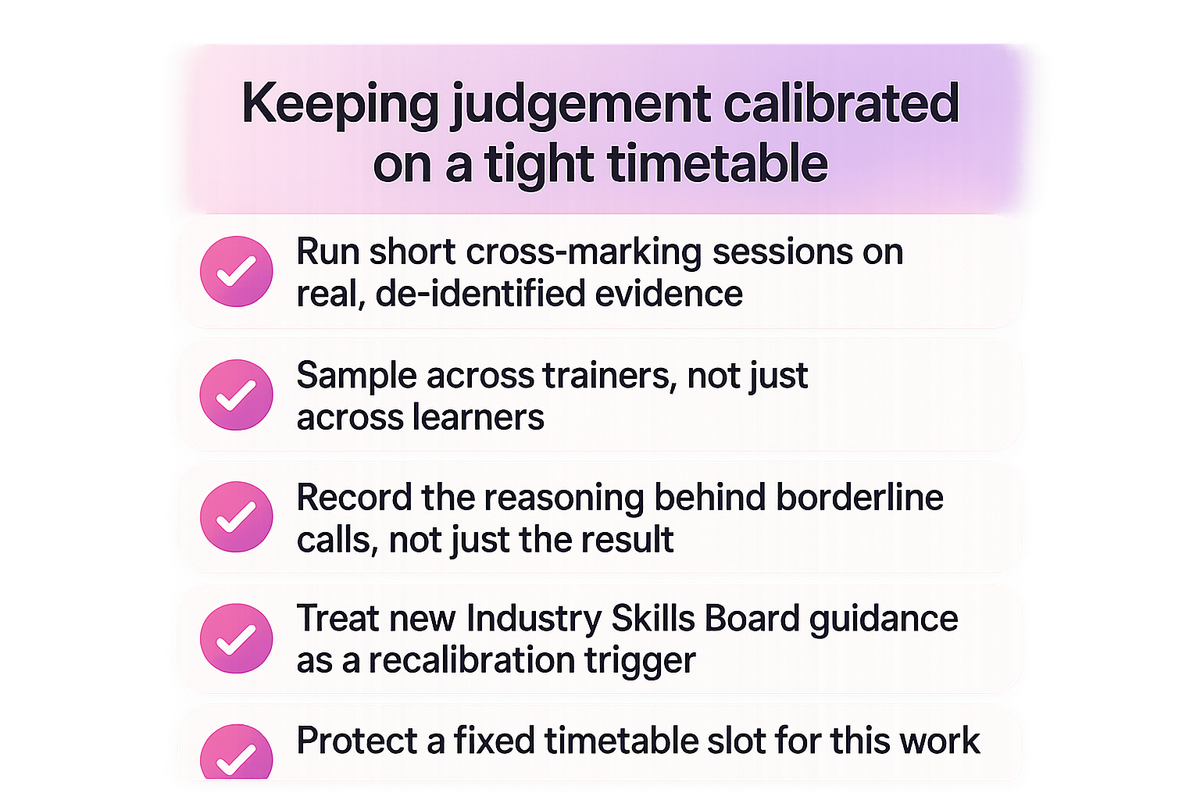
- Run short cross-marking sessions on real, de-identified evidence — not hypotheticals — every time a standard or qualification changes hands between reforms.
- Sample across trainers, not just across learners, when you review outcomes internally.
- Ask trainers to record the reasoning behind a borderline call, not just the result — the reasoning is what reveals drift.
- Treat any new Industry Skills Board guidance on a standard as a trigger for a recalibration conversation, not paperwork to file.
- Protect a fixed slot for this in the timetable, even a short one, rather than relying on goodwill after hours.
Key takeaways
- NZQA's national moderation principles define consistency as assessor judgements being reliable and accurate "across all learners, regardless of who does the assessing or when." That's the actual test national external moderation applies.
- The DASS Rules 2026, in force from 19 January 2026, remove the previous five-year maximum review period and update terminology — check your moderation calendar against this now.
- Industry Skills Boards are taking over standard-setting and moderation coordination from Workforce Development Councils, creating a transition window where trainer teams risk calibrating against outdated interpretations.
- The Tertiary Education Strategy 2025–2030's push toward measuring learner progress from a starting point, not just completion, depends on trainers judging that starting point consistently — extending the calibration problem beyond final sign-off.
- Workforce strain documented in the NZCTU's Mood of the Workforce surveys is a direct threat to the time needed for cross-marking and moderation discussion — protecting that time is now a quality decision, not an admin nicety.
Our take
Structural reform gives everyone a convenient excuse for a few years of inconsistency — new bodies, new terminology, unsettled guidance. It's a real risk, but it isn't a defence NZQA's moderation principles recognise. The obligation on providers with consent to assess hasn't moved an inch through any of this. What has moved is the number of things pulling trainer judgement in different directions at once.
The Heads of Training who come through this transition cleanly won't be the ones with the tidiest moderation folder the week before a visit. They'll be the ones who treated calibration as something trainers do together, routinely, whether or not anyone's watching. That's a harder habit to build than a checklist — and a much harder one for a regulator, or an Industry Skills Board, to find fault with.
FAQ
Does the move from Workforce Development Councils to Industry Skills Boards change what NZQA expects of my trainers' judgement? No. NZQA's national moderation principles — that assessment be fair, valid and consistent — are unchanged. What's changing is who coordinates standard-setting and moderation guidance across industries, which means trainer teams should expect a transition period before new interpretive guidance settles.
Do the DASS Rules 2026 affect our moderation and review timetable? Yes. The Directory of Assessment and Skill Standards Listing and Operational Rules come into force on 19 January 2026 and remove the previous five-year maximum period for reviews, alongside updated terminology for the reformed system. Any internal calendar built around the old five-year cycle is worth reviewing now.
Is assessment consistency across trainers actually something NZQA checks, or is it more of an internal quality concern? It's a compliance obligation. Any provider with consent to assess must participate in national external moderation and supply materials and evidence showing assessor judgements are fair, valid and consistent nationally — this is stated directly in NZQA's guidelines for teaching and education organisations.
How does the Tertiary Education Strategy's focus on learner progress change what we need from calibration? The 2025–2030 strategy proposes measuring progress from a learner's starting point, not just completion, partly because completion alone can mask progress made by disadvantaged learners. That only produces a fair measure if trainers judge starting points as consistently as they judge outcomes — extending calibration work earlier into the learner journey.