Assessment Consistency: A Head of Training's Reckoning
6 August 2026 · 7 min read
Under the Standards for RTOs 2025, two trainers marking the same unit of competency differently isn't just a training quality quirk anymore — it's a named, auditable failure. ASQA now defines reliable assessment as judgement that holds up regardless of which assessor makes it, and inconsistent marking across assessors sits on its published list of recognised audit findings.
That single shift changes what your job actually is this year.
Why this lands on your desk
You own the training and assessment strategy that validation is now testing continuously, not once a year. Under the 2025 Standards, self-assurance is the operating model — which means the gap between what your assessors are supposed to do and what they actually do is being examined constantly, not discovered in an annual scramble before a validation meeting.
You also carry the workforce problem that makes consistency hard to guarantee in the first place. Trainer shortages, burnout, and a heavier reliance on newer or casual assessors all push against the kind of shared judgement ASQA expects. And when marking drifts — particularly around learners who are borderline competent rather than clearly strong or clearly not ready — it shows up downstream as unreliable completion data and eroded learner trust, both of which you answer for.
Validation findings land on your desk either as evidence your system works or as a red flag. There's no neutral outcome anymore.
What "consistency" means under the 2025 Standards
The Standards for RTOs 2025 took effect on 1 July 2025, restructuring RTO obligations into Outcome Standards, Compliance Standards and a Credential Policy. ASQA has confirmed it will audit against these new Standards — not legacy practice — from 2026 onward, so the transition window is closing.
ASQA's Practice Guide on Assessment is explicit: assessment evidence must be interpreted consistently by assessors, and outcomes must be comparable irrespective of who conducts the assessment. That's the regulator's own working definition of reliability, and it's written into guidance you can point your assessors to directly.
More pointedly, ASQA names "inadequate systems to ensure consistency in assessment across assessors" as a recognised audit finding. This isn't a hidden risk you might get caught out by. It's a documented failure pattern regulators are actively looking for, which means the burden of proof sits with your training and assessment strategy, not with individual trainer goodwill.
Validation's new job: continuous, not annual
Validation used to mean a periodic spot-check of a handful of completed assessments. Under the current Standards, it functions more like a continuous, risk-based examination of the whole assessment system.
One of the core questions any validation activity now has to answer is straightforward: do different assessors, using the same tools and the same evidence, arrive at the same judgement? If your validation schedule can't answer that with real examples — not just a tick-box sign-off — it isn't doing the job the Standards require of it.
That means the fix has to sit upstream: in how assessment tools are written, how assessor guidance is structured, and how judgement is calibrated before assessors ever pick up a mapping tool — not just in what validation finds after the fact.
The real danger zone: borderline "adequate" judgement
The hardest part of consistency isn't the obvious cases. Research on assessor judgement — including an Australian physiotherapy education study — found assessors agreed strongly at the extremes, with 89–97% consensus on clearly "good" or clearly "not adequate" performance.
Agreement collapsed to 43% at the "adequate" or borderline level.
That borderline zone is exactly where most real-world competency decisions get made in vocational training — the learner who's mostly there but not quite, the trainee whose evidence is thin but plausible. It's also precisely where a stretched, tired, or less experienced assessor is most likely to default to a personal standard rather than a shared one.
Why your trainer workforce makes this harder
This isn't happening in a vacuum. The VET trainer workforce is ageing, industry is actively poaching skilled practitioners, and currency and credential demands keep rising — a workforce sustainability problem Jobs and Skills Australia has flagged as a national priority through its VET Workforce Blueprint work.
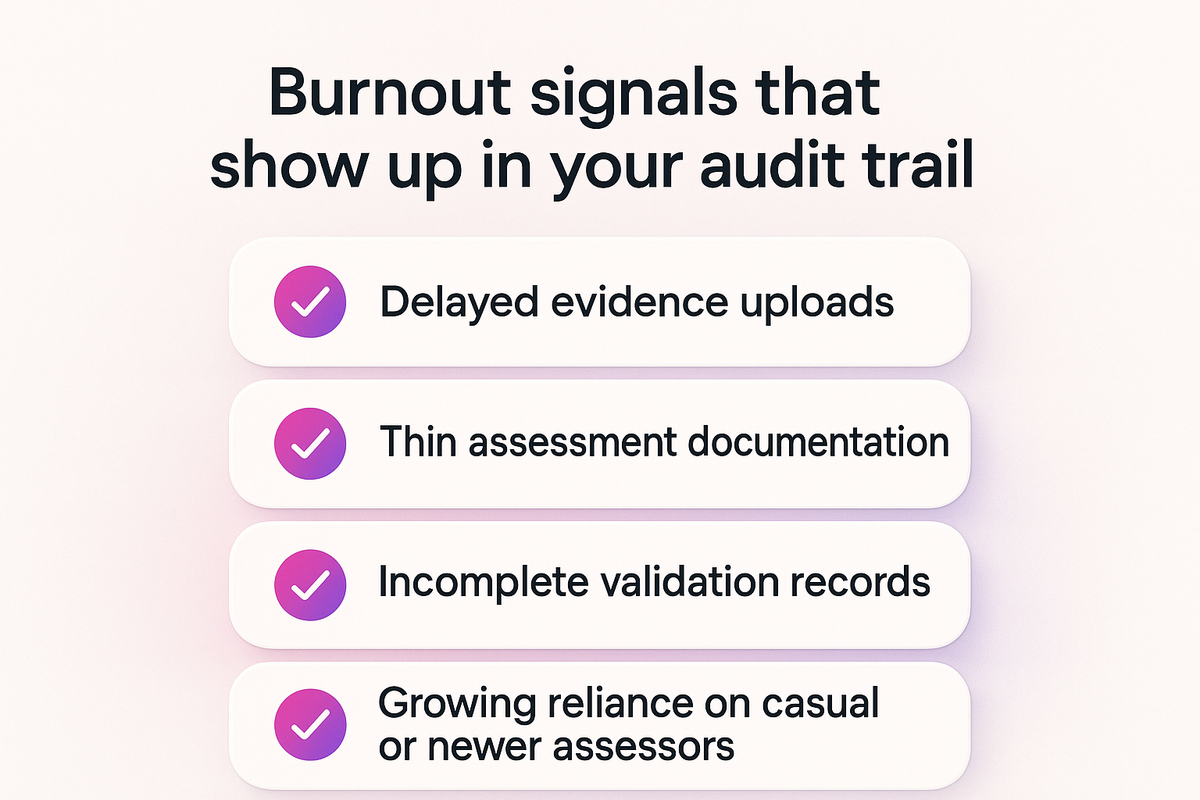
Burnout is now a recognised psychosocial hazard under Safe Work Australia obligations, and in an RTO context it rarely announces itself directly. It shows up as delayed evidence uploads, thin assessment documentation, and incomplete validation records — an operational trail that links trainer wellbeing straight to audit-readiness, whether you've named that connection formally or not.
The completion-rate backdrop
NCVER data for 2025 shows overall qualification completions fell 4.8%, driven largely by an 11.3% drop in fee-for-service completions, even as apprentice and trainee completion rates improved. Consistent, defensible assessment practice matters most exactly when completion pressure is rising and every borderline judgement carries more weight in your outcome data.
Key takeaways
- The Standards for RTOs 2025 make assessor consistency an explicit, auditable requirement — ASQA defines reliable assessment as judgement that holds regardless of which assessor makes it.
- ASQA names inadequate cross-assessor consistency systems as a recognised audit finding, not a theoretical risk.
- Validation has shifted from an annual spot-check to a continuous test of whether your assessment system produces comparable outcomes.
- Assessor agreement research shows consensus collapses around borderline "adequate" judgements — the zone where workload and burnout pressures bite hardest.
- Trainer shortages, burnout and rising currency demands compound the risk, and NCVER completion data shows the stakes are rising, not falling.
Our take
Most RTOs still treat consistency as something validation checks for, rather than something the assessment system is designed to produce. That's backwards under the current Standards. If your validation meetings keep surfacing the same drift — different interpretations of the same evidence requirements, different thresholds for "adequate" — the fix isn't a sharper validation checklist. It's tighter assessment tools, clearer assessor guidance mapped directly to the unit, and calibration conversations that happen before marking, not after. Treat every validation finding as a design signal about your tools, not a performance mark against your trainers.
FAQ
What does ASQA mean by "assessment consistency" under the Standards for RTOs 2025? ASQA's Practice Guide on Assessment defines it as assessment evidence being interpreted consistently by assessors, with outcomes that are comparable irrespective of which assessor conducts the assessment. It's the regulator's own working definition of assessment reliability.
Is inconsistent marking actually something ASQA audits for, or just a quality nicety? It's a named audit finding. ASQA explicitly lists "inadequate systems to ensure consistency in assessment across assessors" as a recognised failure pattern, meaning auditors are actively looking for evidence of it.
How has validation changed under the new Standards? Validation has moved from a periodic review of a sample of completed assessments to a continuous, risk-based examination of the whole assessment system, with a core question being whether different assessors using the same tools reach the same judgement.
Where should a Head of Training focus first to reduce assessor variability? Upstream of validation — in how assessment tools and assessor guidance are written and calibrated — rather than only inside validation meetings after marking has already happened. Research on assessor judgement shows the biggest gaps sit at the borderline "adequate" level, so calibration should target that zone specifically.