Same Unit, Different Marks: RTO Assessment Consistency
6 August 2026 · 7 min read

Every RTO has a validation schedule. Far fewer have evidence that validation findings ever changed what a trainer actually does in the room. That gap — between documenting consistency and producing it — is where ASQA is now looking, and it's the audit risk sitting quietly behind an otherwise clean self-assessment report.
Why This Lands on Your Desk
You own the trainers, the timetables, the training and assessment strategies, and the quality of what gets marked. When ASQA asks whether validation findings changed practice, it's your moderation process being tested, not a policy document. When the Credential Policy lets someone qualified to teach secondary school deliver VET training under supervision, or lets a new trainer work towards their credential for up to two years, it's your team that now spans a wider range of assessment experience than the org chart suggests. When the Training and Assessment Strategy is generic instead of built for the actual cohort in front of a trainer, it's your name on the document ASQA checks first.
And with government-funded VET enrolments falling to 1,137,645 in 2025 across most jurisdictions, completion and outcome data carries more weight than it used to, not less. Inconsistent marking isn't just a compliance exposure any more — it shows up directly in the progress and completion numbers you're judged on.
Validation Just Became a Closed Loop, Not a Checkbox
The Standards for RTOs 2025 took effect on 1 July 2025 and split the old single standard into Outcome Standards, Compliance Requirements, and a separate Credential Policy. Validation and moderation now sit under the Outcome Standards, which are explicitly about learner outcomes, not paperwork.
That shift matters more than it sounds. ASQA has flagged that many RTOs claim a 'risk-based' approach to validation sample size and scope without ever documenting the reasoning behind it — a gap auditors are specifically probing for in 2026. Worse, a common pattern ASQA has named is validation findings being filed away with no recorded follow-through: no updated assessment tools, no trainer professional development, no check that the fix actually worked.
The expectation now is a closed loop: a finding leads to a documented action, the action is delivered, and someone checks — with evidence, not assumption — that it changed the marking behaviour it was meant to fix. A validation report that stops at 'finding noted' is exactly what 2026 audits are built to catch.
Your Trainer Cohort Is More Varied Than Your Files Suggest
The Credential Policy's flexibility provisions were designed to ease trainer shortages, and they do. But they also widen the natural scope for inconsistent judgement on the same unit of competency. A trainer qualified through secondary teacher registration and delivering under supervision brings a different assessment lens to a unit than someone with years in the trade and a Certificate IV in Training and Assessment. Someone 'actively working towards' their credential — permitted for up to two years from commencement — is, by definition, still building the judgement your validation process is meant to standardise.
You're also managing this with less national visibility than you might assume. The most recent comprehensive workforce study, NCVER's 2019 data, found 29% of the VET workforce were trainers or assessors, and that most likely still held the superseded TAE40110 rather than the then-current Certificate IV. No equivalent national census has been run since. That's not a criticism of any individual trainer — it's a reminder that the credential mix inside your team is probably more varied, and less visible, than a quick look at staff files implies.
Your TAS Is Supposed to Prevent This — Often It Doesn't
The Training and Assessment Strategy is one of the first documents an ASQA auditor asks for, and it's meant to be a distinct document for each course and cohort, not a template recycled across intakes. In practice, ASQA repeatedly finds TAS documents too generic, too vague, or simply out of date — a recurring compliance risk that is directly tied to inconsistent delivery and assessment practice.
When the TAS doesn't specify how assessment is actually delivered — what evidence counts as sufficient, how benchmarking judgements are made, what a trainer does differently for a mixed cohort of apprentices and career-changers — trainers fill the gaps themselves. Two competent trainers, working from the same unit of competency and the same assessment tool, will still land on different marks if the strategy document that's supposed to anchor their judgement is silent on the specifics.
What Closing the Loop Actually Requires
None of this needs a new system to start fixing this quarter. It needs a change in what you record and check.
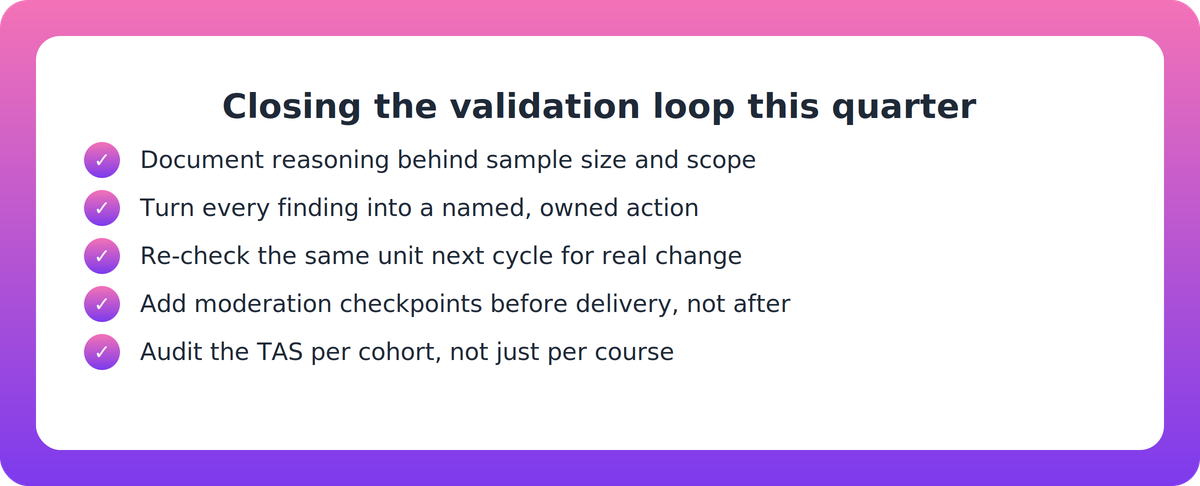
- Document the reasoning behind your validation sample size and scope, not just the schedule itself — auditors will ask why, not just what.
- Turn every validation finding into a named action: an updated tool, a specific piece of trainer PD, a change to marking guidance — with a date and an owner.
- Re-check the same unit at the next validation cycle to see whether the action actually changed marking outcomes, and record that check as evidence.
- Build moderation checkpoints before assessment is delivered, not only after results are in, particularly for units taught by trainers still working towards their credential.
- Audit your TAS per cohort, not per course, especially where trainer experience or credential status varies within the same qualification.
Key takeaways
- The Standards for RTOs 2025 moved validation from a documentation exercise to a closed-loop obligation: finding, action, and monitored impact, not just a completed schedule.
- ASQA has explicitly flagged undocumented reasoning behind risk-based validation sample size as a 2026 audit focus.
- Credential Policy flexibility — supervised delivery by secondary-registered teachers and up to two years 'actively working towards' a credential — genuinely widens the assessment experience gap within a single trainer team.
- No national VET workforce census has run since NCVER's 2019 study, meaning trainer capability visibility across the sector, and often within your own RTO, is thinner than assumed.
- A generic or stale Training and Assessment Strategy is a named, recurring ASQA compliance risk directly linked to inconsistent marking across trainers.
Our take
Most validation processes are built to survive an audit, not to change behaviour. That distinction used to be survivable. Under the Standards for RTOs 2025 it isn't, because ASQA is now asking for the evidence trail between finding and fix, not the finding alone.
The honest fix isn't more paperwork. It's smaller, more frequent checks on the same unit across different trainers, and an actual record of what changed when a gap was found. Some Heads of Training are starting to use AI-assisted coached practice and simulation tools to give newer or credential-in-progress trainers a consistent, low-stakes way to calibrate judgement before it touches real learner evidence — that's one option among several, not a substitute for the validation discipline above.
FAQ
Does the Standards for RTOs 2025 change how often we need to validate assessment? The Standards don't mandate a fixed frequency, but they move validation from a paperwork requirement to an outcome-focused obligation under the Outcome Standards. ASQA now expects evidence that findings led to real changes in trainer practice, not just a completed schedule.
Can a trainer 'actively working towards' their credential mark assessments independently? The Credential Policy allows staff up to two years from commencement to complete their credential while working, but this is designed to sit alongside supervision and support — it's a reason to build in more calibration checks for that trainer, not fewer.
What's the fastest way to check if our Training and Assessment Strategy is a compliance risk? Ask whether it's genuinely written for the current course and cohort, or recycled from a previous intake. ASQA's recurring finding is that TAS documents are too generic — if yours doesn't specify how assessment is actually delivered by your current trainer mix, it's exposed.
How do we show ASQA that validation findings actually changed practice? Record the specific action taken after each finding — an updated tool, named trainer PD, a revised marking guide — with a date and owner, then re-check the same unit at the next cycle and document whether marking outcomes actually shifted.