Assessment Delivery Modes for NZ PTEs: End the Rewrite
25 August 2026 · 6 min read

A single unit standard often has to work twice as hard: once for a classroom cohort building underpinning knowledge, and once for a workplace-based learner demonstrating the same competency on the job. When PTEs and ITPs draft one version and then manually adapt it for the other context, they're not improving the assessment — they're just paying the same NZQA requirement twice in staff time.
The Real Cost Isn't the First Draft
Writing the initial assessment against a unit standard is expected work. The part that quietly drains hours is what comes after: taking a conceptual, classroom-style assessment and turning it into something a workplace assessor can actually use on-site — or the reverse. Multiply that across a typical programme matrix and the problem compounds fast.
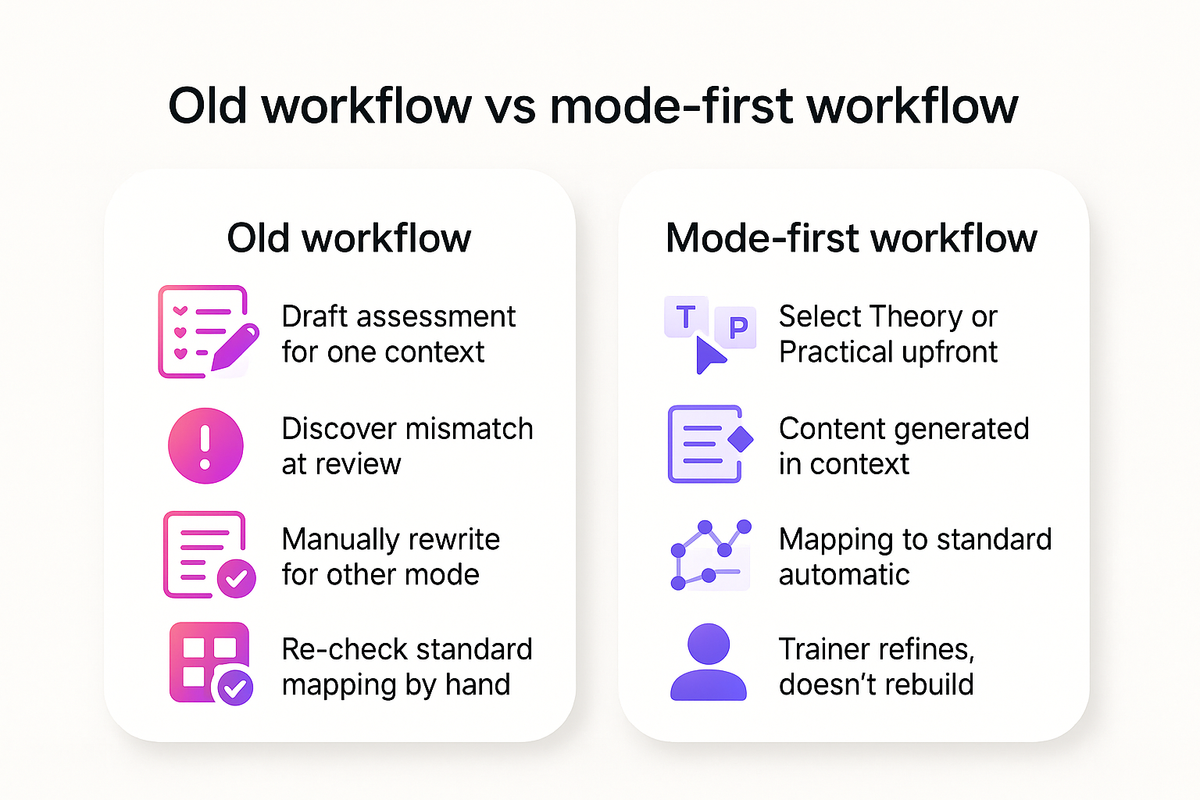
Consider what a mid-sized PTE or Wānanga is often managing:
- The same unit standard delivered to a classroom intake and a workplace-based cohort in the same quarter.
- Multiple employer contracts, each needing an assessment that fits their site and equipment.
- ESOL and LLN learners who need the same standard assessed in a way that matches their language and literacy level, not a simplified copy of the classroom version.
- Distance learners who need a self-directed format that still proves the same performance criteria.
Each of these is a legitimate, fit-for-purpose version of the same unit standard. Today, many providers get there by writing once and reworking repeatedly — and rework done under deadline pressure is exactly where assessments start to drift from what the standard actually requires. That drift is a moderation risk, not just a scheduling headache.
Why the Rewrite Happens After the Assessment Is Built
The underlying issue isn't skill or effort — it's timing. Most assessment design still generates content first and only discovers the theory-versus-practical mismatch once someone tries to use it in the wrong context. By then, the fix means going back into a finished document and rebuilding sections rather than starting from a version that was right for the delivery mode from the outset.
This is the specific problem VETos has built for: not the writing of the first assessment, but the structural decision about which version you're writing, made too late in the process to save any time.
How VETos Fixes the Timing Problem
VETos puts the Theory/Practical decision at the front of the workflow, not the back. Trainers and instructional designers select the intended mode directly inside the assessment-generation workflow — no separate setup, no extra steps bolted on afterwards. The assessment is then generated for that context from the outset, rather than produced generically and reworked once someone notices it doesn't fit.
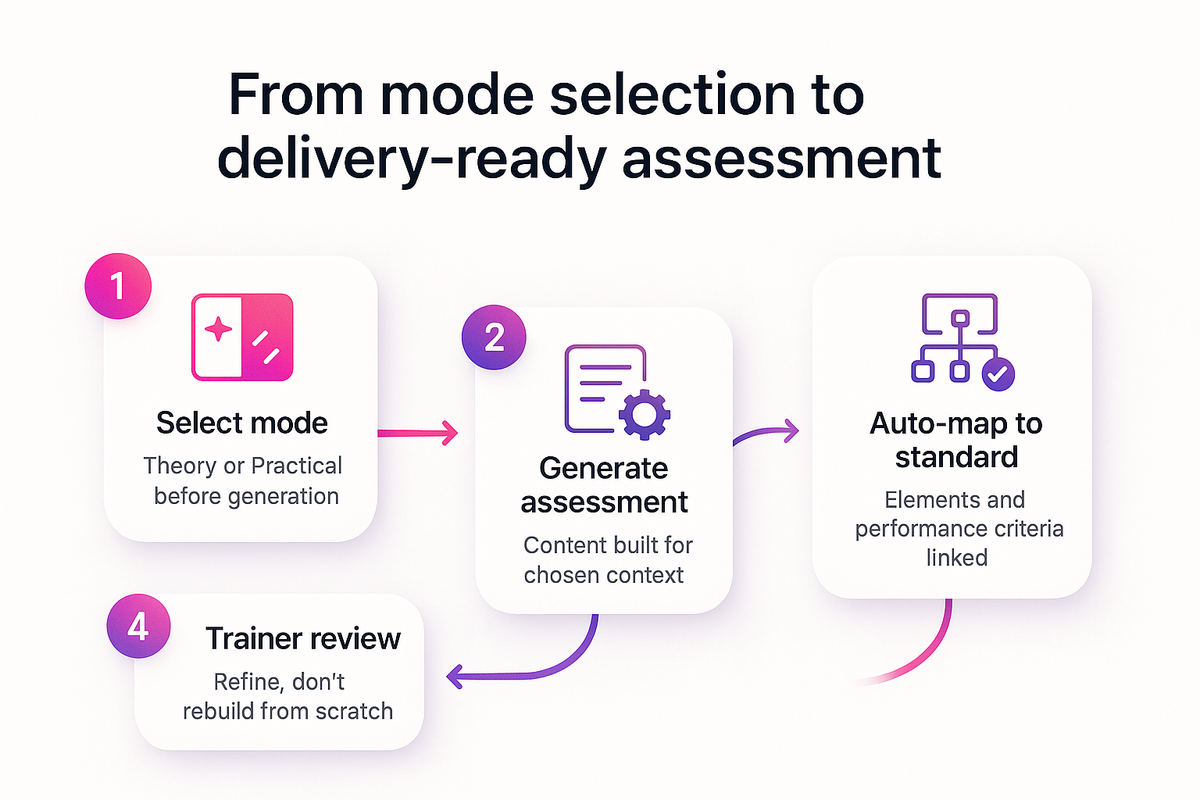
Underneath that selector sits VETos's mapping engine. Whichever mode is chosen, every generated assessment is automatically mapped back to the unit standard's elements and performance criteria. Switching between a classroom-style theory assessment and a workplace-ready practical one doesn't mean losing the audit trail back to what NZQA actually requires — the traceability holds regardless of which version you generate.
For a PTE running the same unit standard across a classroom intake, a workplace cohort and a distance-learning group, that means three fit-for-purpose assessments without three separate rebuild cycles.
Concrete Proof: What This Looks Like in Practice
This isn't a hypothetical efficiency gain. Mast Academy, a New Zealand PTE, used VETos to rebuild how it creates courses — work that previously took weeks now takes minutes, without compromising the quality learners and industry expect.
The mechanics behind that shift are specific, not vague:
- The mode selector sits inside the existing assessment-criteria workflow — trainers don't need a parallel process or additional software step.
- Mapping to elements and performance criteria happens automatically on generation, whichever package is uploaded or selected.
- Educators review and refine the output — they aren't starting from a blank page, and they aren't starting from the wrong context either.
That combination — mode chosen upfront, mapping maintained automatically — is what removes the rewrite cycle rather than just speeding up the first draft.
Key takeaways
- The expensive part of dual-context assessment isn't the first draft — it's reworking a classroom assessment for workplace use, or vice versa, for the same unit standard.
- That rework multiplies across cohorts, employer contracts, and learner groups including ESOL and LLN learners, and it's where quality can quietly drift from NZQA requirements.
- VETos addresses this by letting trainers choose Theory or Practical mode before content generation, not after.
- Automatic mapping back to the unit standard's elements and performance criteria is maintained in both modes, so switching context doesn't cost traceability.
- Mast Academy's course creation time dropped from weeks to minutes using this workflow, without lowering the bar on quality.
Our take
Most assessment tools have focused on speeding up the writing itself — better templates, faster drafting, tidier formatting. That's useful, but it treats the symptom. The real inefficiency in NZ vocational assessment design sits in the handoff between contexts: classroom to workplace, workplace to distance, standard version to ESOL-adapted version. Fixing that means changing when the delivery-mode decision gets made, not just how fast you can type once it's made. Providers managing several delivery contexts per unit standard should treat mode selection as a design decision worth making explicit and early, whichever tools they use to get there.
FAQ
Does choosing Theory or Practical mode change what NZQA requires for a unit standard? No. The unit standard's elements and performance criteria stay the same regardless of delivery mode. What changes is how the assessment is framed for the learner — conceptual and knowledge-based for classroom delivery, task-based and on-the-job for workplace delivery — while VETos keeps both versions mapped back to the same standard.
Can we still generate assessments for ESOL or LLN learners in either mode? Yes. VETos generates assessments in the context of the industry and the learner you're supporting, which includes ESOL, LLN, workplace, classroom and distance contexts, in either Theory or Practical mode.
Does switching modes affect moderation readiness? The mapping engine links every generated assessment back to the unit standard's elements and performance criteria automatically, in either mode, which is designed to support pre-moderation quality checks rather than create a second layer of manual mapping.
Do we need to set anything up before using the mode selector? No. It's embedded directly in the existing assessment-criteria workflow — there's no separate configuration step before you generate content.
Is this only useful for PTEs running multiple delivery contexts? It's most valuable there, but any provider — PTE, ITP or Wānanga — assessing the same unit standard for more than one learner context benefits from setting the delivery mode correctly at the start rather than fixing it after the fact.