Assessment Moderation Consistency: FE's Hidden Ofsted Risk
6 August 2026 · 7 min read

Ofsted's renewed framework doesn't care whether your IQA policy exists on paper. It cares whether two trainers marking the same portfolio would land on the same grade. For most colleges and independent training providers, they wouldn't — and that gap, more than any single weak trainer, is the likelier route to a disappointing report card.
Why this lands on your desk
Since 10 November 2025, Ofsted's renewed inspection framework has replaced single-word judgements with report cards graded across categories including curriculum and inclusion. Sector commentary on the changes is consistent on one point: inspectors are now testing whether evidence is lived rather than laminated. That's a polite way of saying they want to see whether assessment decisions actually hold up across your team, not just whether your sampling records look tidy.
That consistency sits with you, not with the IQA policy document sitting on a shared drive. You're also judged on the numbers that grading drift directly threatens. Inflated grades can mask learners quietly drifting toward the dropout figures the Department for Education tracks. Overly harsh or inconsistent grading, in the other direction, erodes completion. Either way, the achievement rate you answer for moves — and it moves because of a judgement gap, not a curriculum failure.
Two competent trainers, two different judgements
Sector commentary is blunt about why this happens: two competent assessors can genuinely interpret assessment criteria differently, particularly where performance evidence is holistic, contextual or drawn from workplace activity. That's not a training failure on either trainer's part. It's the nature of judgement-based assessment.
The risk sharpens when your team includes newer staff, which is a structural reality for most providers right now. Standardisation isn't something you establish once and maintain — for many teams it's something you're constantly rebuilding as experienced assessors move on and less experienced ones step in.
An IQA function stretched too thin to standardise
Internal quality assurance in FE has widened well beyond its original remit. IQAs are now expected to monitor compliance, coach assessors, sample decisions, maintain records and prepare evidence for external quality assurance activity — often within the same finite hours each week.
Ann Gravells' widely used IQA guidance is explicit that moderation should be continuous and proactive from the point a learner starts to the point they finish. "It should not just take place at the end of a programme, as this is bad practice." When IQA capacity is thin, that principle is the first thing to slip. Moderation becomes an end-of-programme compliance check rather than a running conversation about how judgement is being applied — and grading drift goes undetected until an EQA visit or inspection surfaces it.
The structural gap: colleges versus independent training providers
Colleges and independent training providers hit this problem from different angles. Colleges have to standardise across curriculum areas that may rarely talk to each other — a moderation gap that's organisational as much as individual. Independent training providers usually have one team under one roof, but they carry a workforce turnover problem colleges don't face at the same scale: 21% turnover reported for independent training providers, against 13% for colleges and 6% for adult community learning.
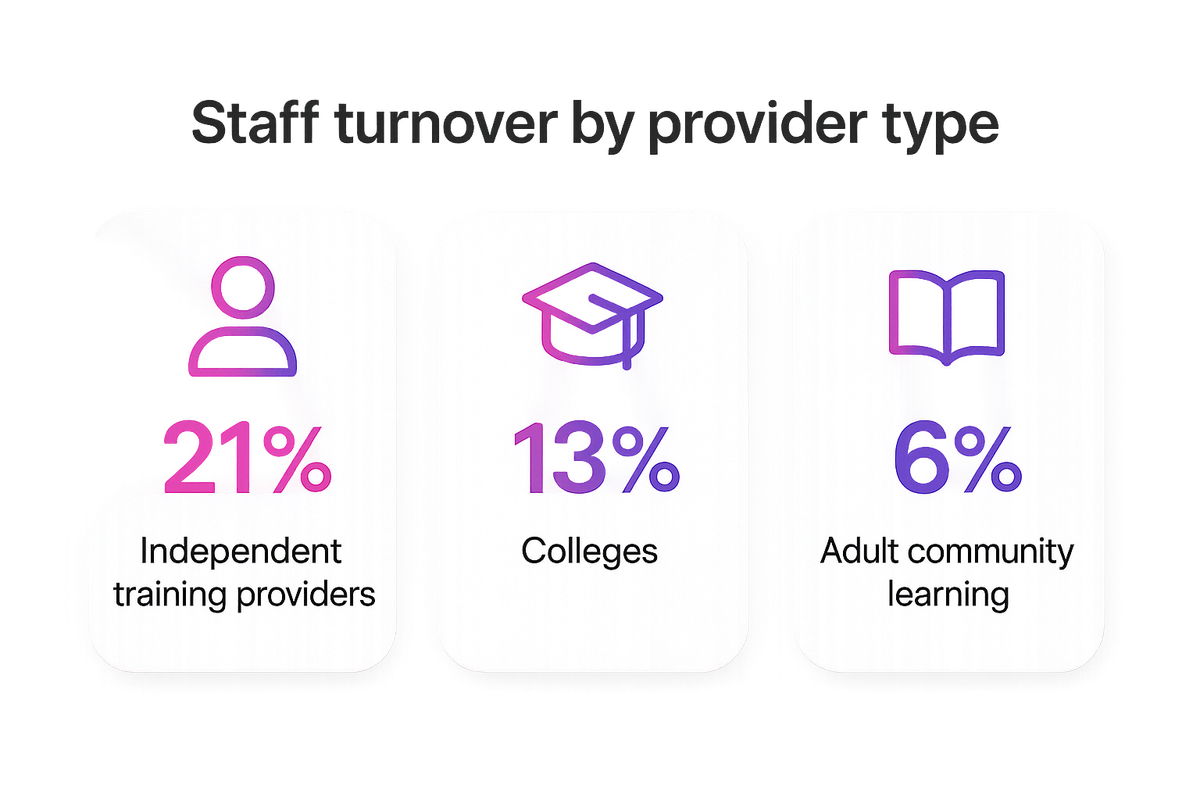
That means the standardisation conversation is being restarted more often, with less experienced assessors, in exactly the settings where a single misaligned judgement has the fewest checks around it.
What the renewed inspection framework is actually testing
Commentary on the November 2025 changes flags a specific risk: over-reliance on paperwork rather than lived evidence. Inspectors are expected to see that leaders have already identified and prioritised known issues — which means a Head of Training who can point to where grading judgement might be drifting, and what's being done about it, is in a stronger position than one relying on a sampling log that looks complete but hasn't been genuinely tested against practice.
The end-point assessment parallel
Apprenticeships already have a version of this problem baked into their design, and the sector's response to it is instructive. IfATE's move toward Ofqual- or OfS-regulated end-point assessment organisations was explicitly intended to promote consistency and comparability of EPA outcomes across different assessment bodies — because employers want assurance that a pass means the same thing regardless of who assessed it.
That's the exact same principle you need applied inside your own assessor team. If external EPA outcomes need engineered consistency across organisations, internal grading needs the same discipline across trainers.
The numbers behind the risk
National apprenticeship achievement rates reached 65.4% in 2024-25, just missing the government's 67% ambition. Dropout before completion has improved to 38.1% in 2023-24, but it remains a substantial share of starts. Against that backdrop, grading inconsistency isn't a paperwork risk — it's a direct lever on the two figures your provider is measured against.
Key takeaways
- Grading inconsistency between competent trainers, not individual weakness, is the more common threat to your next Ofsted report card.
- The renewed framework tests whether evidence is lived and consistent across trainers, not whether sampling records exist.
- IQA's widened remit — compliance monitoring, coaching, sampling, EQA prep — leaves less time for the continuous standardisation best-practice guidance calls for.
- Independent training providers face higher turnover (21% versus 13% for colleges and 6% for adult community learning), meaning standardisation is constantly being rebuilt rather than maintained.
- The EPA sector's move to regulated assessment organisations, designed to make a pass mean the same thing everywhere, is the same discipline your own assessor team needs internally.
Our take
Most providers treat moderation as an assurance exercise — a sample, a sign-off, a file for the EQA visit. Treated that way, it will always lag behind the thing it's meant to catch. The providers who hold up under the renewed framework are the ones running moderation as a live conversation about judgement: trainers periodically grading the same piece of work independently and talking through where they diverge, not just where they agree. That's slower to set up than a sampling spreadsheet. It's also the only version of moderation that actually finds the gap before an inspector does.
FAQ
Is grading inconsistency between trainers an Ofsted risk under the renewed framework? Yes. Sector commentary on the framework, live from 10 November 2025, warns that over-reliance on paperwork rather than lived evidence is a specific risk inspectors are alert to — and consistent grading judgement across trainers is part of what "lived" evidence means in practice.
How does IQA best-practice guidance say moderation should be run? Ann Gravells' guidance states IQA should be continuous and proactive from the start of a learner's programme to its end, not an end-of-programme check — "it should not just take place at the end of a programme, as this is bad practice."
Why do independent training providers face a sharper version of this problem? Independent training providers report around 21% staff turnover, against 13% for colleges and 6% for adult community learning, meaning standardisation practice is more often being rebuilt with newer assessors rather than established once and sustained.
What can a Head of Training realistically do given a stretched IQA function? Build short, regular moderation conversations into the delivery cycle — trainers independently grading the same sample of work and comparing judgements — rather than relying solely on end-of-programme sampling, which best-practice guidance already flags as the weaker approach.