Assessment Version Control for PTEs: Fix the Audit Trail
4 October 2026 · 6 min read
A moderator asks which version of an assessment learners actually sat, who approved it, and what changed. At many PTEs, the answer gets pieced together from file names, email threads and someone's memory. The version usually exists somewhere. The problem is showing it quickly, and in order.
Why is assessment version control such a problem for PTEs?
The gap rarely shows up on a quiet day. It shows up when a moderation request, an external evaluation and review (EER), or a consent-to-assess query lands and someone needs an answer by Friday.
Assessments get edited across their life. A unit gets reworded for a new cohort, a task is adjusted for ESOL learners, a quality lead asks for a fix. Each change is reasonable. Together they leave a trail nobody can read.
Then there's mapping. A standalone mapping document doesn't move when the assessment does. Months later, it describes a version that no longer exists. VETos makes this point on its assessment-mapping guide, which is written for the Australian sector. We use it here only as a principle: if mapping and content live apart, they drift apart.
What's making it harder in New Zealand right now?
Standards are shifting from unit standards to skill standards. That means materials are being revised, and the mapping and the record of what changed need to follow.
The VETos NZ buyer's guide says software should track NZQA's actual standards data, including the move to skill standards on DASS. A tool that can't do that leaves you rebuilding the trail by hand, just when you most need it.
The stakes are practical. Provider registration and consent to assess both depend on being able to show a sign-off trail that holds up.
What should a defensible content trail look like?
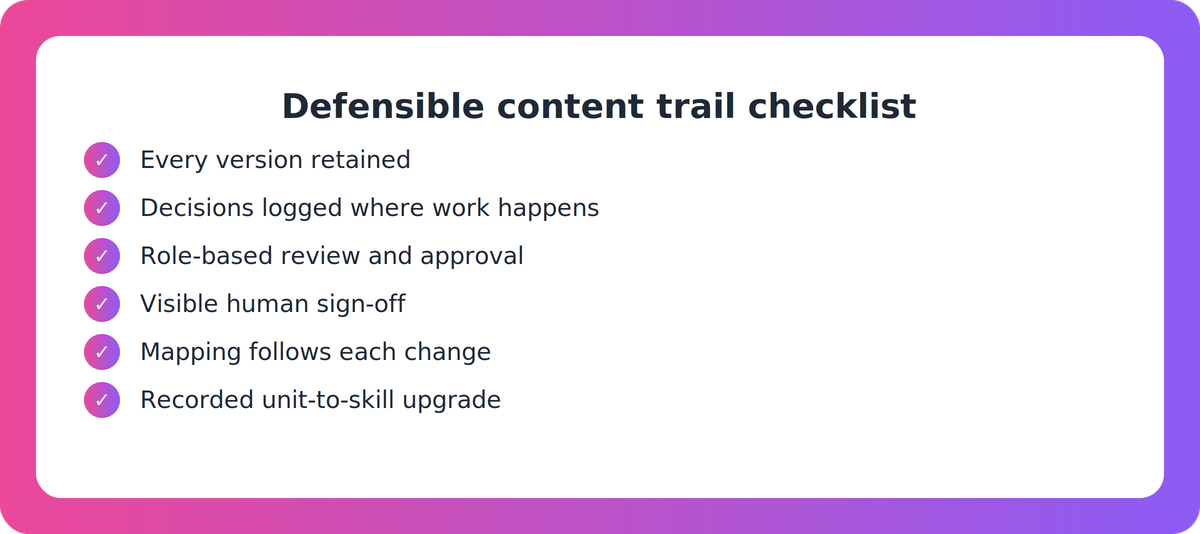
If you're weighing tools, test them against what a reviewer will actually ask. Here's a checklist you can take into any demo:
- Every version retained. Not just the latest. You should be able to open what learners sat in a given intake.
- Decisions logged where the work happens. If the approval lives in an email, it's not part of the record.
- Role-based review and approval. Authors, validators and quality leads should have defined steps, not a shared folder and goodwill.
- Human sign-off that's visible. A qualified person should review before anything goes near moderation, and that step should be on the record.
- Mapping that follows each change. When the assessment changes, the coverage evidence should change with it.
- A recorded path from unit standard to skill standard. The upgrade should be a traceable step, not an untracked rewrite.
One caution. Ask to see how a vendor shows this, not just whether they say it. The point of a trail is that someone else can follow it.
How does VETos handle the content trail?
VETos is built by SupaHuman, an Auckland-based company. Here's what the platform pages and FAQ state it does, specifically:
- Full version history on every artefact, with every version retained.
- Every decision logged, with the audit trail captured without extra clicks.
- Role-based review and approval flows between authors, validators and quality leads.
- Assign, review, approve and lock for resource developers, so approved content can be locked.
- Unit and skill standards held in its regulatory graph, so you can pull a standard into the workspace and build against it.
The NZ page frames the outcome as evidence that holds up. Version history, currency control and audit trails are built as you go, so EER, consent-to-assess obligations and moderation requests are answered from the record rather than reconstructed.
What happens when a unit standard is replaced?
This is the case that tends to hurt. According to the VETos FAQ, existing unit-standard materials can be upgraded to their skill-standard replacements, with the mapping regenerated and a version trail moderators can follow.
The upgrade becomes a recorded step. A moderator can see what the material was, what it became and that the mapping was regenerated alongside it. That's the difference between a documented change and a quiet rewrite.
VETos also supports assessment tools designed to hold up to NZQA moderation (standalone, clustered, grouped or integrated), with the mapping and assessor guidance moderators expect.
Where does the human fit?
The platform records and retains. A qualified person still validates and signs off. The trail supports professional judgement and doesn't replace it.
That's also what makes it credible to a reviewer. A log of decisions only means something if the decisions were made by people with the authority to make them.
A note on scope: the platform material lists walkthroughs for an Assessment Design Rationale Report and Audit Events in the VET workspace, but doesn't describe screen-level detail. Ask for a live look at both when you evaluate. The 80% faster content development figure from the Mast Academy case study on the NZ page relates to development speed only. It isn't evidence about audit trails.
Key takeaways
- The version control problem is usually not a missing file. It's the inability to show, in order, what was used, who approved it and why it changed.
- Mapping that sits outside the assessment drifts as soon as the assessment is edited.
- The move from unit standards to skill standards makes a recorded upgrade path a practical need, not a nice-to-have.
- Test any tool on retained versions, logged decisions, role-based approval, visible human sign-off and mapping that follows changes.
- VETos states it provides these capabilities, with a qualified person still validating and signing off.
Our take
Most PTEs don't have a compliance problem. They have a memory problem dressed up as one. The work was done properly; it just can't be shown on demand.
We think the audit trail should be a by-product of doing the work, not a separate admin job after it. If keeping the record takes extra effort, it will be skipped in exactly the busy weeks when you need it. And no tool should claim to replace the person signing off. A good trail makes that person's judgement easier to prove.
FAQ
What does a moderator or EER panel typically want to see about an assessment?
In practice, they want to know which version learners sat, who reviewed and approved it, and what changed over time. A defensible trail answers all three from the record, in order, without anyone reconstructing it from emails.
Why does mapping drift away from the assessment?
When mapping lives in a separate document, edits to the assessment don't automatically update it. Months later it can describe a version that no longer exists. Mapping that is regenerated and versioned alongside the assessment avoids this.
How should PTEs handle the move from unit standards to skill standards?
Treat it as a recorded step. Upgrade the existing materials, regenerate the mapping to the new standard and keep a version trail showing what changed. VETos states it supports this, with a trail moderators can follow.
Does an audit trail replace human sign-off?
No. The platform records and retains versions and decisions. A qualified person still validates and signs off before material goes to moderation. The trail evidences that judgement.
What should I ask a vendor about version control in a demo?
Ask to see every retained version of one assessment, the logged approval for a change, how roles are separated between author and validator, how content is locked after approval, and how mapping updates when a task changes.
If you're comparing tools, ask for a walkthrough built around a real moderation question: which version, who approved it, what changed. You can see how VETos approaches it at supahuman.com.