Assessor Currency and NZQA: Staying True to Industry
1 October 2026 · 7 min read
In New Zealand, assessor currency under NZQA is a programme-level duty, not an hours-logged rule for individual assessors. As skill standards replace unit standards and Industry Skills Boards take over standards ownership, keeping assessment content true to real industry practice depends on assessor judgement and disciplined version control.
A caveat first. We found little NZ material that speaks directly to assessor currency in the last 90 days, and some publication dates are approximate. What follows is analysis built on NZQA rules, Ministry of Education material and Industry Skills Board (ISB) guidance, not a report of a new currency requirement.
Where does NZQA actually put the currency obligation?
On the programme, not on the individual. Under NZQA's Programme Approval, Recognition and Accreditation Rules 2026, the institution assesses the currency and content of its programme. Assessment must be fair, valid, consistent and appropriate. There must also be an effective system for moderating assessment materials and decisions.
In practice, currency is spread across three mechanisms:
- Programme review: does the content still reflect what the industry does?
- Moderation: do assessment materials and decisions hold up to scrutiny?
- Consent to assess: are you approved to assess against the specific standard?
No single rule says an assessor must log a set number of industry hours. The system trusts providers to build currency into how they run programmes.
Cross-market comparison: Australia's 2025 standards do the opposite. They make demonstrated current industry competence a core requirement for individual trainers and assessors. We found no direct NZ equivalent, so NZ providers shouldn't borrow that framing.
Why do skill standards raise the stakes?
Because they ask more of assessor judgement. NZQA's listing guidelines say skill standards will generally replace several unit standards and carry larger credit values. They group related skills into broader outcomes with less prescriptive detail.
When criteria were tightly specified, an assessment could lean on the wording. With broader outcomes, an assessor has to decide what competent performance looks like in a real workplace today. If that picture is out of date, the assessment is out of date, even when it maps neatly to the standard.
What's changing in who owns the standards?
Legislation passed in October 2025 disestablished Te Pūkenga. From 1 January 2026, regional polytechnics and Industry Skills Boards were established. The Ministry of Education notes that former work-based learning divisions are temporarily operating as divisions of the ISBs.
So standards ownership and moderation arrangements are still settling. Providers are working against a moving target, which is why housekeeping matters more than it used to.
What does a standard change look like in practice?
Toitū te Waiora's First Aid standards are a concrete example. Unit standards 6400–6402 expire on 31 December 2027, and the replacements arrive as skill standards. Providers face a defined re-mapping window.
The process, as Toitū te Waiora describes it:
- Providers with consent to assess the old standards are automatically granted consent for the replacements.
- Before using the new standards, they must submit pre-assessment moderation to the ISB.
- Content and assessments must then be re-mapped to the new outcomes.
NZQA's January 2026 unit standard change report adds a wrinkle. It shows guidance information being updated to match industry requirements, with review dates extended to 31 December 2027. Guidance moves, and your materials need to move with it.
NZQA also expects standard-setting bodies to set two-year transition periods for superseded unit standards. That's a useful planning anchor.
Don't jump early
Food and Fibre ISB advises that where a qualification or micro-credential is updated to include skill standards, providers may need to review programmes, course content and assessment arrangements. Until you're advised of a change, keep delivering against your currently approved programmes. Currency doesn't mean racing ahead of approvals.
Which content is quietly going stale?
The Qualification and Micro-credential Listing and Operational Rules 2026 added a process for expiring status and qualification expiry. One example is a qualification that hasn't been awarded for five consecutive years. Content tied to a qualification heading for expiry is a currency risk, because nobody is reviewing it with the same energy.
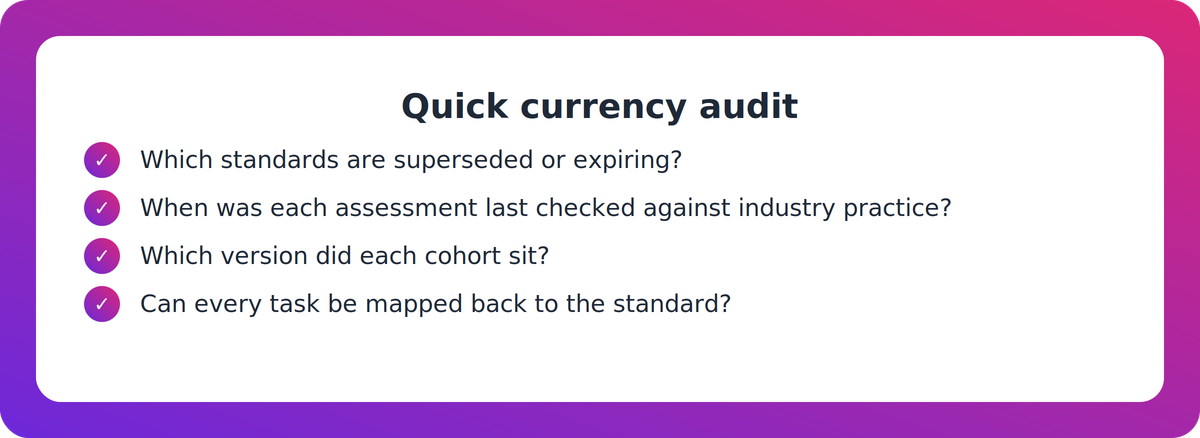
A quick audit helps:
- Which standards do we assess against, and which are superseded or expiring?
- When was each assessment last checked against current industry practice?
- Which version did each cohort actually sit?
- Can we show the mapping from every task back to the standard?
Where can software help, and where can't it?
Software is good at the record-keeping side of currency: versions, mapping, audit trails, and a clear answer to "which version did this learner sit?". When a transition window opens, that saves real time. It's the kind of problem we think about at Supahuman.
It can't tell you how a job is done on site this year. That comes from assessors who stay connected to industry, through employers, workplace visits, industry advisers and moderation conversations. Tools can free up the hours for that work. They can't replace it.
Key takeaways
- NZ places currency obligations on the programme (review, moderation, consent to assess), not on individual assessor hours.
- Skill standards are broader and less prescriptive, so assessor judgement of real industry practice carries more weight.
- Te Pūkenga's disestablishment and the new ISBs from 1 January 2026 mean standards ownership and moderation are still settling.
- Transition windows, such as First Aid unit standards 6400–6402 expiring on 31 December 2027, make version control and re-mapping a practical priority.
- Software can track content currency. Knowing how industry actually works stays a human job.
Our take
The lack of an NZ hours rule isn't a loophole. It's a bet that providers will build currency into their programmes. With skill standards, that bet gets bigger, because the standard no longer spells out as much and the assessor has to fill the gap. We think the providers who do well will treat currency as a visible, documented routine, with industry input logged, versions controlled and mapping kept current, rather than something they assume their people have.
What would your last moderation conversation have looked like if someone had asked how you know this assessment still reflects the job?
FAQ
Does NZQA require assessors to log industry hours to stay current?
The research found no NZ rule equivalent to an individual hours requirement. Currency sits at programme level. Under NZQA's Programme Approval, Recognition and Accreditation Rules 2026, the institution assesses the currency and content of the programme, and must have an effective system for moderating assessment materials and decisions.
How do skill standards change what assessors need to do?
Skill standards group related skills into broader outcomes with less prescriptive detail. NZQA's guidelines say they will generally replace several unit standards and carry larger credit values. Assessors therefore judge competence against outcomes, which puts more weight on understanding current industry practice.
What happens to consent to assess when unit standards are replaced?
Using the First Aid standards as the example, Toitū te Waiora says providers with consent to assess the old standards are automatically granted consent for the replacements. They must still submit pre-assessment moderation to the ISB before using the new standards.
Should we update our programmes as soon as a skill standard is released?
Not necessarily. Food and Fibre ISB advises that providers should keep delivering against currently approved programmes until they are advised of a change. Where a qualification or micro-credential is updated to include skill standards, programmes, content and assessment arrangements may need review.