Assessor Guide Generation NZ: The Step Teams Skip
3 August 2026 · 6 min read

Building the assessment is only ever half the compliance job at a PTE or ITO. Once it's approved, someone still has to write the assessor guide — the rubric-style document that tells an assessor exactly how to judge evidence against the unit standard. For most NZ providers, that step is still manual, done unit standard by unit standard, long after the actual assessment content is finished.
The guide-writing gap in your workflow
Ask any programme manager where the hours actually go and assessment writing usually isn't the answer. It's what happens after: turning marking criteria into a usable guide, formatting it, checking it maps cleanly to the unit standard, then doing it again for the next one.
This matters because assessor guides aren't optional paperwork. NZQA-registered providers need them to show assessors are applying consistent, standards-based judgement — not personal interpretation. Skip the guide, or let it drift from the current unit standard, and you've got a moderation problem waiting to surface.
The practical cost shows up in a few familiar ways:
- SMEs and assessment writers finish the assessment, then start an almost identical second task from scratch.
- Guides get built in whatever format is fastest that week — Word, Excel, someone's personal template — instead of a consistent house style.
- New qualifications take longer to get to market because the guide-writing queue sits behind the assessment-writing queue.
- Version drift creeps in: the guide references an earlier version of the unit standard because nobody flagged the update.
None of this is a training or effort problem. It's a workflow problem — the guide has been treated as a separate task instead of part of the same authoring step as the assessment.
How VETos generates assessor guides alongside the assessment
VETos' Authoring Engine treats the assessor guide as a defined output of the same content run that produces the assessment — not a follow-on task. When an assessment is generated, structured marking and rubric-style guidance is generated with it, drawing on the same unit standard, the same industry context, and the same learner profile (workplace, classroom, distance, ESOL or LLN).
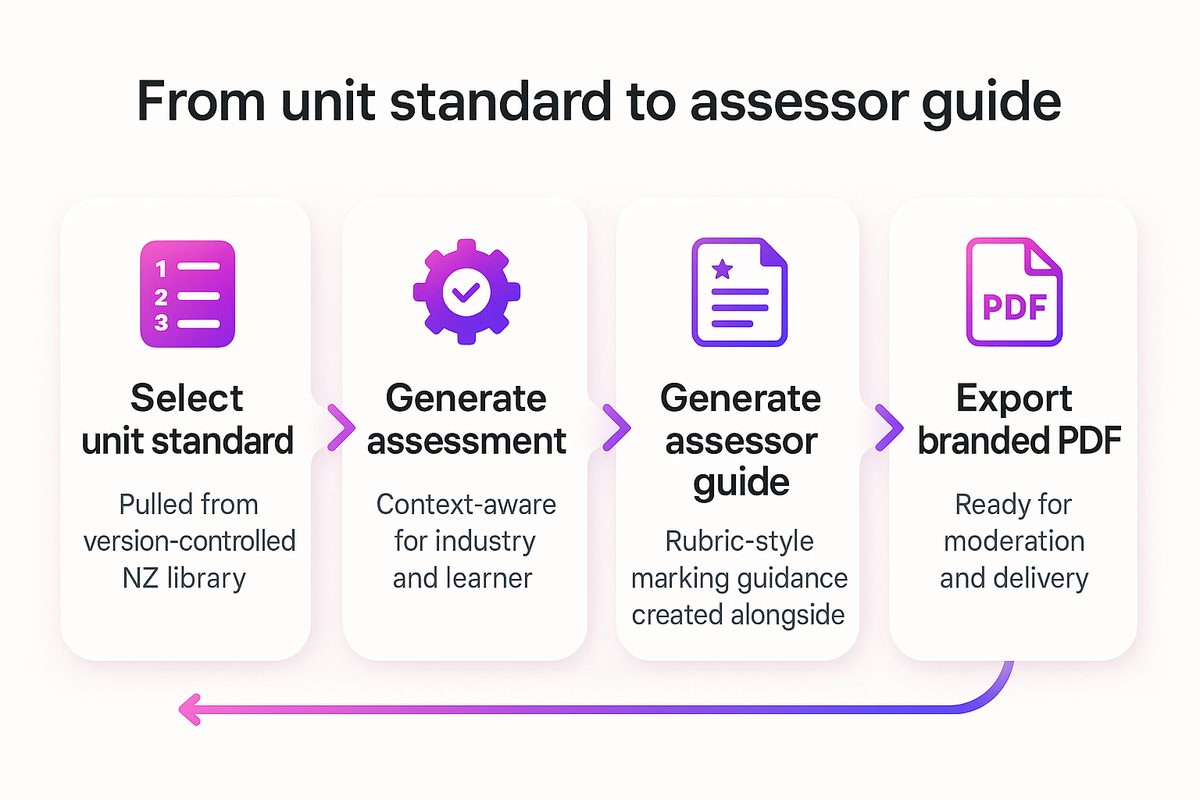
That guide comes out as a branded, formatted PDF, sitting alongside the validation report and student materials from the same run. There's no separate formatting exercise, no reformatting someone else's rubric into your house style — it's ready to hand to an assessor or drop into a moderation pack.
Underneath this sits a centralised NZ unit standard library with version control and full audit history. That's the detail that stops guides going stale: content is generated against the current version of the standard, not a local copy someone downloaded eighteen months ago. VETos' Solutions material confirms this same foundation — approved templates and unit standards — is what lets it rapidly draft NZQA-aligned study guides and assessment tools in the first place.
From unit standard to assessor guide
Proof: what this compression looks like in practice
This isn't a theoretical efficiency gain. Mast Academy, a New Zealand PTE, rebuilt its course creation process with VETos and went from six weeks to six minutes for work that used to involve multiple contributors and several drafting rounds.
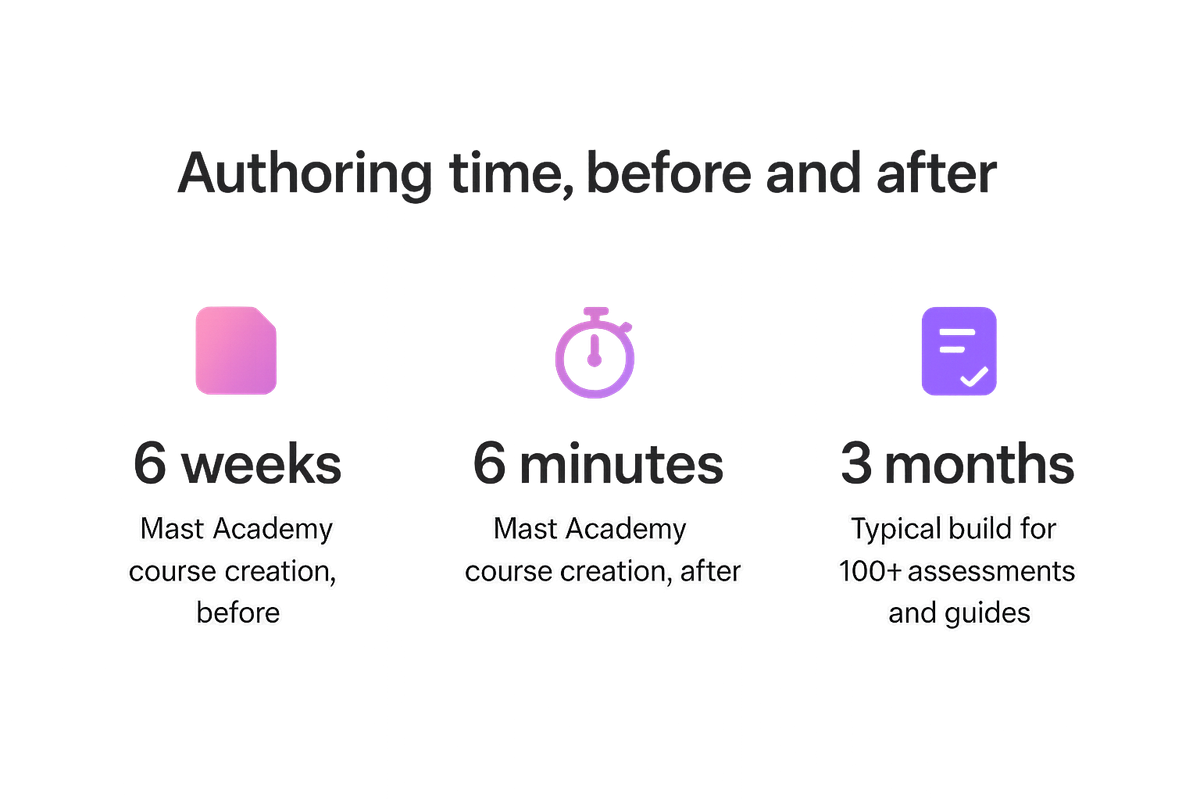
A separate regional NZ provider building a new Level 6 programme needed more than 100 new assessments and learning guides — normally a three-month effort spread across several people. Using AI-supported drafting for the standards-aligned content, they moved through that build without the usual three-month bottleneck.
Neither example is about replacing the assessor's judgement or a moderator's sign-off. It's about removing the repetitive drafting step that sits before either of those things can happen.
Key takeaways
- Assessor guides are a compliance necessity, not optional documentation — NZQA-registered PTEs and ITOs need rubric-style guidance that shows consistent judgement against the unit standard.
- Most providers still write guides by hand after the assessment is finished, duplicating effort and slowing programme launches.
- VETos generates the assessor guide as part of the same authoring step as the assessment, using structured marking and rubric-style guidance tied to the unit standard.
- Guides ship as branded PDF output alongside validation reports and student materials — no separate formatting task.
- A centralised, version-controlled NZ unit standard library keeps guide content tied to the current standard, with full audit history behind it.
Our take
The assessor guide has always been treated as the boring bit — necessary, repetitive, easy to shortcut when time is tight. That's exactly why it's worth automating first, not last. The judgement calls in moderation and assessment still need a human. Turning a rubric into a formatted document that matches the current unit standard doesn't. For NZ providers weighing up AI tools in this space, the real test isn't whether it writes an assessment — it's whether it finishes the job the assessment started.
FAQ
What is an assessor guide, and why does NZQA expect one?
An assessor guide sets out how to judge learner evidence against a specific unit standard — marking criteria, rubric-style guidance, and the standard the evidence needs to meet. NZQA-registered PTEs and ITOs need it to show assessment decisions are consistent and standards-based, not left to individual interpretation.
How does VETos generate assessor guides?
VETos' Authoring Engine produces the assessor guide as part of the same content run as the assessment itself, generating structured marking and rubric-style guidance and delivering it as a branded PDF alongside the validation report and student materials.
Will the guide stay current if the unit standard changes?
Guides are generated against a centralised NZ unit standard library with version control and full audit history, so content is tied to the current version of the standard rather than a stale local copy someone saved earlier.
Does this work across different delivery modes, like workplace or ESOL learners?
Yes — VETos generates content in the context of the industry and the learner profile involved, including workplace, classroom, distance, ESOL and LLN contexts, so the guide reflects how that learner will actually be assessed.
Does this replace moderation or assessor judgement?
No. The guide gives assessors a consistent, standards-aligned starting point for marking. Moderation and the assessor's own judgement on evidence still happen the same way — this removes the manual drafting step beforehand, not the human decision.
If your team is still writing assessor guides by hand after the assessment is done, it's worth taking a closer look at how this authoring step could sit inside your existing workflow rather than after it.