Audit-Ready Further Education Can't Be a Yearly Project
30 July 2026 · 8 min read

Audit-readiness used to mean surviving one week a year — the week the inspector turned up. That worked when standards held still between visits. This cycle they haven't: Ofsted has retired single-word judgements, IfATE has closed, ESFA's functions have moved into the DfE, and funding rules have been reissued twice already. A spring review can be wrong by autumn.
Why this lands on your desk
You own audit-ready status year-round, not just in the run-up to a visit. This year the goalposts have moved several times over — Ofsted's framework, the funding rules, the apprenticeship standards themselves — which makes a once-a-year review obsolete by design, not by neglect.
You're accountable for keeping policies, training and assessment strategies (TAS) and supporting evidence current against standards that are, in places, dual-running: older apprenticeship standards operating alongside reformed ones, under a regulator — Skills England — that is itself still building out its guidance.
You're judged on inspection outcomes and funding-assurance findings, and the Department for Education's own published assurance work keeps landing on the same failure point: off-the-job training evidence. That's a gap that only surfaces when evidence is scattered across drives, inboxes and spreadsheets rather than reconciled continuously.
You are, in practice, the provider's early-warning system for non-compliance risk. Ofsted's own move away from paperwork-heavy deep dives, toward evidence that reflects live practice, removes the safety net of a binder assembled the week before a visit.
The reference points themselves have moved
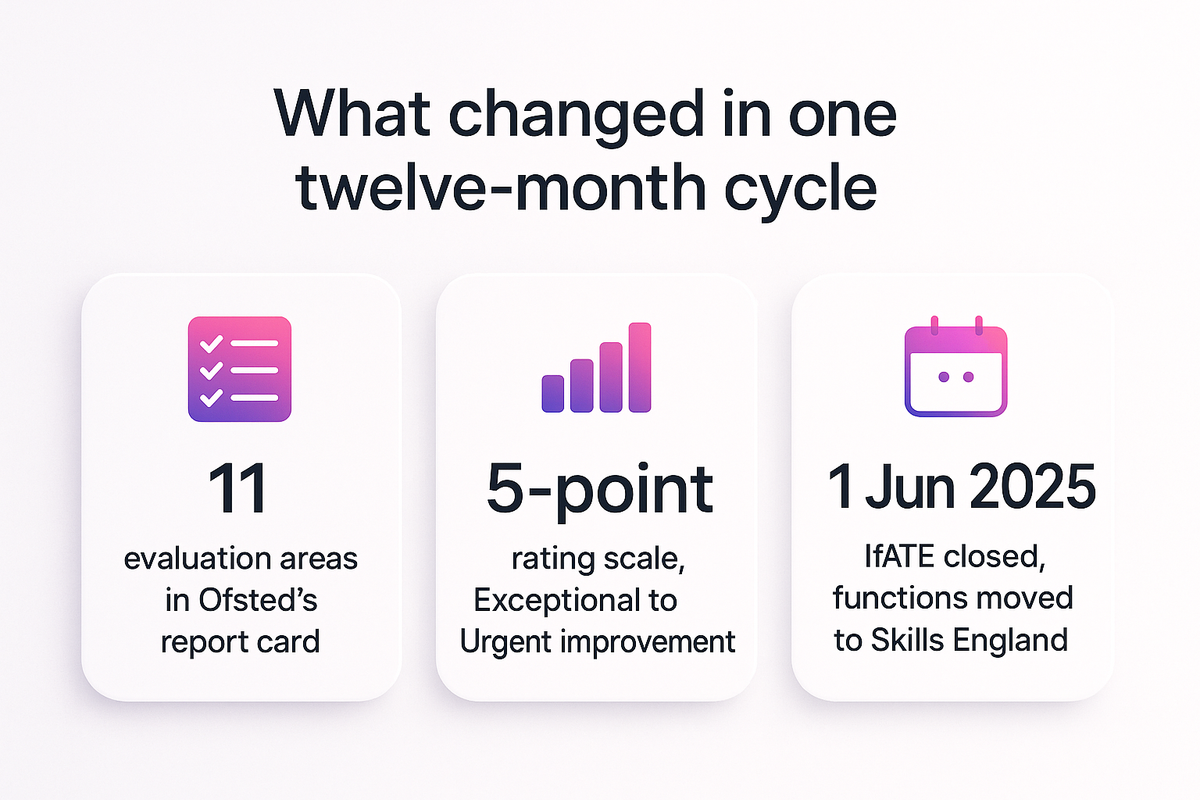
From 10 November 2025, Ofsted's updated inspection framework replaces single-word overall judgements with a report card that rates eleven evaluation areas on a five-point scale, from Exceptional down to Urgent improvement, with safeguarding graded separately as met or not met. The FE and Skills Inspection Handbook is being replaced by a new Inspection Toolkit.
The framework also drops formal 'deep dive' evaluations in favour of more emphasis on a provider's own self-reflection and longer-term development. Sector commentary has been blunt about what that means in practice: evidence needs to be lived, not laminated. A well-organised folder produced for the day of the visit is no longer the target; ongoing practice is.
At the same time, the machinery around you has been rebuilt. IfATE closed on 1 June 2025, with its standards-setting functions transferring to the newly established Skills England. References to the ESFA have been stripped out of the apprenticeship funding rules following the decision to bring its functions into the Department for Education. Neither change is cosmetic — it changes who issues the guidance you're mapping against, and how complete that guidance is while the new bodies bed in.
Funding rules are moving mid-year, not annually
The funding rules aren't a once-a-year publication anymore either. Version 2 of the 2025–2026 apprenticeship funding rules was published in July 2025, with version 3 following in the same cycle. A policy you mapped and signed off in spring can be out of step with the rules your provider is actually funded under by the following term.
Some of what's changed inside those versions is substantial, not administrative:
- Minimum apprenticeship duration cut from twelve months to eight, effective 1 August 2025.
- English and maths exit requirements made optional for apprentices aged 19 and over in most cases, from 11 February 2025.
- Level 7 apprenticeship funding restricted from January 2026 to apprentices aged 16 to 21, with limited exceptions.
Layered on top of that, apprenticeship standards are entering a period of dual-running, with existing and reformed standards operating side by side, and end-point assessment being renamed Apprenticeship Assessment and spread across the programme rather than concentrated in a single end-point event. That's a structural change to when and how evidence gets generated, not just what it's called.
Where the evidence gaps actually bite
None of this is theoretical for funding assurance. DfE guidance confirms that assurance reviewers test a provider's Education and Learning Records directly against the funding rules' evidence requirements, and DfE's own published findings identify off-the-job training evidence as the most common and costly cause of funding errors and resulting control recommendations.
One published outcome report — into Park Education Training Centre — found missing eligibility-check and initial-assessment evidence stretching back across four separate funding years. That's not a single bad audit. That's a gap that was there long before anyone went looking, because nobody was continuously checking that what was delivered, assessed and evidenced still lined up with the rules in force at the time.
The staffing reality behind the paperwork
It's worth naming the constraint most compliance functions are actually working under. The National Audit Office reports persistent teacher shortages and vacancy rates across secondary and further education. FE Week, citing Institute for Fiscal Studies data, reports that almost half of FE teachers leave within three years.
That turnover thins out exactly the institutional memory a compliance function relies on — the person who remembers why a policy was written a particular way, or which cohort is still on the old standard versus the reformed one. When that memory walks out the door, the gap doesn't show up in a spreadsheet. It shows up months later, in an assurance review or an inspection.
From annual project to continuous discipline
None of the changes above are unusual individually — regulators update guidance, funding rules get revised, standards get reformed. What's unusual is the clustering: several major reference points moving inside the same twelve months, onto a provider that's also short-staffed in the roles meant to track them.
The practical response isn't a bigger binder. It's treating audit-readiness as a standing question you can answer at any point in the year, not a project you run up to a deadline. A few habits help, regardless of what tools you use:
- Keep a live register of which standard, qualification version, or funding rules version applies to which cohort — not a static list reviewed annually, but one flagged for review whenever a source document changes.
- Set a trigger, not a calendar date, for policy and TAS review: a new funding rules version, a standard moving to reformed status, or an Ofsted guidance update should each start a review, rather than waiting for the next scheduled cycle.
- Separate 'evidence exists somewhere' from 'evidence is reconciled' — off-the-job training records sitting in three different systems isn't the same as a checked, current record that maps to the rule in force.
- Build in a route for staff turnover to trigger a compliance handover, not just an HR one, so institutional knowledge about why a policy exists doesn't leave with the person who wrote it.
Key takeaways
- From 10 November 2025, Ofsted's report card rates eleven areas on a five-point scale and drops formal deep dives — evidence now needs to reflect live practice, not a pre-visit scramble.
- IfATE closed on 1 June 2025 (functions moved to Skills England) and ESFA functions have moved into the DfE — the bodies issuing your reference standards have themselves changed.
- Apprenticeship funding rules were reissued twice within the 2025–2026 cycle alone; a spring review can be out of date by the following term.
- DfE's own assurance findings point to off-the-job training evidence as the leading cause of funding errors — one outcome report found gaps stretching back four funding years.
- FE teacher turnover (NAO data; IFS figures cited by FE Week) is thinning institutional memory, raising the cost of treating compliance as an annual catch-up rather than a continuous discipline.
Our take
The instinct to run a big pre-inspection push isn't wrong — it's just no longer sufficient on its own. Ofsted has told the sector, in effect, that it wants to see practice, not preparation. Funding assurance keeps finding the same evidence gap because it's structurally likely to appear when reconciliation only happens once a year.
The compliance managers who come through this cycle well won't be the ones with the thickest binder in November. They'll be the ones who can answer, on any random Tuesday, which standard version applies to which cohort and where the evidence for it lives — without a scramble first.
FAQ
What changed in Ofsted's inspection framework from November 2025? From 10 November 2025, Ofsted replaced single-word overall judgements with a report card that rates eleven evaluation areas on a five-point scale, from Exceptional to Urgent improvement, with safeguarding graded separately as met or not met. The FE and Skills Inspection Handbook is being replaced by a new Inspection Toolkit.
Does Skills England now set apprenticeship standards instead of IfATE? IfATE closed on 1 June 2025, and its standards-setting functions transferred to the newly established Skills England. Guidance from the new body is still developing, which is one reason standards mapping needs closer, more frequent review rather than a single annual check.
How often are apprenticeship funding rules actually changing? More often than once a year. Version 2 of the 2025–2026 apprenticeship funding rules was published in July 2025, with version 3 following in the same cycle — alongside substantive changes such as the minimum apprenticeship duration cutting from twelve months to eight, from 1 August 2025.
What's the most common cause of funding-assurance findings? DfE's own published assurance findings identify off-the-job training evidence as the leading cause of funding errors and resulting control recommendations. One published outcome report found missing eligibility-check and initial-assessment evidence going back across four separate funding years.