Automated Training Package Mapping: What Changes
19 July 2026 · 6 min read

Building an assessment from a training package usually starts the same way: tracing every element and performance criterion into draft tasks, unit by unit, then hoping the coverage map survives validation or an ASQA audit. For most RTOs, that manual cross-referencing — not the writing itself — is what eats the time and where compliance gaps quietly form.
Why the mapping step, not the writing, is the bottleneck
Ask an instructional designer where the hours go on a new unit of competency and it's rarely the assessment tasks themselves. It's the process of pulling apart a training package, checking each element and performance criterion against draft content, and building a coverage record that will hold up when someone else checks it.
Done by hand across a large scope, this creates predictable problems:
- Coverage gets rebuilt from scratch for every unit, even when qualifications share components.
- Small inconsistencies — a performance criterion touched on but not clearly assessed — are easy to miss until validation.
- By the time an internal validator or an ASQA auditor flags a gap, the assessment is already in use with learners.
- Training materials are often developed separately, so the link between what's taught and what's assessed isn't always explicit.
- Every review cycle, training package update or scope expansion means redoing the mapping exercise again.
None of this is about assessor skill. It's a structural problem: training packages are large, interconnected documents, and reconstructing that structure by hand, repeatedly, is where risk enters the system.
What automated training package mapping actually does
This is the specific problem VETos is built to remove — not "AI writes your assessments", but the manual mapping step underneath that work. When a training package is selected in VETos, the platform builds a connected model of the whole scope: qualifications, units, elements and performance criteria linked together, rather than treated as separate documents to be cross-checked by a person.
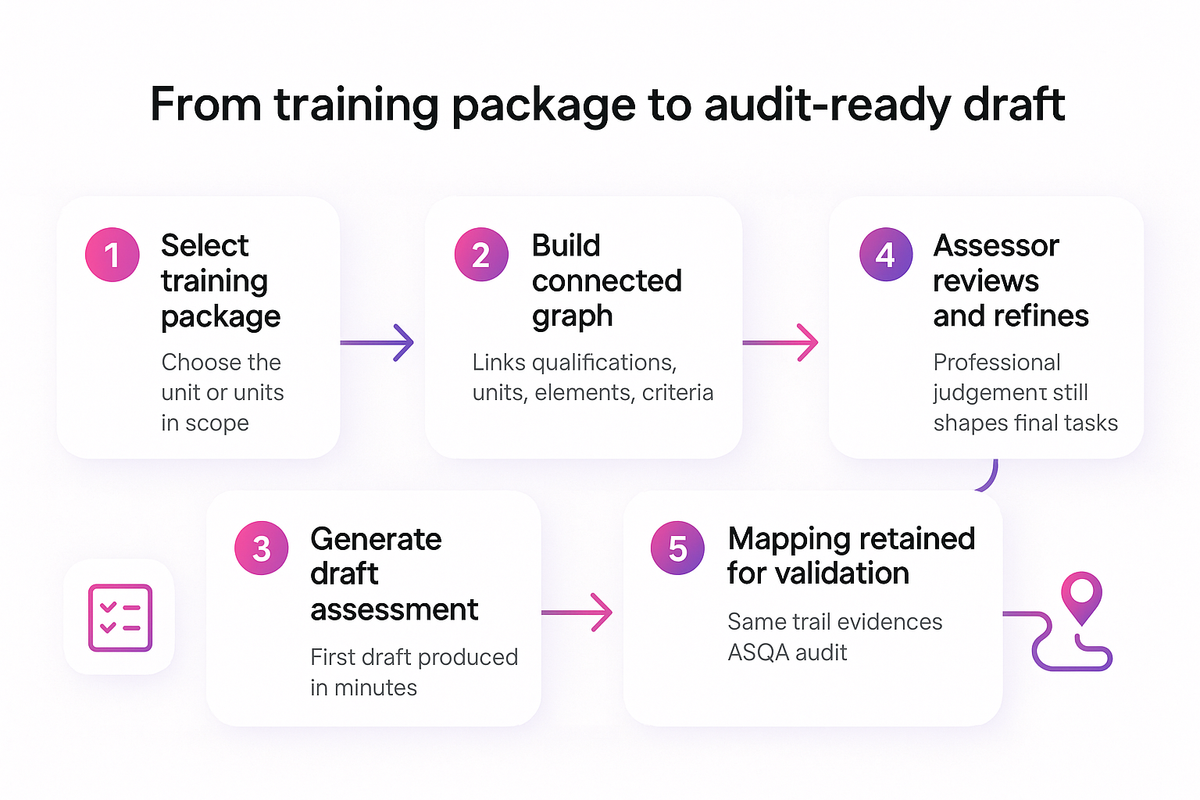
From that mapped structure, VETos generates a first draft assessment aligned to the relevant units in minutes. The draft is a starting point for an assessor to review and refine — it doesn't replace the professional judgement that assessment validation depends on, but it removes the blank-page, blank-spreadsheet starting point.
The important detail is what happens after the draft is generated. Because the mapping is retained rather than reconstructed each time, every assessment stays traceable back to the specific elements and performance criteria it covers. That's the same evidence trail an RTO needs to present at internal validation and at an ASQA audit — it's not a one-off export that goes stale the moment the training package is updated.
Where this shows up in an RTO's day-to-day
A few specifics ground this beyond the general claim:
- The mapping supports AQF Levels 1–6, across both training package and accredited qualifications — so it isn't limited to a narrow slice of an RTO's scope.
- Outputs are built for what RTOs actually need to produce for compliance: Training and Assessment Strategies (TAS), LLN documentation, assessment maps and validation records.
- The mapping capability sits inside the same workspace as assessment design, learning design and compliance documentation — so training material generation is linked directly to the assessment it supports, rather than developed as a disconnected exercise.
- VETos is positioned specifically for Australian training packages and ASQA-facing documentation, not as overseas assessment software adapted for the local market.
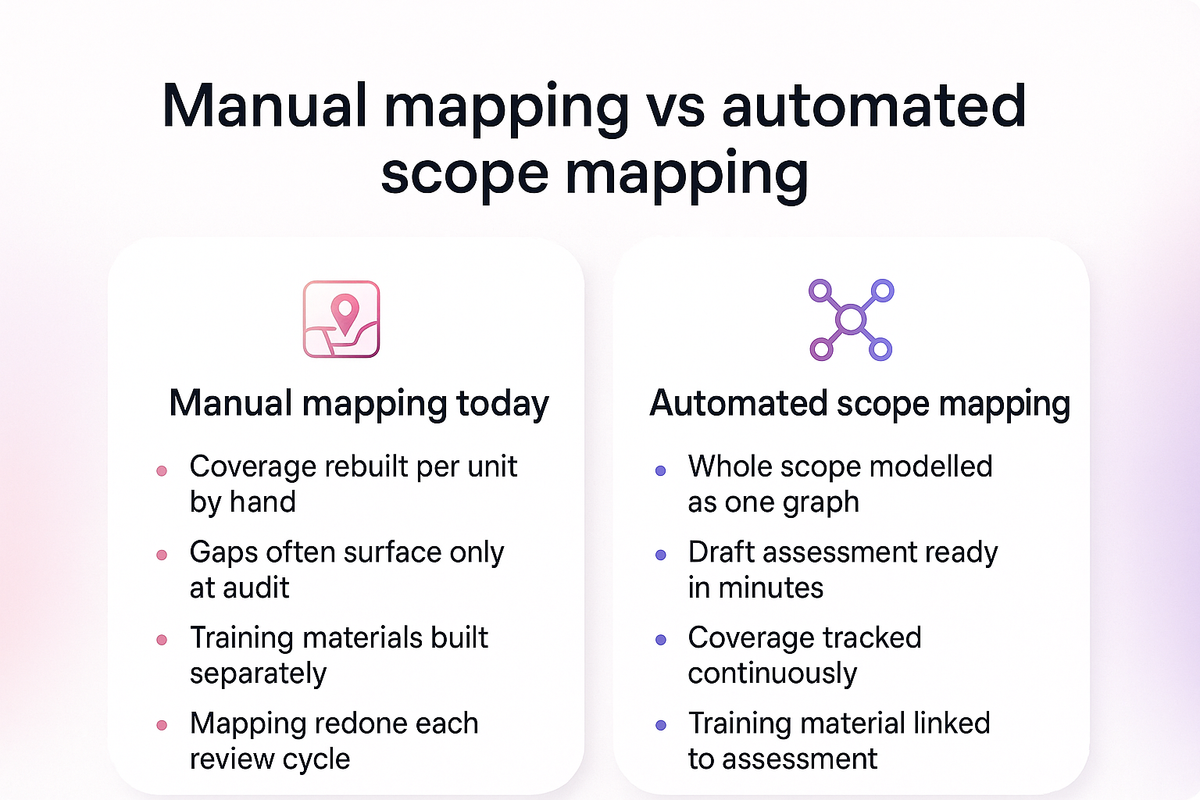
There isn't yet a published, named Australian RTO case study with quantified before-and-after figures for this specific workflow — that's a gap worth being upfront about. The claim here is narrower and more verifiable: the mapping step that currently gets rebuilt by hand, unit by unit, is instead modelled once as a connected structure and kept current.
Key takeaways
- The slowest part of assessment development is usually manual mapping of elements and performance criteria, not drafting content.
- Gaps built by hand often surface too late — at validation or ASQA audit — to fix without rework.
- Automated scope mapping models a training package as one connected structure across qualifications, units, elements and performance criteria.
- A first draft assessment is generated from that structure in minutes, giving assessors a starting point rather than a blank document.
- Because the mapping is retained, the same coverage trail doubles as validation and audit evidence — it isn't recreated each time.
Our take
The useful shift here isn't speed for its own sake — it's that "audit-ready" stops being something an RTO reconstructs under pressure before a validation cycle and becomes a by-product of how the assessment was built in the first place. That matters more under the Standards for RTOs 2025, where the expectation is ongoing evidence of quality, not a scramble to assemble it. We'd still want to see this proven out with named Australian RTOs over a full validation cycle before treating it as settled — but removing a manual, error-prone step that every training provider currently repeats by hand is a genuinely useful place to start.
FAQ
Does automated mapping replace the need for assessment validation? No. It changes what assessors and validators start from — a mapped draft instead of a blank document — but validation under the Standards for RTOs 2025 still requires human review and judgement.
Which qualifications does the mapping cover? It supports AQF Levels 1–6, across both training package and accredited qualifications, rather than being limited to a narrow subset of an RTO's scope.
What does the mapping actually produce for compliance purposes? Outputs are built around what RTOs need for ASQA-facing documentation: Training and Assessment Strategies (TAS), LLN documentation, assessment maps and validation records.
Is this the same as generic AI assessment writing? No. The specific capability is modelling a training package's elements and performance criteria as a connected structure so coverage is tracked automatically — draft generation is built on top of that mapping, not a separate step.
Is there a published Australian case study with results for this workflow? Not yet, with quantified figures. The workflow is described and demonstrated on the VETos site and in product walkthroughs, and that's worth treating as a starting point for your own evaluation rather than a settled outcome.
If your team is still tracing elements and performance criteria into spreadsheets before every validation cycle, it's worth looking at how a connected scope model changes that — VETos has a walkthrough of the mapping workflow worth a closer look before your next training package update.