The AVETMISS Reporting Process Is Now an Audit Test
30 July 2026 · 6 min read

Every RTO survives AVETMISS season. That's not the achievement it used to be. Under the Standards for RTOs 2025, which commenced 1 July 2025, ASQA doesn't just want your data submitted by the deadline — it wants evidence that the systems producing that data operate reliably, every cycle, at any volume. A manual reporting scramble isn't just inefficient anymore. It's evidence at audit.
Why this lands on your desk
You own the submission calendar. You own the people, the SMS exports, and the reconciliation that turns raw enrolment data into a compliant NCVER submission. When the AVETMISS window opens on 1 January 2026, with submissions due by 5pm ACDT on 28 February 2026, that deadline sits on your desk — not the CEO's, and not the trainer's.
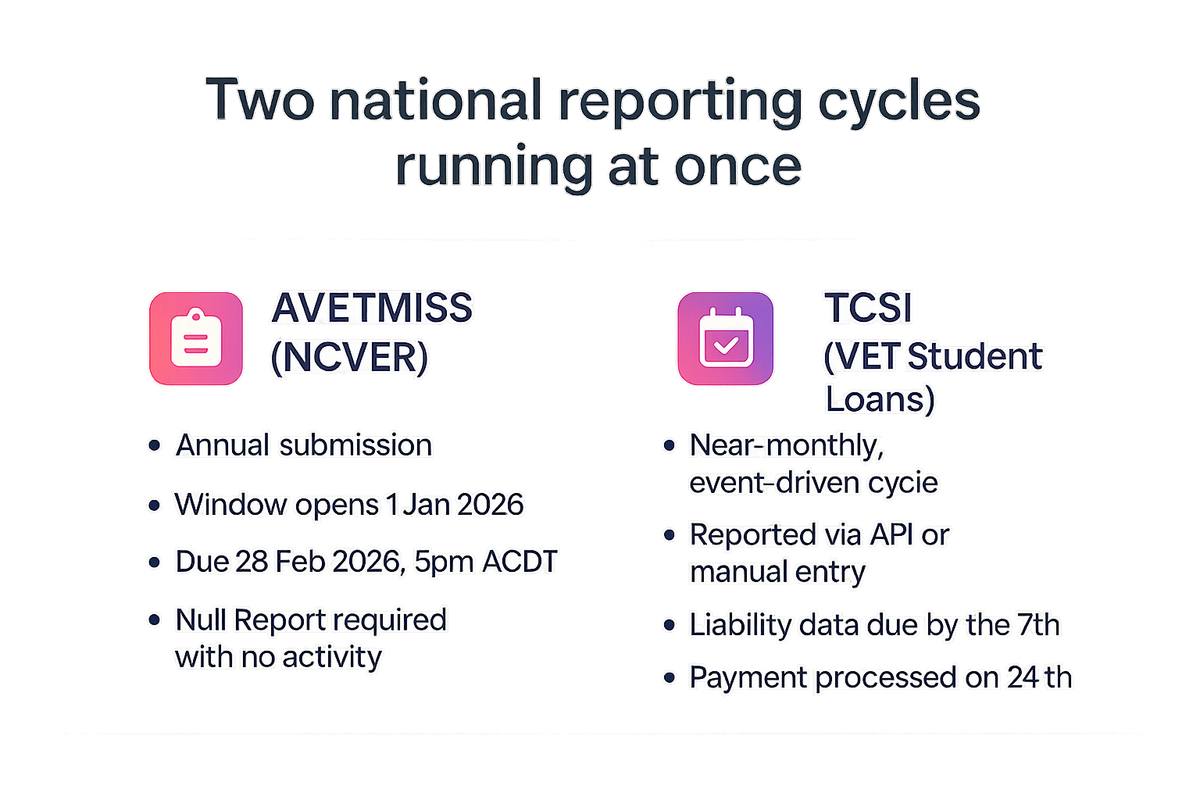
If your RTO offers VET Student Loans, you're also running a second, parallel obligation through the Tertiary Collection of Student Information (TCSI). It doesn't wait for an annual window — liability data for each census day is due by the 7th of the following month, with payment for eligible data processed on the 24th, and the reporting cadence has been updated again for the 2026 collection. Two national data obligations, two rhythms, one operations function holding both together.
The 2025 Standards changed what happens if that function breaks. They restructured RTO compliance by moving administrative requirements out of the Outcome Standards and into the Compliance Standards, specifically so ASQA can test whether your systems operate effectively in real delivery contexts — not just whether the paperwork exists. A reporting process held together by one person's memory of "where the export file lives" isn't a process. It's a single point of failure with a national deadline attached.
What the 2025 Standards actually test now
The practical shift is subtle but real. Previously, a lot of RTOs treated reporting obligations as a separate compliance lane — get the AVETMISS file in, tick the box, move on. The restructured Standards fold that lane back into the operational test: does the system work, in practice, under real conditions, repeatedly?
That reframing matters for how you prepare. An auditor asking whether your enrolment-to-reporting pipeline operates effectively isn't satisfied by a successful submission alone. They're testing whether the process would survive a staff absence, a system outage, or a quarter with unusual enrolment patterns — because that's what "operates effectively in real delivery contexts" means in practice.
Worth noting: commentary from early 2025 pointed out the revised Standards hadn't been finalised despite the scheduled 1 July 2025 start date. That uncertainty made it genuinely hard for operations leaders to lock in long-term systems planning ahead of commencement — a reminder that the regulatory ground under reporting infrastructure doesn't always move at a pace that suits annual planning cycles.
Two compliance clocks, no room for manual error
AVETMISS and TCSI don't run on the same schedule, and treating them as one problem is a common mistake. One is annual and volume-based. The other is monthly and event-driven. Both assume your underlying data is clean and traceable at any point, not just at deadline week.
The Null Report is the real stress test
Here's a detail that's easy to overlook: even an RTO with zero training activity in the collection period must still lodge a Null Report through the AVETMISS Validation Software. There's no "opt out because nothing happened" clause.
That single requirement tells you something about how NCVER and ASQA think about reporting infrastructure. It isn't meant to scale up during busy periods and switch off during quiet ones. It's meant to be a standing capability — reliable at zero enrolments, reliable at a thousand. If your process only really works when someone senior clears their diary for reporting week, it hasn't passed that test, even if the submission goes in on time.
The capacity question nobody has clean numbers for
Independent workforce research names administrative and compliance burden as one of the genuine threats to RTO viability — competing directly with delivery capacity at a time when the sector is also short of qualified Teach, Train and Assess practitioners, particularly in regional areas, and the cost and complexity of the Certificate IV in Training and Assessment is discouraging new entrants.
It's worth being honest about what we don't know. No regulator-published data from ASQA or NCVER quantifies exactly how many staff hours or FTE-equivalent capacity RTOs lose to AVETMISS or TCSI cycles each year. The narrative that reporting quietly eats your best people's time is real in sector commentary, but it rests on practitioner experience, not official statistics. That doesn't make it less true for your organisation — it means you're better placed than any external report to measure it, because you own the calendar, the roster, and the reconciliation logs.
Key takeaways
- AVETMISS is an annual national obligation to NCVER for every RTO, regardless of activity — the 2025 collection window opens 1 January 2026 and closes at 5pm ACDT on 28 February 2026.
- VET Student Loan providers run a second, near-monthly obligation through TCSI, with liability data due by the 7th of each month and payment processed on the 24th.
- The Standards for RTOs 2025 moved administrative requirements from the Outcome Standards into the Compliance Standards, making "does the system operate effectively" the actual audit question — not just "was the file submitted."
- Every RTO must lodge a Null Report even with zero activity, which means your reporting process needs to be reliable at any volume, not just built to survive peak season.
- No official ASQA or NCVER data quantifies the staff hours lost to these cycles — which means the operations function is the only place that data will ever get measured.
Our take
The instinct during reporting season is to throw capable people at the problem until the deadline clears. That gets the submission in, but it doesn't answer the question the 2025 Standards actually pose: would this process hold up if ASQA walked in and asked to see it work, unannounced, in a quiet month?
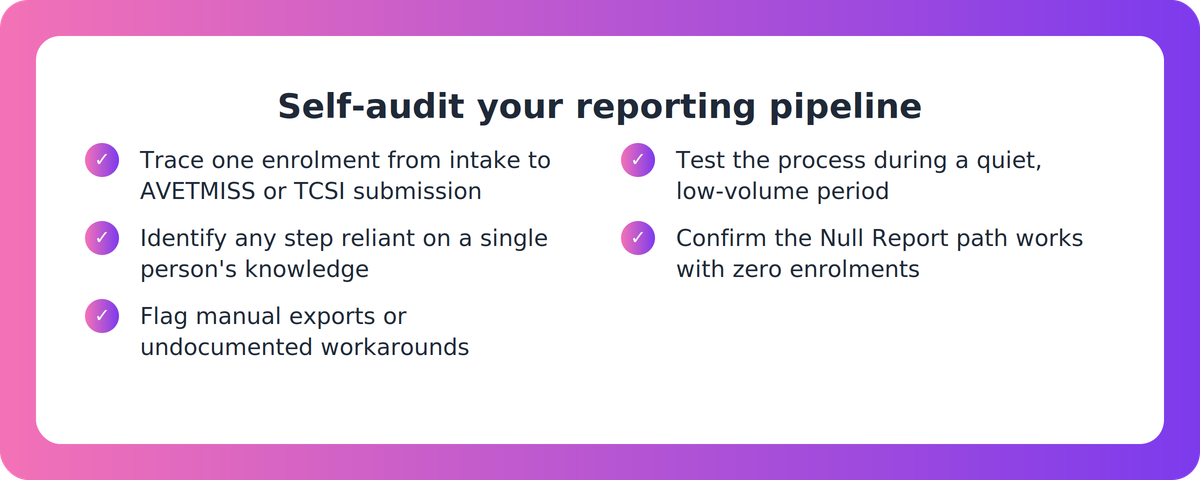
Treat your own reporting pipeline the way an auditor would. Trace a single enrolment from intake through to its line in the AVETMISS file or TCSI submission, and check whether that path depends on one person, one manual export, or one undocumented workaround. If it does, that's not an efficiency gap. Under the current Standards, it's a compliance exposure with your name on it.
FAQ
Does every RTO have to submit AVETMISS data even with no training activity? Yes. RTOs with no activity in the collection period must still lodge a Null Report through the AVETMISS Validation Software (AVS) — there's no exemption based on enrolment volume.
When is the 2025 AVETMISS collection due? The 2025 collection window opens 1 January 2026, with submissions due to NCVER by 5pm ACDT on 28 February 2026.
How does TCSI reporting differ from AVETMISS for VET Student Loan providers? TCSI runs on a near-monthly, largely event-driven cycle rather than an annual one: student liability data for each census day is due by the 7th of the following month, with payment for eligible data processed on the 24th, and the timeframes were updated again for the 2026 collection.
What actually changed under the Standards for RTOs 2025? Administrative requirements were moved out of the Outcome Standards and into the Compliance Standards, shifting the audit focus toward whether an RTO's systems demonstrably operate effectively in real delivery and assessment contexts — not just whether records exist.