AVETMISS Reporting Process for RTOs: A COO's Blueprint
13 October 2026 · 7 min read
The AVETMISS month-end scramble isn't a data-entry problem. It's an operating-model problem. RTOs that run reporting as a continuous, monitored process, with clean data at enrolment, routine reconciliation and named owners, handle the annual NCVER submission calmly. They are also better placed for the specification change NCVER lists from 1 January 2027.
Why this lands on your desk
You own the systems and people behind enrolments, delivery and reporting. So an accurate, on-time AVETMISS submission is yours, every year, inside a fixed window.
The obligation itself is simple. ASQA says all RTOs must collect and report all delivery activity (Total VET activity) to NCVER at least annually, including full AVETMISS data under the National VET Data Policy. The pain comes from how the work is organised, not from the rules.
Two pressures are stacking up. NCVER lists VET Provider Collection Specifications 8.1 (and Apprentice and Trainee Collection Specifications 8.0) from 1 January 2027, and says Skills Ministers have approved the changes. ASQA staff have also reportedly said they often see reactive improvement systems. That comes from one attendee's notes of a March 2026 workshop, not an ASQA publication. Still, it describes a maturity question you'll recognise: does action follow only when something goes wrong?
Step 1: Map your obligations and deadlines
Start with a single obligations register, owned by one person. Include:
- The annual NCVER submission. Providers with no training activity must still lodge a nil return through AVS when the collection window opens in January/February. It's small, and it's exactly the kind of task that falls between two people.
- Where you report, by funding source. In Queensland, RTOs with mixed funded and non-funded activity can report everything to DTET or split the return between DTET and NCVER. Other states have their own arrangements. Confirm each jurisdiction you operate in rather than assuming one rule fits all.
- The wider calendar. Secondary sources put the 2025 NCVER deadline at 5pm ACDT on 28 February 2026, with other ASQA obligations clustering around March (Annual Declaration on Compliance), 30 June (Quality Indicator) and 31 July (Annual Registration Charge). Confirm every date on asqa.gov.au before you build around it. The point is that these land on the same small team in the same months.
Step 2: Fix the data where it's born
Most month-end pain is enrolment-time pain that has been deferred. A missing field or inconsistent code costs seconds to fix at the front desk and hours to chase at reporting time, once the learner has moved on.
Make the enrolment form and SMS do the policing. Use required fields, controlled lists and validation at the point of entry. Then agree who is accountable for data quality at each handoff, from the admissions team to the trainer to the student services officer.
If staff re-key the same learner details into more than one system, that is your biggest risk. Every duplicate entry is a chance for two versions of the truth.
Step 3: Build a monthly reconciliation rhythm
Reconciling once a year is a scramble by design. Reconciling monthly turns it into a short, boring meeting, which is what you want.
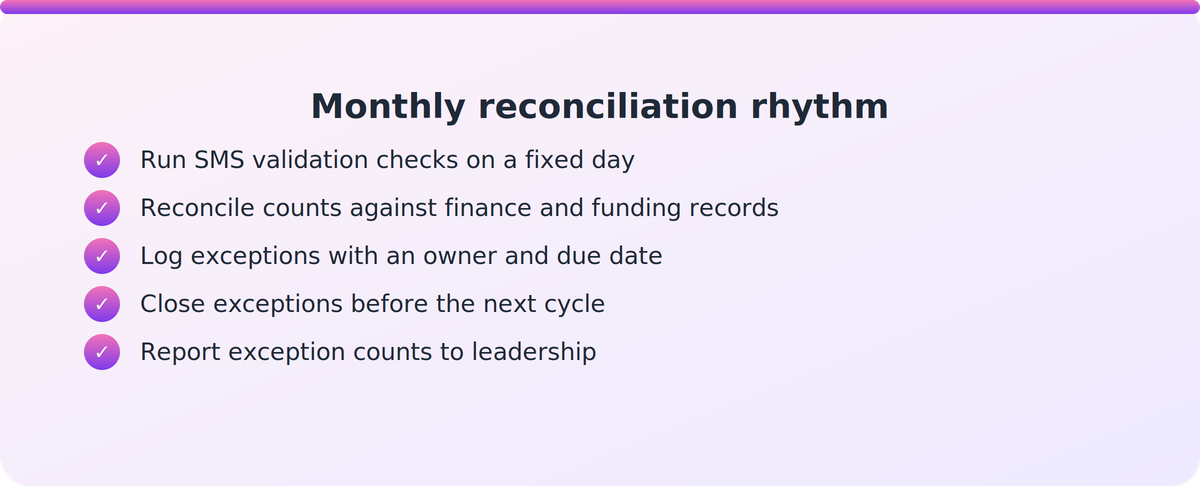
A workable rhythm looks like this:
- Run your SMS's validation or export checks on a fixed day each month.
- Reconcile enrolment and completion counts against your finance and funding records.
- Log exceptions with an owner and a due date, and close them before the next cycle.
- Report the exception count to your leadership team, as you would any operational metric.
The last step matters most. ASQA staff reportedly flagged a continuous improvement spreadsheet that is not implemented or monitored. A reconciliation log nobody reviews is the same failure in a different tab. ASQA's Statement of Regulatory Expectations (v1.0, 6 May 2026) expects effective governance and compliance arrangements, and a monitored routine is evidence of exactly that.
Step 4: Own the vendor roadmap
Your student management system is the engine of your reporting, so its roadmap is your risk. For the 8.1 change, the field-level detail wasn't confirmed in the material behind this post, so don't take anyone's summary on trust, including this one.
Three things to do this quarter:
- Read NCVER's release page for the 8.1 specifications directly.
- Ask your SMS vendor in writing when 8.1 support will ship, how it will be tested, and what you must change on your side.
- Check ASQA's page on the National VET Regulator (Data Provision Requirements) Amendment (Data Streamlining) Instrument 2026. ASQA lists it as taking effect on 1 October 2026, and NCVER runs a related VET Data Streamlining Program. What changes for providers is something to confirm with ASQA, not assume.
Schedule a dry-run export well before the 2027 window, not during it.
Step 5: Get the process out of people's heads
If one person knows how the submission really gets done, you have a continuity risk, not a process. Write the run sheet: who does what, in what order, with which checks, and what "done" looks like.
Then test it. Ask someone who has never done the submission to follow the document while the usual owner watches. Every question they ask is a gap to close.
Why more headcount is the wrong answer
The usual reflex is to add a person at peak. The numbers don't support it. NCVER reports 5.1 million students in nationally recognised VET in 2025, up just 1,585 on 2024, and government-funded students fell 6.8% in January–June 2025. Industry Skills Australia says it is harder to attract and retain experienced trainers and assessors.
Flat volume and a tight labour market mean you'd be paying more to staff a peak that better process would remove. Capacity you spend on reconciliation in February is capacity you can't spend on retention or delivery.
Key takeaways
- The scramble comes from reactive operations, not from the AVETMISS rules themselves.
- Every RTO must report all Total VET activity to NCVER at least annually, including a nil return where there's no activity. Where you report depends on funding and state arrangements.
- Fix data at enrolment, then reconcile monthly with a named owner and a reviewed exception log.
- Verify the 8.1 specifications (from 1 January 2027) and the Data Streamlining Instrument with NCVER, ASQA and your SMS vendor. Don't speculate.
- With flat enrolments and a tight workforce, improve the process before adding people.
Our take
Reporting is the most honest test of your operating model. A year-end scramble tells you that your data discipline depends on heroics, and the same weakness will show up in funding claims, board reports and audits.
We'd go further. Treat the annual submission as a by-product of good operations, not an event. If the monthly rhythm is healthy, the NCVER lodgement should be the least interesting day of your year. If it isn't, the 2027 specification change is simply the next thing you'll absorb through overtime.
FAQ
Who must submit AVETMISS data to NCVER?
ASQA states that all RTOs must collect and report all delivery activity (Total VET activity) to NCVER at least annually. Providers with no training activity must still submit a nil return through AVS when the collection window opens in January/February.
What changes on 1 January 2027?
NCVER lists VET Provider Collection Specifications 8.1 and Apprentice and Trainee Collection Specifications 8.0 from 1 January 2027, and says Skills Ministers have approved the changes. Check NCVER's release page for field-level detail and ask your SMS vendor for its roadmap.
Do funded RTOs report to NCVER or the state?
It depends on funding and jurisdiction. In Queensland, RTOs with mixed funded and non-funded activity can report everything to DTET or split the return between DTET and NCVER. Confirm the arrangements for every state you operate in.
How often should we reconcile AVETMISS data?
Monthly is a sensible operating rhythm, because it makes the annual submission a review rather than a rebuild. Whatever cadence you choose, give it a named owner and review the exception log at leadership level, so it is a monitored process, not a spreadsheet nobody opens.
Here's a first step for this week. Ask the person who ran your last submission to write down, in one page, exactly how they did it. Then see what's missing.