One Standard, Five Delivery Modes: NZ's Moderation Risk
13 July 2026 · 7 min read

Delivering the same unit standard in a classroom, on a worksite, at a distance and online looks efficient on a delivery plan — until moderation reveals the assessment evidence doesn't actually prove competence in each context. NZ providers scaling blended delivery are finding that one assessment written for one mode rarely stretches cleanly across the rest, and NZQA moderators are usually the first to notice.
Why one unit standard needs different evidence in different settings
A unit standard specifies the outcomes and performance criteria a learner must meet. It doesn't specify how evidence has to be gathered — that's left to the provider's assessment design. This flexibility is useful, but it means a single assessment task built for a classroom setting can fail badly when reused for workplace or distance learners.
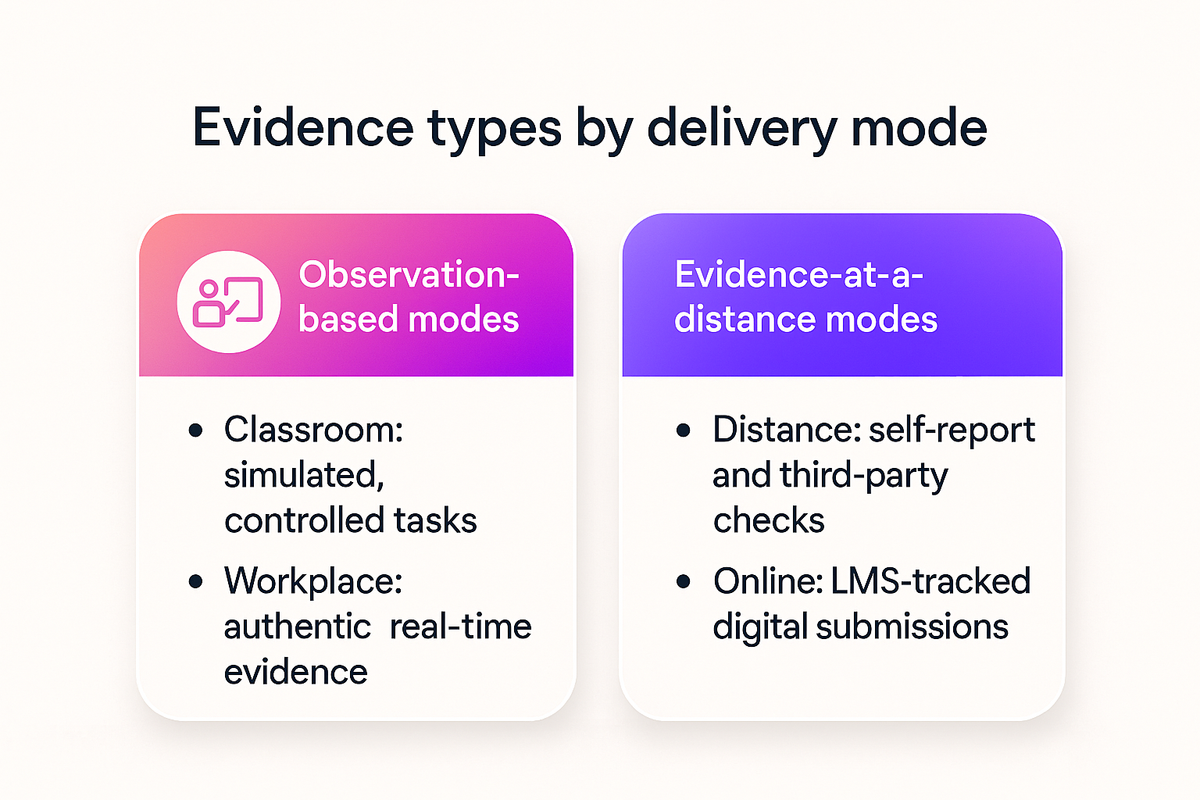
Each delivery mode generates a different kind of evidence:
- Classroom delivery favours simulated or controlled exercises, where direct observation is easy but real workplace context is thin.
- Workplace delivery gives authentic, real-time evidence, but the tasks available depend on what the employer's operation actually throws up on any given day.
- Distance delivery relies heavily on self-report, submitted work and third-party verification, since an assessor usually can't be there to watch.
- Online/blended delivery adds LMS-tracked submissions and digital artefacts, which need their own authenticity checks.
A single assessment tool rarely covers all four without gaps somewhere.
What changes across classroom, workplace, distance and online delivery
The practical differences show up in four areas that matter to moderators: sufficiency, authenticity, currency and validity of evidence.
- Sufficiency — does the volume and range of evidence actually meet the standard, or does a workplace learner get fewer opportunities to demonstrate a criterion than a classroom learner sitting a set task?
- Authenticity — can the provider confirm the work is genuinely the learner's own, particularly for distance and online submissions with no direct observation?
- Currency — is workplace-based evidence current enough, given that real operational conditions change faster than a fixed classroom brief?
- Validity — does the evidence actually address the performance criteria, or has it been stretched to fit a task designed for a different context?
These aren't abstract concerns. They are exactly what external moderation is designed to test, and mismatched evidence pathways are an easy pattern for a moderator to spot across a sample of learner files.
Where the 'one assessment, four contexts' approach breaks down
The risk compounds when assessor guides are written with only one delivery mode in mind. A guide built for classroom observation gives a workplace assessor little to work with when they're trying to verify evidence from a busy shift, and gives a distance assessor almost nothing when there's no observation moment at all.
The result is inconsistent assessor judgement across modes for the same standard — which is precisely the kind of variability that shows up in moderation findings and can trigger re-assessment, additional sampling, or conditions on funding-linked programmes.
Why this matters more as blended and workplace delivery grows
PTEs, ITPs and industry-facing providers are extending blended and workplace-based delivery to reach regional learners and industry learners who can't easily attend a fixed classroom. That's a sound response to access and industry demand. But it also means more unit standards are now being assessed across more delivery contexts than they were designed for, often without a matching update to the evidence pathway.
The operational effect is real:
- More assessment formats to maintain per standard.
- More assessor guides to write and keep current.
- More moderation exposure, because each additional mode is another place evidence quality can slip.
- More time spent reconciling assessor judgements across classroom, workplace and distance cohorts before a moderation cycle.
For a provider running a large portfolio of unit standards across several qualifications, this adds up to a genuine capacity problem, not just a paperwork one.
What mode-aware assessment design actually requires
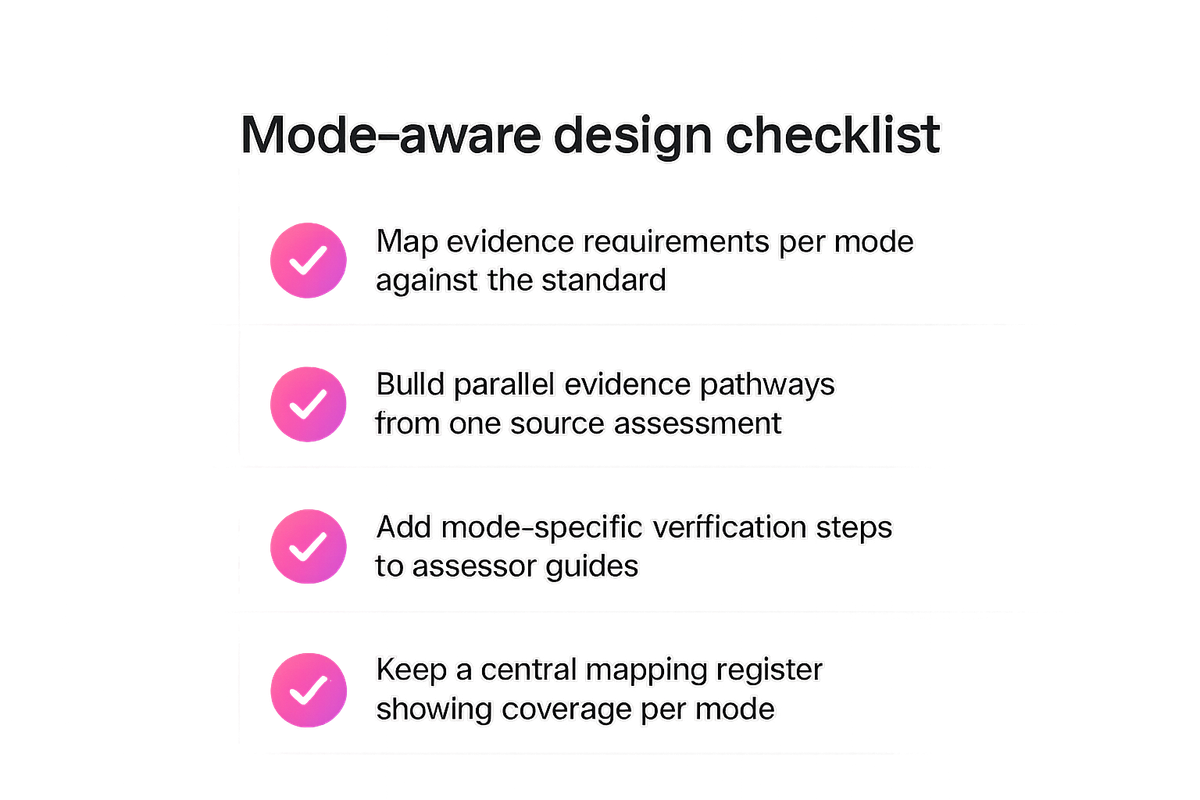
Treating delivery mode as a first-class design input — not an afterthought — is the fix. In practice that means:
- Mapping evidence requirements against the standard separately for each delivery mode before writing tasks.
- Building parallel evidence pathways from one source assessment, rather than exporting a classroom task and hoping it survives the trip.
- Writing assessor guides with mode-specific verification steps, especially for distance and online evidence where authenticity checks need to be explicit.
- Keeping a central mapping register that shows, for every standard, exactly how each mode's evidence traces back to the same performance criteria.
Done well, this doesn't mean five separate assessments per standard. It means one well-mapped design with mode-aware variants, so coverage of the standard is provable regardless of where or how the learner is being assessed.
Key takeaways
- Unit standards don't specify evidence format, so the same standard can be assessed very differently across classroom, workplace, distance and online delivery.
- Sufficiency, authenticity, currency and validity are the four areas where mismatched evidence pathways typically fail under moderation.
- Assessor guides written for one delivery mode often don't transfer to another, creating inconsistent judgement across cohorts.
- Growth in blended and workplace-based delivery to reach regional and industry learners is increasing the number of standards exposed to this risk.
- Mode-aware design — mapping evidence requirements per mode from a single source — reduces moderation exposure without multiplying the workload.
Our take
The instinct to reuse one assessment across delivery modes is understandable — writing five versions of every unit standard by hand isn't realistic for most portfolios. But the fix isn't fewer modes or less flexibility; it's designing evidence pathways per mode from the outset, mapped back to the same standard, so coverage is provable no matter how a learner is being assessed. Providers that keep treating delivery mode as a logistics detail rather than an assessment design input will keep finding this out at moderation, when it's expensive to fix.
FAQ
Does NZQA require a different assessment for every delivery mode? No. NZQA doesn't mandate separate assessments per mode, but it does expect the evidence gathered — whatever the mode — to meet the standard's performance criteria for sufficiency, authenticity, currency and validity. A single assessment can work across modes only if it was designed with those requirements in mind for each context.
Why does workplace-based evidence often fail moderation more than classroom evidence? Workplace evidence depends on what tasks are actually available on the day, which varies more than a controlled classroom exercise. Without a clear mapping of what counts as sufficient evidence in that context, workplace assessors can end up making inconsistent judgements compared with classroom assessors working from a fixed brief.
What's the biggest risk with distance and online delivery specifically? Authenticity. Without direct observation, providers need explicit verification steps — such as video evidence, structured self-report with corroboration, or third-party sign-off — built into the assessor guide. Assuming a classroom-style task will simply transfer to a distance context is a common gap.
How does this connect to a provider's moderation cycle? External and internal moderation samples typically cut across delivery modes for a given standard. If assessor judgement is inconsistent between a classroom cohort and a workplace cohort assessed against the same standard, that inconsistency is exactly what a moderation sample is designed to surface.
Does mode-aware design mean writing five separate assessments per unit standard? Not necessarily. It means mapping evidence requirements per mode from one well-structured source, with mode-specific variants and matching assessor guidance, rather than one task exported unchanged across contexts. The mapping is the work — the assessment itself can still share a common core.