Casual Assessor Management NZ: A COO's Blind Spot
1 October 2026 · 7 min read
A casual assessor network is where a PTE's quality system either holds or quietly frays. Under NZQA's 2026 rules, with self-review at the centre, that is an operations problem before it is an academic one. If consistency depends on what each assessor remembers from last term, you don't have a process. You have goodwill.
Why this lands on your desk
You own the machinery behind the quality management system that the Quality Assurance of Tertiary Education Providers Rules 2026 expect: annual self-review, reporting to NZQA, monitoring, and retention of assessment records. Casual assessors sit inside that system whether or not it was designed with them in mind.
The gap is easy to miss. Your core team knows the templates, the moderation habits and the file-naming conventions. A contractor who marks eight scripts a month from their kitchen table probably knows a version of them. When a self-review asks how you know assessment is consistent, "our senior staff catch it" is not a satisfying answer, and it doesn't scale.
There is also a deadline. Providers that didn't have a qualifying quality management system on 1 January 2026 must have one in place before 1 January 2027. Documenting how assessors are managed is part of that work.
What we can and can't say about casual assessors
Here is the candid part. We found no authoritative public source on how many PTEs use casual or contract assessors, what they cost, or how they affect consistency. Any benchmark you see quoted should be treated with suspicion.
So don't wait for one. Audit your own network and reason from what the regulators publish.
NZ has more than 400 PTEs across over 1,000 sites (careers.govt.nz). PTEs must comply with sections 342 to 361 of the Education and Training Act 2020 and the PTE Rules. NZQA reissued a series of its Rules on 19 January 2026 to align with the integrated Quality Assurance Framework (iQAF), which replaces External Evaluation and Review for PTEs and ITPs. Immigration NZ said it would keep using existing EER ratings for 12 months from early 2026.
Three expectations matter most for assessor management:
- Fair, valid, consistent assessment. The Programme Approval, Recognition and Accreditation Rules 2026 require this, backed by an effective system for moderating assessment materials and decisions.
- Capability and moderation obligations. Providers with consent to assess must meet the Consent and Moderation Requirements, which set capability requirements for teachers and assessors, and must take part in national external moderation.
- Moderation before results go out. NZQA's internal moderation guidance says moderation verifies the fairness, validity and consistency of assessor decisions before results are reported. It recommends standardised pre-assessment moderation forms.
None of that says "depend on your best people." It describes a repeatable process.
Run it as one process, not five favours
Most PTEs handle casual assessors as five separate tasks owned by five different people. Onboarding is HR. Briefing is whoever has time. Materials come from a shared drive. Moderation is the quality lead's problem. Records end up in someone's inbox.
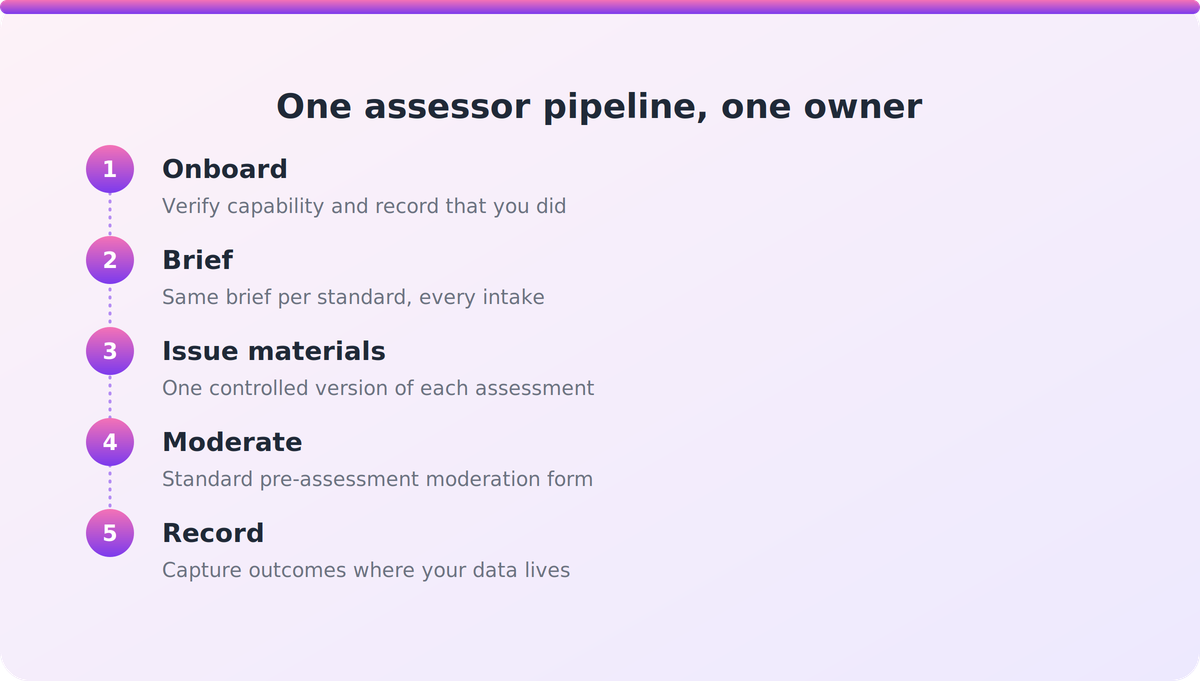
Treat it as a single pipeline with one owner:
- Onboarding. Verify capability against the relevant Consent and Moderation Requirements, and record that you did.
- Briefing. Give every assessor the same brief for the same standard, in the same format, every intake.
- Materials. Issue one controlled version of each assessment and assessor guide. No local copies, no "the one I used last time."
- Moderation. Use a standard pre-assessment moderation form, as NZQA recommends, so the check doesn't change with the moderator.
- Records. Capture outcomes where the rest of your data lives. Enrolment records must be kept until at least two years after the education or training is completed (PTE Rules 2026).
The test is simple. If your most experienced quality person were on leave for a month, would all five steps still run?
What to audit this quarter
You don't need a consultant to start. You need a spreadsheet and a few honest hours.
Map the network before you manage it
List every casual assessor, the standards they assess, the volume they handle, and how their results reach your systems. Most COOs find at least one assessor nobody has briefed in over a year, and one whose records arrive by email.
Then ask for each step in the pipeline: who owns it, where is it written down, and what evidence would we show if NZQA asked tomorrow?
Check sub-contracting separately
Where assessment is sub-contracted, the provisions now sit in the Quality Assurance of Tertiary Education Providers Rules 2026, according to SAARA's summary. Confirm that against NZQA's rule text before you rely on it. A casual assessor on your payroll and an organisation assessing on your behalf are different arrangements, and your documentation should say which is which.
The data downstream
Assessment outcomes drive completions, and completions drive what you report. NZ funded providers report through the TEC Single Data Return. TEC's financial-viability risk factors include historical poor delivery forecasting accuracy and low values of delivery within SDR reporting.
A marker who submits results late, or in a format your team re-keys by hand, shows up weeks later as a forecasting problem. The gap between assessor and funding risk is shorter than it looks. It is the same dull chain of timeliness and accuracy, and it runs through people who aren't on site.
Our take
Most PTEs treat their casual assessor pool as a staffing question: can we find enough people? The more useful question is whether our process holds when the person changes. Casual networks flex with demand, which is exactly why they're valuable, and exactly why they expose any process that lives in people's heads.
We'd go further. The 2026 reforms make this more urgent, not less. Te Pūkenga's centralised model is being disestablished, eight Industry Skills Boards are being created, and some industry groups are looking to establish PTEs for work-based learning (TEC). Moderation responsibilities and assessor networks may need to adapt. A documented, repeatable assessor process travels through that change. An informal one gets rebuilt from scratch.
One caution: a September 2025 proposal to discontinue the consistency-review process was only a proposal. Confirm the current position with NZQA before you plan around it.
Key takeaways
- Casual assessors sit inside your quality management system under NZQA's 2026 rules, whether or not the system was designed for them.
- No authoritative public data exists on casual assessor use or cost in NZ PTEs, so audit your own network instead of chasing benchmarks.
- Treat onboarding, briefing, materials, moderation and records as one process with one owner.
- NZQA recommends standardised pre-assessment moderation forms. Use them for every assessor, not only the new ones.
- Providers without a qualifying quality management system on 1 January 2026 must have one before 1 January 2027.
FAQ
Do NZQA rules treat casual assessors differently from permanent staff?
The research found no source that sets out a separate regime for casual assessors. The expectations on fair, valid and consistent assessment, effective moderation, and assessor capability apply to the provider's system. Confirm any specific question with NZQA.
How many NZ PTEs use casual assessors, and what do they cost?
No authoritative public data exists. The research found nothing on prevalence, cost or consistency effects. Audit your own network of assessors, volumes and moderation outcomes.
What should a standard moderation process include?
NZQA's guidance says internal moderation verifies the fairness, validity and consistency of assessor decisions before results are reported. It recommends standardised pre-assessment moderation forms. Apply them consistently across all assessors.
How long must assessment-related records be kept?
Under the PTE Rules 2026, enrolment records must be kept until at least two years after the education or training is completed. Check NZQA's rule text for any further record requirements that apply to your programmes.
Here is a first step you can take this week: pick one casual assessor at random and trace their last batch of results from briefing to SDR. Wherever you had to ask a person rather than open a document, you've found your next process to write down.