Clinical Placement Shortage: Can Simulation Close the Gap?
3 August 2026 · 7 min read

Ahpra's April 2025 guidance formally recognises simulation-based learning and virtual care as legitimate parts of health practitioner training, not just a placement top-up. Yet a February 2026 scoping review of 131 studies found most programs still replace only 0–50% of clinical placement hours with simulation. That gap between regulatory permission and actual practice is where the real story sits.
What did Ahpra actually change?
On 24 April 2025, Ahpra's independent Accreditation Committee published national guidance confirming that clinical placements, simulation-based learning and virtual care are complementary, necessary components of contemporary health practitioner education — not a fallback for when placements run short. Universities Australia had made a formal submission during the consultation, and the final guidance reflects that tension: simulation is endorsed, but framed as one part of a mixed model, not a replacement pathway.
For providers, this matters because it removes a large chunk of regulatory ambiguity. Course designers no longer need to justify simulated hours as an exception. They can build them in as core curriculum from day one — which changes the investment case for how that content gets made.
Why hasn't simulation filled more of the gap already?
The honest answer, based on Australia's own evidence base, is that most providers aren't using anywhere near the substitution ceiling regulators now allow.
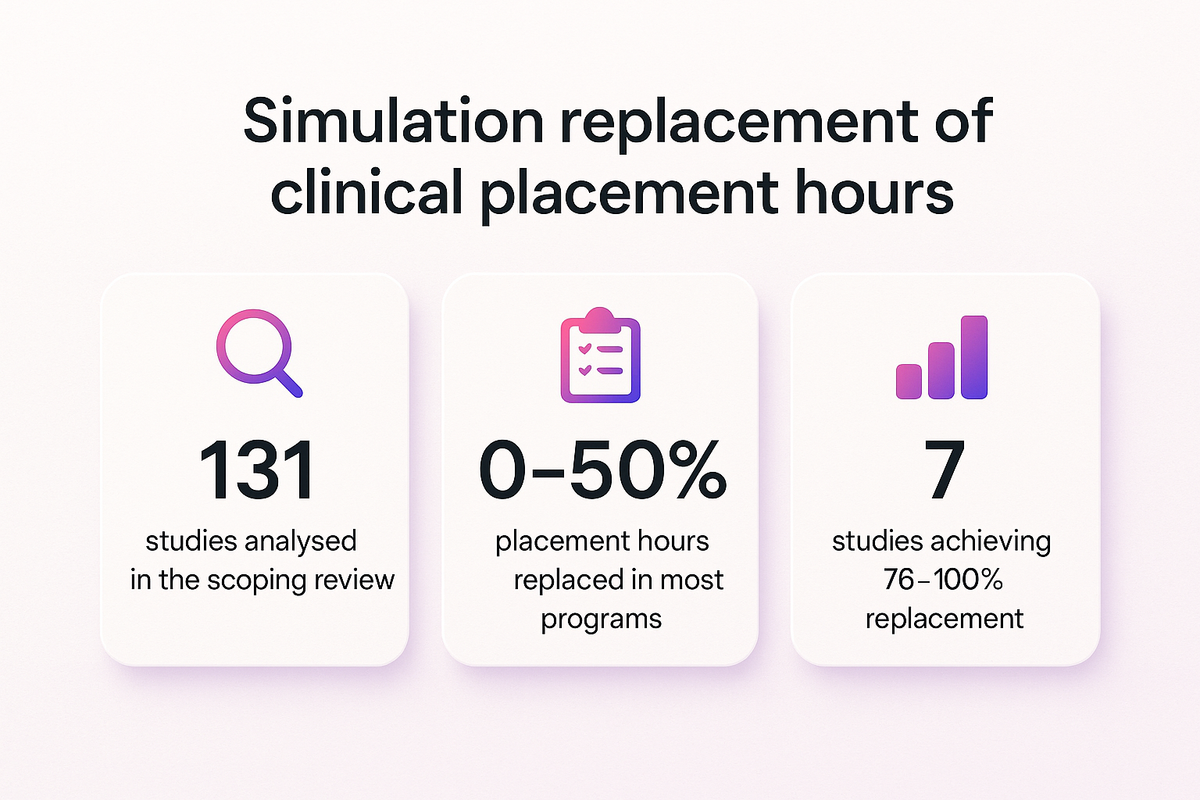
- The February 2026 *Advances in Simulation* scoping review analysed 131 studies (Australia the second-largest contributing country) and found most programs replace only 0–50% of traditional clinical placement hours with simulation.
- Just seven of those studies achieved 76–100% replacement — a small minority operating anywhere near what's technically permitted.
- Nursing, physiotherapy and radiography are the most-studied fields for simulated placements, but the review's authors called for far more sophisticated design, delivery and curriculum integration, rather than providers simply maximising substitutable hours.
That last point is the crux. Counting hours is easy. Building simulation that's actually good enough to trust with high-stakes clinical judgement — role-specific, scenario-rich, adaptive to a learner's progress — is a different order of problem, and it's one static, one-size-fits-all simulation modules were never built to solve.
Is placement scarcity really the constraint?
Universities Australia has consistently argued that placement scarcity, not simulation capability, is the core bottleneck on graduate throughput — a position it reiterated through its submission to Ahpra's consultation. The Australian Institute of Health and Welfare projects that nearly half (49%) of all employment growth in Australia over the next decade will land in health care, social assistance and related professional and training sectors. That's a lot of new practitioners needing supervised, placement-dependent training in a system that already can't find enough placement hours.
This pressure isn't confined to universities. Enrolled nurse and allied health assistant pathways, delivered by Registered Training Organisations against AQF-aligned training packages and units of competency, sit on the same placement infrastructure and face the same scarcity. Whatever eases pressure at the university end tends to flow through to the vocational education and training sector too.
What are providers actually building?
Some universities are responding with capital investment rather than waiting for the sector-wide picture to resolve. The University of Wollongong opened new Clinical Simulation Labs in 2025, fitted with VR headsets, SimCapture recording and playback, and Mask-Ed tools, specifically to expand training capacity for rare or high-pressure scenarios amid the ongoing nursing shortage and an ageing population.
That's a sensible move for physical infrastructure. But infrastructure alone doesn't solve the design problem the scoping review flagged. A lab full of VR headsets still needs someone to script, build and continually refresh the scenarios running inside it — and that's traditionally been the slow, expensive part of instructional design, whether the output is a physical mannequin exercise or a branching e-learning module.
Where does adaptive, AI-generated practice fit?
This is exactly where the gap between regulatory permission and practical capacity opens up. If most providers are only using a fraction of the simulation hours Ahpra now allows, the constraint isn't appetite — it's the cost and lead time of producing enough good scenarios to justify going further.
AI-generated role plays and coached practice scenarios change that equation. Instead of months of instructional design to script a single simulated placement module, providers can generate contextual, role-specific practice environments — audio, video and interactive formats combined — in a fraction of the time, and iterate them as curriculum and clinical guidelines shift. That doesn't replace physical clinical placements or the kind of hands-on skill Mask-Ed and VR labs deliver. It does mean the 0–50% replacement ceiling most programs are currently stuck under has more room to move, without each additional percentage point requiring another expensive production cycle.
Key takeaways
- Ahpra's 24 April 2025 guidance formally recognises simulation-based learning and virtual care as necessary, complementary parts of health practitioner education.
- A February 2026 scoping review of 131 studies found most programs replace only 0–50% of clinical placement hours with simulation; just seven studies reached 76–100%.
- Nursing, physiotherapy and radiography are the most-studied fields, but the review calls for more sophisticated design and curriculum integration, not just more substitutable hours.
- The AIHW projects 49% of Australia's employment growth over the next decade will be in health care and related sectors, adding further pressure to placement-dependent pathways.
- Universities Australia maintains placement scarcity, not simulation capability, is the core constraint — positioning simulation as a partial rather than complete fix.
Our take
Ahpra's guidance removes the regulatory excuse for under-using simulation, but it doesn't remove the production bottleneck that's actually holding most programs back. The scoping review is blunt about this: providers aren't stuck at 0–50% replacement because they've decided that's enough, they're stuck there because building enough good simulated content is slow and expensive. That's a design and production problem, not a policy problem, and it's the one worth solving next — because until scenario production gets faster and cheaper, the gap between what regulators now permit and what providers can practically deliver will keep widening as health workforce demand grows.
FAQ
What did Ahpra change in April 2025? On 24 April 2025, Ahpra's independent Accreditation Committee published national guidance formally recognising clinical placements, simulation-based learning and virtual care as necessary, complementary components of health practitioner education, rather than treating simulation as a lesser substitute for placements.
How much of clinical placement time can simulation actually replace? A February 2026 scoping review in *Advances in Simulation*, analysing 131 studies, found most programs replace only 0–50% of traditional clinical placement hours with simulation, with just seven studies achieving 76–100% replacement.
Is the clinical placement shortage in Australia mainly a simulation problem? No. Universities Australia has argued that placement scarcity itself, not the availability or capability of simulation, is the core constraint limiting graduate throughput, and it made this case in its submission to Ahpra's consultation on the new guidance.
Which health disciplines are furthest ahead on simulated placements? The February 2026 scoping review found nursing, physiotherapy and radiography are the most-studied fields for simulated clinical placements in Australia and internationally, though the authors called for more sophisticated design and curriculum integration across all disciplines.
Does this affect vocational pathways as well as university degrees? Enrolled nurse and allied health assistant qualifications delivered by Registered Training Organisations under AQF-aligned training packages rely on the same placement infrastructure as university degrees, so pressure on placement availability affects both sectors.