The Compliance Bottleneck: A NZ Compliance Manager's Guide
30 September 2026 · 6 min read
A compliance function that routes every decision through one approver isn't hardworking. It's fragile. Under NZQA's integrated Quality Assurance Framework (iQAF), a provider has to show a quality management system that stays current all year, not one that is tidied up before a review. One person's queue can't guarantee that, however good they are.
Why this lands on your desk
You're the person NZQA will look to for an up-to-date quality management system and an annual self-review. The Quality Assurance of Tertiary Education Providers Rules 2026 took effect on 19 January 2026 and require both. The iQAF itself went live on 15 January 2026, replacing the EQAF for PTEs and institutes of technology and polytechnics.
The documents that need review have also multiplied in a short span:
- The PTE Rules 2026 replace the PTE Registration Rules 2025 and the PTE Enrolment and Academic Records Rules 2022.
- Sub-contracting rules have moved into the Quality Assurance of Tertiary Education Providers Rules 2026, according to SAARA's commentary.
- The programme rules reduce approval requirements for qualifications made up entirely of skill standards, and remove the need for ISB endorsement for Type 2 changes.
- Workforce Development Councils were disestablished on 31 December 2025, and eight Industry Skills Boards now carry standard-setting, programme endorsement and moderation functions.
- Te Pūkenga is being wound up under a bill that enables regionally governed polytechnics.
Every one of those changes generates policies, procedures and mappings that need checking. If they all queue on your desk, your system is only as current as your inbox.
What the iQAF actually asks of a provider
NZQA's design has three parts: an annual self-review, a succinct summary on an NZQA template, and an annual conversation with NZQA. NZQA describes self-review as evidence-based and covering the whole organisation and its systems.
The October 2024 consultation draft said providers may need to produce supporting evidence on request. That is draft wording, so check the final rules and NZQA's self-review page before you rely on it. Even so, plan as if someone may ask to see the evidence.
A yearly summary can't be produced by a queue. It's the roll-up of things that should already be happening through the year. One approver can make the roll-up accurate only by reconstructing it from memory.
Why one approver is a structural risk
No public source we found measures compliance-staff workloads or turnover. So this isn't a complaint about hours. It's an argument from how the framework is built.
Currency depends on throughput. Standards changes, new rules and ISB transitions all wait in the same line. The slowest review sets the pace for the whole system.
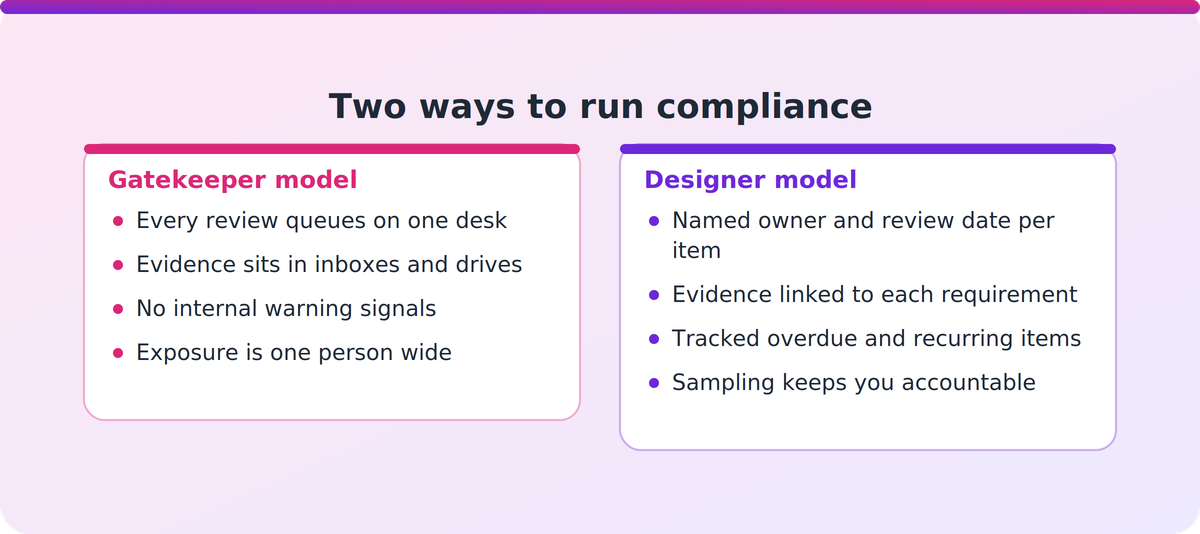
Evidence stays scattered. When approval happens by email, the proof of it lives in inboxes, drives and spreadsheets. That's tolerable in a quiet year. Under an annual, whole-of-organisation self-review it becomes a live exposure.
Nobody is watching for warning signs. NZQA says it takes a risk-informed approach, and an aide-memoire says it will monitor data changes to detect potential risks or warning signs. A provider with a single reviewer has no internal equivalent. The person best placed to spot a pattern is too busy approving individual items to see it.
The exposure is one person wide. Leave, illness or resignation leaves decisions stalled or waved through.
The stakes also carry beyond the audit room. Per a provider-side summary (CTMES, not NZQA), EER category ratings aren't being replaced by a new rating system. NZQA will instead publish information about statutory actions taken against a provider for non-compliance. Immigration New Zealand has said it will keep using existing EER ratings for 12 months from early 2026.
From gatekeeper to system designer
Moving away from single approval doesn't mean giving up accountability. It means making accountability provable. Here is what you can do this quarter:
- Tier your documents by risk. Decide which items genuinely need your sign-off, such as registration-critical policies and responses to rule changes. Everything else goes to a named owner.
- Name an owner and a review date for each document and process. "The compliance team" is not an owner.
- Link evidence to the requirement it supports. One location, one trail. If you can't show it in minutes, assume a reviewer can't either.
- Build your own warning signals. Track overdue reviews, open actions and items that keep coming back late. That's your small-scale version of NZQA's data monitoring.
- Sample delegated approvals. Check a few each quarter. You stay accountable for the system without touching every page.
Our take
The gatekeeper role is comforting because it feels like control. It isn't. Control is being able to say, for any date, who owned each part of the system, what they checked and what evidence backs it.
The iQAF was developed partly in response to stakeholder feedback about growing compliance burden, according to a CTMES summary of the consultation. It doesn't remove the work. It moves it from a periodic scramble to continuous practice, and continuous practice can't sit in one person's queue.
A first step that costs nothing: list the last ten documents you approved, and mark the ones that truly needed you. The unmarked ones are your first candidates for a named owner.
Key takeaways
- The iQAF (live 15 January 2026) and the Quality Assurance of Tertiary Education Providers Rules 2026 require a current quality management system and an annual, evidence-based self-review.
- Single-approver compliance is a structural risk, because system currency is capped by one person's queue.
- NZQA monitors data for warning signs. Build an internal equivalent rather than relying on one reviewer's memory.
- Distribute ownership, keep evidence traceable, and stay accountable through tiering and sampling.
- This argument rests on regulatory design, not workload statistics, which no public source measures.
FAQ
When did the iQAF start, and what does it require of a PTE?
The iQAF went live on 15 January 2026. NZQA expects an up-to-date quality management system, an annual evidence-based self-review with a succinct summary on an NZQA template, and an annual conversation with NZQA.
Do I have to stop approving documents myself?
No. You stay accountable for the system. The shift is from approving everything to designing who owns what, which items need your sign-off, and how you check delegated decisions.
Will NZQA ask for supporting evidence behind the self-review?
The October 2024 consultation draft said providers may need to produce supporting evidence on request. That is draft wording, so confirm the position against NZQA's current self-review guidance before citing it.
Are EER ratings going away?
Per a provider-side summary (CTMES, not NZQA), there is no new rating system. NZQA will instead publish information about statutory actions taken for non-compliance. Immigration New Zealand will keep using existing EER ratings for 12 months from early 2026.