Compliance Evidence Ownership: A NZQA Guide for PTEs
12 October 2026 · 7 min read
NZQA has replaced the periodic external audit with something harder to stage-manage: an annual self-review resting on a quality management system that is up to date on any given day. The biggest risk is no longer a failed audit. It is a compliance function that quietly owns every piece of evidence and cannot show that any of it is current.
Why this lands on your desk
Under the Quality Assurance of Tertiary Education Providers Rules 2026, in force from 19 January 2026, you answer for four things. They are an up-to-date quality management system, an annual self-review, reporting on that self-review to NZQA, and discussing the improvement plan with NZQA. None of these is a one-off event.
The external panel used to be your early-warning system, however uncomfortable. NZQA announced on 15 January 2026 that the integrated Quality Assurance Framework (iQAF) is live. From 1 January 2026 it is not beginning any new external evaluation and review (EER) processes or consistency reviews, though those already under way will be completed. If gaps are going to be found, you now find them first.
Meanwhile the rules changed across several instruments at once: the QA Rules, the Private Training Establishment Rules 2026, the Programme Approval, Recognition, and Accreditation Rules 2026, and the Qualification and Micro-credential Listing rules. References to Workforce Development Councils moved to Industry Skills Boards. Someone has to recheck policies, programme documents and standards versions. In most PTEs, that someone is you.
What iQAF actually asks of you
The shape is simple. Providers submit an annual self-review summary report and meet NZQA to discuss the improvement plan. NZQA's information session Q&A says it intends to reduce compliance by incorporating as much of the self-review as possible.
Read that carefully. A lighter touch from the regulator does not mean a lighter load inside your organisation. It means the self-review has to be credible enough to carry the weight. A self-review built from memory, or from whatever you could find in your inbox the week before, will not be.
The framework applies to all private training establishments, wānanga, polytechnics, industry skill boards and government training establishments. Nobody is exempt from the question.
The sub-contracting rule shows where NZQA is heading
Sub-contracting now sits in the QA Rules. It requires a copy of the arrangement and evidence of internal quality assurance approval by the Chief Executive or a senior manager with delegated authority. SAARA, a consultancy rather than a regulator, advises that NZQA approval must be sought before any training takes place.
The detail matters less than the pattern. NZQA is asking for a named person with authority, and a trail showing that person signed off. It is not asking whether the compliance team handled it.
That is a reasonable reading of the direction of travel, though it is our reading, not a stated NZQA position. Accountability sits with people who hold the authority, and the evidence has to show it.
Run the owner test on your evidence
The bottleneck is rarely laziness. It is that compliance becomes the default home for anything with a standard attached. You review it, you file it, you remember when it expires.
Try this on your ten most important evidence items. Policies, sub-contracting approvals, assessment records retention arrangements, programme approval conditions and pastoral care documentation are good starting points. For each one, ask the questions below.
The five-question owner test
- Who owns the content, by name and role, not by department?
- Who has delegated authority to sign it off?
- When was it last reviewed, and is that date visible without asking you?
- When is the next review due, and what triggers an earlier one?
- If you were away for a fortnight, could someone else answer all four?
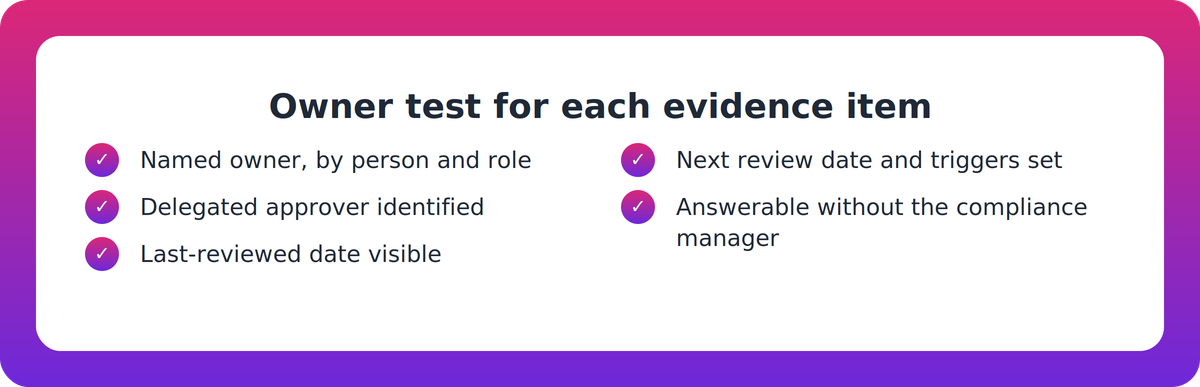
If the honest answer to the last question is no, you have found the gap. It will not show up as a missing document. It will show up as a document nobody can vouch for.
Delegate sign-off, keep assurance
Moving ownership out of compliance does not mean stepping back. Your role shifts from author and approver to assurer. You set the standard for what "current" means, you check that owners are keeping to it, and you report on it in the self-review.
A workable pattern looks like this:
- Keep a single register of evidence items, each with an owner, a delegated approver, a last-reviewed date and a next-review date.
- Let programme leads own programme documents and let operations own records retention. Let the Chief Executive or delegated senior managers own approvals the rules assign to them.
- Review the register monthly, not annually. Chase the overdue items, not the whole library.
- Use the register as the backbone of the annual self-review, so the report is a summary of what you already know.
The format matters less than the discipline. A spreadsheet with honest owners beats a sophisticated system with blank fields.
International learners: don't let the clock confuse you
If you enrol international learners, note the timing. Immigration NZ will keep using existing EER ratings for 12 months from early 2026, and the research found no successor arrangement. The Pastoral Care Code 2021 still applies, and it requires timely action on deficiencies identified in a review.
That last point connects directly to ownership. A deficiency with no named owner is a deficiency nobody acts on in time. You may see claims online that providers failing the new requirements will lose the ability to enrol international students. We could not verify that, so treat it with caution.
What we don't know yet
NZQA said it will provide self-review templates and engage on scheduling. The research found no published templates or first-submission dates. Confirm timing directly with NZQA through the quality assurance hub rather than relying on a third party's reading. Build your register now, because it will serve whatever template arrives.
Key takeaways
- iQAF replaces periodic external audit with an annual self-review, a report to NZQA and an improvement-plan conversation.
- NZQA is not starting new EER or consistency reviews from 1 January 2026, so early warning now has to come from inside your organisation.
- The sub-contracting rule's requirement for Chief Executive or delegated senior-manager approval signals that NZQA expects named, traceable accountability.
- Every evidence item needs an owner, a delegated approver and a visible review date. If it depends on your memory, it is not ready.
- Your job moves from author and approver to assurer. You define "current" and check that owners meet it.
Our take
Most compliance managers we speak to see themselves as the safety net. That instinct is understandable and it is now the weak point. A single safety net gives you a single point of failure, and under an annual self-review model that failure is visible to NZQA.
The providers who will find iQAF easy are not the ones with the thickest policy library. They are the ones where a programme lead can say "that's mine, I reviewed it in March, it's due again in September" without calling compliance. Spreading ownership is not a loss of control. It is the only way to prove control on an ordinary Tuesday.
Start small. Pick one document type this week and put a name beside every instance of it. Then ask yourself what else you are quietly holding that someone else should own.
FAQ
Does iQAF mean PTEs no longer face external review?
Not entirely. From 1 January 2026 NZQA is not beginning new EER processes or consistency reviews, but those already under way will be completed. Providers now submit an annual self-review summary report and meet NZQA to discuss the improvement plan.
Who must approve a sub-contracting arrangement?
The QA Rules require a copy of the arrangement and evidence of internal quality assurance approval by the Chief Executive or a senior manager with delegated authority. SAARA, a consultancy, advises that NZQA approval must be sought before any training takes place.
Are there NZQA self-review templates and submission dates yet?
NZQA said it will provide templates and engage on scheduling, but the research found none published and no first-submission dates. Check the NZQA quality assurance hub and confirm timing directly with NZQA.
What happens to EER ratings for international learner enrolment?
Immigration NZ will keep using existing EER ratings for 12 months from early 2026, and no successor arrangement was found. The Pastoral Care Code 2021 still applies and requires timely action on deficiencies identified in a review.