Compliance Evidence Traceability for PTEs: A Manager's Guide
6 October 2026 · 7 min read
The NZQA material we reviewed doesn't prescribe an evidence tool or format. What it does demand is a quality management system you can stand behind. For a compliance manager, that comes down to traceability: who owns each obligation, which version of a standard it was built against, and where the proof sits when someone asks.
Why this lands on your desk
You are the person who has to say whether your quality management system is credible. Under the Quality Assurance of Tertiary Education Providers Rules 2026, a provider that didn't have a system of the required kind on 1 January 2026 must have one before 1 January 2027. That is the nearest hard date in the material, and the sign-off is yours in practice, whatever the org chart says.
Then there is the annual cycle. Every calendar year, your PTE must run an organisational self-review and report to NZQA. The report identifies areas for improvement and the plan to address them, confirms compliance with the Act, the rules and the Code, and describes practice on the themes in NZQA's annual schedule. That is a standing evidence-assembly job, and it doesn't pause for a rule change.
The stakes are real. If a provider doesn't meet NZQA's quality standards, NZQA can withdraw approvals or put conditions on them. A gap in the trail isn't a paperwork irritation. It can become a registration conversation.
Three moving parts that quietly date your evidence
The rulebook has moved on three fronts at once. Each one can make a perfectly good file out of date without anyone noticing.
1. The NZQA Rules. Updated Rules have been in force since 19 January 2026. For PTEs, NZQA's summary says the wording reflects the removal of external evaluation and review, the annual financial return becomes biennial unless NZQA notifies otherwise, enrolment and academic records rules are folded into the PTE Rules, and the Annual Fee Rules 2022 are revoked. Any policy that cites the old structure now points at something that has moved.
2. Who owns the standards. The new VET system started operating on 1 January 2026, with eight Industry Skills Boards and 10 stand-alone polytechnics. From that date the ISBs develop and maintain industry qualifications and unit standards, run national external moderation, endorse consent-to-assess applications and approve micro-credentials. The Workforce Development Councils that held those duties have been disestablished. If your moderation records or approval evidence name the old body, a reader will have to work out the link themselves.
3. Review timing. The Directory of Assessment and Skill Standards rules remove the five-year maximum review period, and the Qualification and Micro-credential Rules were re-issued on 1 January 2026 with changed review periods. The sources we reviewed don't state the new periods, so check the NZQA Directory and your ISB directly. What we can say is that you can no longer assume a standard will sit still for five years.
Programme approval is shifting too. NZQA notes that requirements are reduced where a qualification consists entirely of skill standards. Whatever the outcome for you, the approval evidence is only defensible if you can show which version of the rules it was built under.
Traceability is a design question, not a tooling one
It's tempting to read all this as a case for buying something. The material doesn't support that. NZQA's self-review toolkit says there is no prescribed format for self-review, although it expects certain core components. Nothing we reviewed shows NZQA requiring a particular system of record.
So the useful question isn't "which tool?" It's whether your system, whatever it runs on, can answer a small set of questions fast. A spreadsheet that does can beat a platform that doesn't.
The three-question test
Pick any obligation: a Code requirement, a PTE Rule, a unit standard you assess against. Time yourself answering these:
- Who owns it? A named person, not a team or a shared inbox.
- What version was it built against? The rule or standard version, and the date you last checked it.
- Where is the evidence? A location someone else could open without calling you.
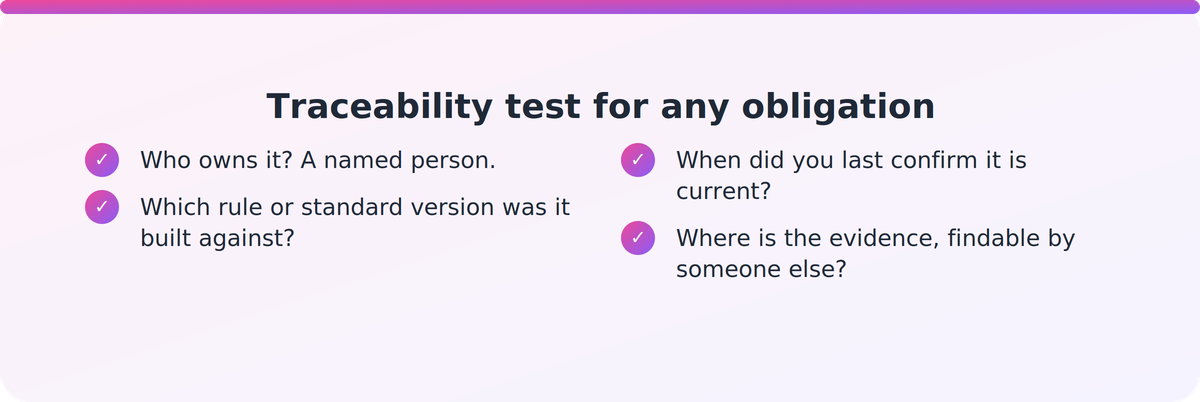
If you can answer all three in minutes, you are audit-ready in the way that matters. If the honest answer is "I'd have to ask around", you've found your exposure, and it's cheaper to find it now than during a rectification scramble.
What to do this quarter
You don't need a transformation programme. You need a small number of habits that make the trail current.
- Build a register of obligations, not a pile of documents. One line per obligation from the Act, the PTE Rules, the Code and your own policies, each with an owner and an evidence location.
- Stamp versions. Record which rule or standard version each policy and assessment was built against, and when you last confirmed it is current. Where a body has changed (WDC to ISB, for example), note it.
- Set a review trigger for each standard. Without a fixed maximum review period, you can't rely on the calendar. Put a recurring check against the NZQA Directory and your ISB's communications.
- Run the self-review as a year-round feed. If the annual report is assembled in a rush each year, the trail is being rebuilt, not kept. Log improvement actions and compliance checks as they happen.
- Spread the load. If every document review routes through you, you are the bottleneck and the single point of failure. Owners should keep their own lines current. You audit the register.
One caveat to state plainly: the sources we reviewed don't say what replaces EER in practice, and NZQA's own pages are inconsistent on it. Check NZQA's site directly rather than relying on a summary, including this one.
Key takeaways
- The material reviewed doesn't show NZQA prescribing an evidence tool or format. Your exposure is the inability to trace, not the absence of software.
- A quality management system of the required kind must be in place before 1 January 2027 if you didn't have one on 1 January 2026.
- Three changes can date your evidence at once: the NZQA Rules (from 19 January 2026), ISB ownership of unit standards (from 1 January 2026), and less predictable review timing.
- For any obligation, you should be able to say who owns it, which version it was built against, and where the evidence lives.
- Verify EER's replacement and ISB-specific unit standard changes directly with NZQA and the relevant ISB.
Our take
Most compliance anxiety in the sector is about the wrong thing. People worry about whether they've kept enough evidence. The more common failure is that they kept plenty and can't connect it to an obligation, an owner or a version.
We think the compliance manager's job is shifting from guardian of documents to designer of the trail. A system of record isn't something a regulator hands you. It's something you decide to build, and the decision is about clarity of ownership, not technology. The 2027 deadline is a fair prompt to make it deliberately.
FAQ
Does NZQA require PTEs to use a specific system for compliance evidence?
Not in the material we reviewed. NZQA's self-review toolkit says there is no prescribed format for self-review, though it expects certain core components. The sources don't show NZQA requiring a particular tool, system of record or evidence format.
What is the next hard deadline for a PTE's quality management system?
1 January 2027. Under the Quality Assurance of Tertiary Education Providers Rules 2026, providers without a quality management system of the required kind on 1 January 2026 must have one before that date.
What must the annual report to NZQA include?
Providers must run an organisational self-review each calendar year. The annual report must identify areas for improvement and the plan to address them, confirm compliance with the Act, rules and Code, and describe practice on themes in NZQA's annual schedule.
How do the Industry Skills Boards affect my evidence trail?
Since 1 January 2026, ISBs develop and maintain industry qualifications and unit standards, run national external moderation, endorse consent-to-assess applications and approve micro-credentials. These were previously Workforce Development Council duties, so records naming the old body should be checked. For ISB-specific changes, confirm with the relevant ISB.
Pick one obligation on your register today and run the three-question test. How long did it take, and what does that tell you about the other hundred?