Compliance Key-Person Risk for Training Providers
4 August 2026 · 8 min read

Your compliance lead resigning shouldn't be a governance crisis. But right now, for many UK training providers, it is. Ofsted's new report-card framework and the biggest apprenticeship funding shake-up in a decade are landing in the same eighteen months as historically high FE staff turnover — turning one person's departure into a board-level exposure.
Why this lands on your desk
You answer to your board for audit outcomes. From 10 November 2025, Ofsted's move to a multi-category report card makes gaps in evidence and self-assessment far more visible than under the old single-grade system — and those gaps surface fastest the moment the person who understood the old evidence base walks out the door.
You also own the P&L exposure sitting underneath all of this. The Growth and Skills Levy, faster levy expiry, higher co-investment rates and Level 7 age restrictions all take effect within months of each other. Get the rules wrong mid-transition and it hits funding income directly, not just a compliance file.
And you're judged on regulatory standing generally, not just on inspection day. Sector guidance is explicit that Ofsted-ready providers embed quality assurance into daily operations rather than treating it as a discrete pre-inspection scramble owned by one person.
The report card raises the bar on what one person can hold in their head
From 10 November 2025, Ofsted's renewed education inspection framework replaced the single overall grade with a multi-category report card covering curriculum, leadership, inclusion and personal development (Wrigleys Solicitors, October 2025). For your board, that's good news and bad news at once. Good, because it maps out where you're strong. Bad, because it also maps out where you're thin, for inspectors and for anyone reading the published outcome.
Sector commentary on the new framework describes a shift "away from surface-level compliance" toward deeper evidence of impact, with safeguarding, inclusion and employer engagement running as golden threads through every judgement area (OneAdvanced; SkillsOfficeNetwork). That's a lot of threads for one compliance lead to hold together, especially if they built the evidence base from scratch and never documented how it fits.
The funding rules are changing faster than most providers can document them
While Ofsted raises the evidence bar, the funding rules underneath apprenticeship provision are being rewritten in the same window. Skills England took over responsibility from the Institute for Apprenticeships and Technical Education in June 2025, then moved under the Department for Work and Pensions in September 2025 (House of Commons Library). Minimum apprenticeship duration dropped to eight months from August 2025. From April 2026, the Growth and Skills Levy starts replacing the Apprenticeship Levy, funding modular apprenticeship units (Business Forever; House of Commons Library).
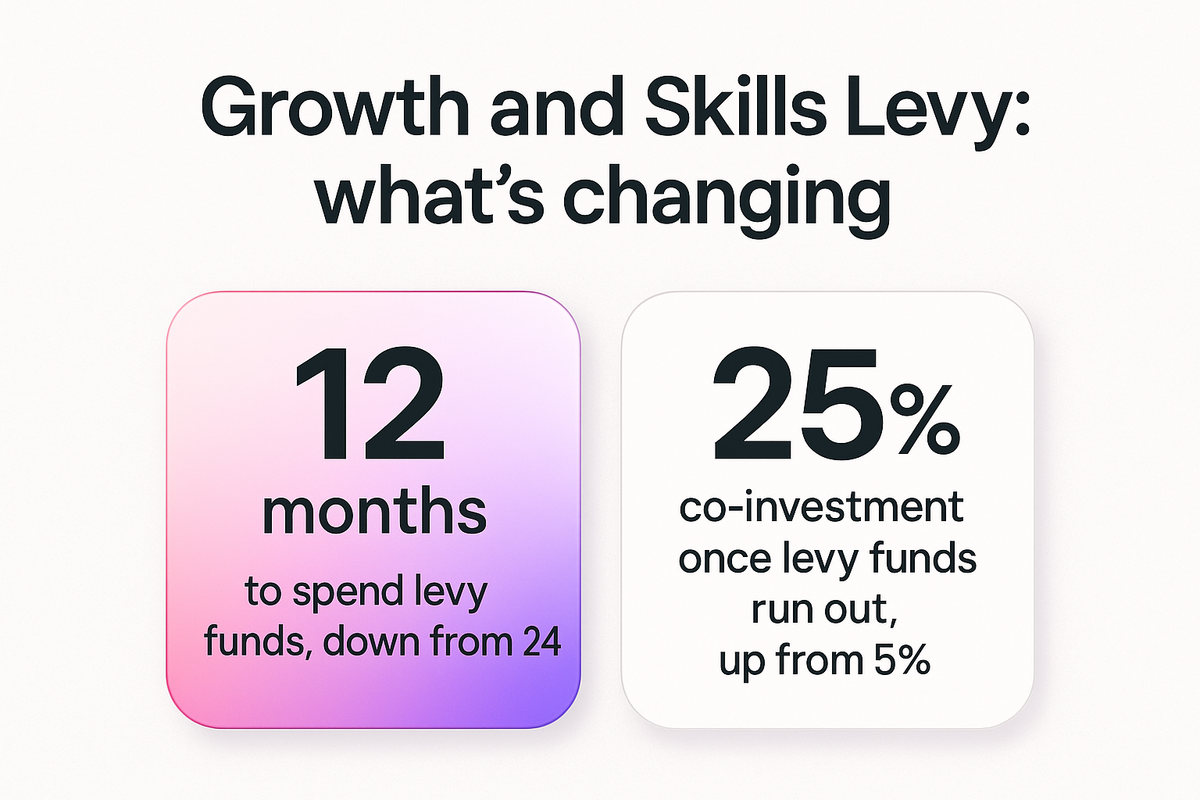
The mechanics matter to your income, not just your compliance file. Employers now have 12 months, not 24, to spend levy funds. Co-investment rises to 25% once levy funds are exhausted, up from 5%. The monthly government top-up is being withdrawn (Grant Thornton, December 2025). From January 2026, Level 7 apprenticeship funding is restricted to apprentices aged 16 to 21 at the start of their apprenticeship, narrowing eligibility for some of your higher-value provision (House of Commons Library).
Get any one of these wrong mid-transition and it shows up in your funding income, not just an audit finding. That's a P&L conversation, not an HR one.
Why the person who understands all this is a flight risk
Here's the part that should worry you most: the workforce carrying this knowledge is under real pressure to leave. FE college one-year staff retention sat at 75.5% in 2023/24 — better than recent prior years, but still historically low (DfE, Explore Education Statistics). Parliamentary written evidence and NFER/Gatsby research both point to a pay gap of roughly £9,300 against school teachers, alongside excessive administrative workload, as leading drivers of attrition (NFER/Gatsby, September 2024).
Compliance and quality roles carry more of that administrative load than almost anyone else in the building. If your best compliance lead is tired, underpaid relative to comparable roles, and sitting on institutional knowledge that lives nowhere except their own head, you don't have a staffing risk. You have a single point of failure sitting across your audit readiness and your funding compliance at the same time.
Treat quality assurance as infrastructure, not inheritance
Sector compliance guidance is blunt about what separates providers that sail through inspection from those that scramble: effective providers "embed quality assurance into daily operations rather than treating inspection preparation as a discrete activity," backed by robust self-assessment, regular internal review and systematic evidence-gathering (SkillsOfficeNetwork, Apprenticeship Providers: A 2026 UK Compliance Guide).
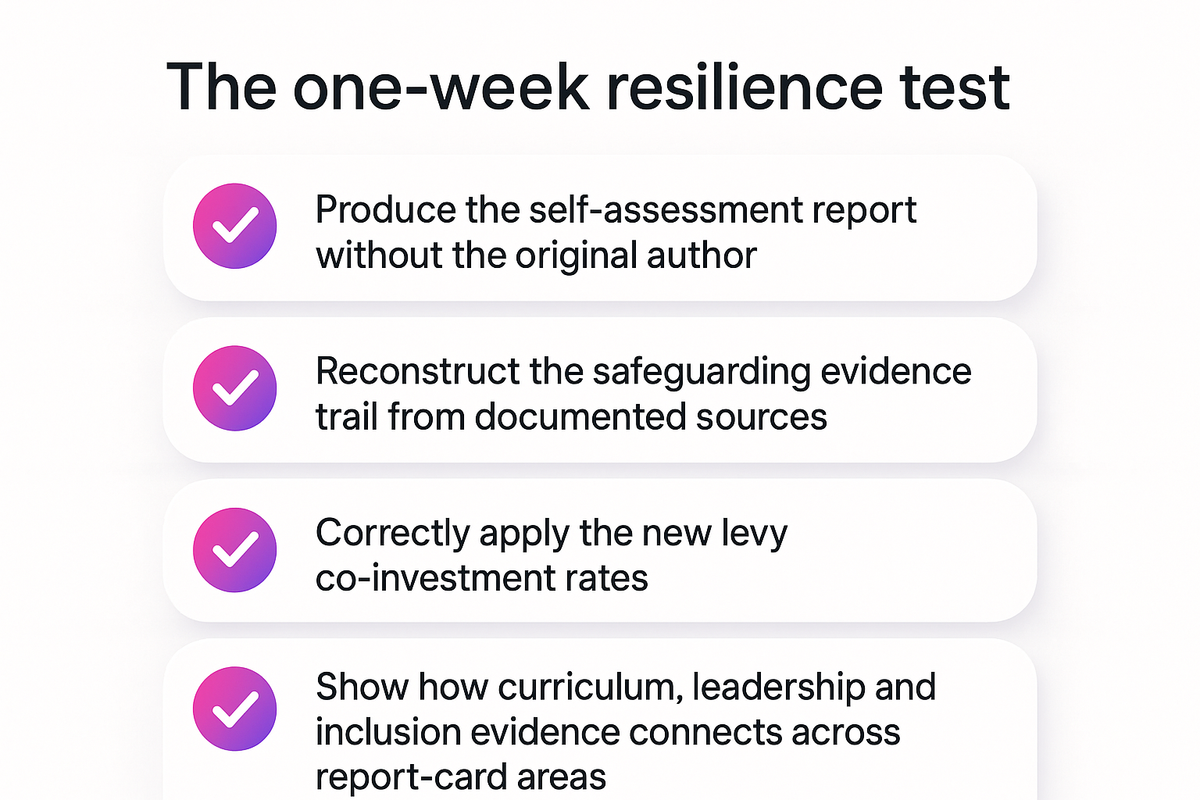
That's a structural statement, not a personnel one. The evidence base, the self-assessment cadence and the funding-rule interpretations should sit in documented processes and shared systems — reviewable by more than one person, understandable by a successor without months of ramp-up, and current enough to survive a departure without a scramble.
A useful test for your next board paper: if your compliance lead left tomorrow, could someone else produce your self-assessment report, reconstruct your safeguarding evidence trail, and correctly apply the new levy co-investment rates within a week? If the honest answer is no, that's your risk register item, not theirs.
Where AI genuinely changes the calculation
Ofsted's own published findings on early AI adopters in the sector concluded that "the biggest risk is doing nothing" (Ofsted, 2025, via Third Space Learning) — a signal that regulators expect providers to actively engage with how AI reshapes delivery and operations, not wait for certainty. That doesn't mean bolting AI onto a broken process. It means the providers thinking hardest about resilience are asking where technology can turn tacit, one-person knowledge into something documented, searchable and teachable — whether that's evidence management, self-assessment drafting, or the practice environments where new compliance staff actually build competence before they're trusted with a live audit.
Key takeaways
- Ofsted's report-card framework (from 10 November 2025) makes thin evidence far more visible to your board and to inspectors — gaps surface fastest right after a key compliance person leaves.
- The Growth and Skills Levy, faster levy expiry, higher co-investment rates and Level 7 age restrictions are all landing within months of each other; misapplying any of them hits funding income directly.
- FE retention data (75.5% one-year retention, 2023/24) and a roughly £9,300 pay gap against school teachers mean losing your compliance lead is a realistic near-term risk, not a hypothetical one.
- Sector guidance is consistent: providers that embed quality assurance into daily operations, rather than holding it in one person's head, are best placed to handle both the inspection and funding transitions.
- A fair test for your board: could someone else reconstruct your self-assessment and correctly apply the new funding rules within a week of your compliance lead leaving?
Our take
Key-person risk in compliance isn't a new idea — providers have talked about the "bus factor" for years. What's changed is the cost of getting it wrong just went up on two fronts at once. A thinner evidence base is now visible in a report card your board, and ultimately the public, can read. A funding-rule error during the levy transition lands on your income statement inside the same financial year. Boards that would never accept a single point of failure in their finance function are, in our experience, still comfortable with it in compliance. That's worth revisiting at your next governance meeting, independent of who currently holds the role.
FAQ
Does Ofsted's new report card actually change what evidence we need, or just how it's graded? Both. The framework replacing the single overall judgement from 10 November 2025 covers separate categories — curriculum, leadership, inclusion and personal development among them — and sector commentary describes a shift toward deeper evidence of impact rather than surface-level compliance (Wrigleys Solicitors; OneAdvanced). Providers need evidence that demonstrates outcomes across each area, not just a compliance checklist.
What's the actual timeline for the funding changes we need to track? Skills England took over from the Institute for Apprenticeships and Technical Education in June 2025 and moved to the Department for Work and Pensions in September 2025. Minimum apprenticeship duration fell to eight months from August 2025. The Growth and Skills Levy begins replacing the Apprenticeship Levy from April 2026, and Level 7 apprenticeship funding narrows to apprentices aged 16 to 21 from January 2026 (House of Commons Library).
How big is the FE staff turnover problem, really? One-year retention for FE college staff was 75.5% in 2023/24 — better than recent prior years, but still low by historical standards, according to DfE's Explore Education Statistics data. Parliamentary written evidence and NFER/Gatsby research (September 2024) point to a roughly £9,300 pay gap against school teachers and heavy administrative workload as the leading causes.
Is embedding quality assurance into daily operations really different from good inspection prep? Yes, according to sector compliance guidance. Inspection prep is a discrete activity you do before a visit. Embedded quality assurance means self-assessment, internal review and evidence-gathering happen continuously as part of how the provider runs — so there's nothing to reconstruct when someone leaves or an inspector calls.