Construction Apprentice Training NZ: Rehearse Safety First
21 September 2026 · 7 min read
New Zealand's construction sector is about to be judged less on paperwork and more on whether workers can actually hold a safe, practical conversation on site. The Health and Safety at Work Amendment Bill, in force from 1 April 2027, sharpens the focus onto managing critical risks and repositions WorkSafe as an educator as much as an enforcer. MBIE's own consultation shows the group most likely to fall through that gap is young apprentices — which means the fix has to happen before they ever reach a real job.
What's actually changing under the reform?
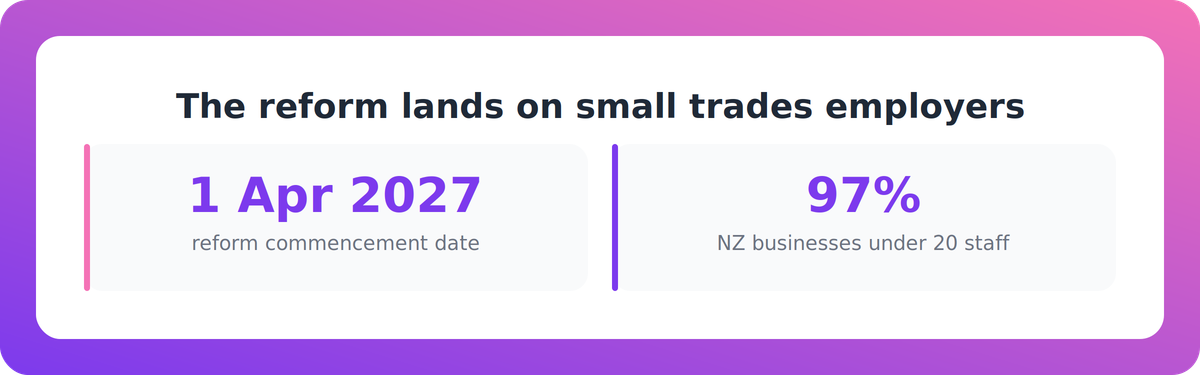
The Health and Safety at Work Amendment Bill received Royal Assent on 9 July 2026. Commencement was pushed back from the original 1 November 2026 date to 1 April 2027, giving employers and training providers a defined runway to prepare, according to MBIE and law firm Securo.
The substance of the reform matters more than the date. Russell McVeagh's analysis notes the changes sharpen the Health and Safety at Work Act's focus onto managing critical risks specifically, and shift WorkSafe's posture toward advice and education rather than enforcement-first regulation. MBIE frames this as a deliberate move away from documentation-heavy compliance.
That shift lands unevenly. Russell McVeagh points out that 97% of New Zealand businesses have fewer than 20 employees — and those are exactly the businesses that host most trades apprentices. A small plumbing, electrical or building firm doesn't have a health and safety team. It has a supervisor, a site, and whatever training the apprentice arrived with.
Why does this matter most for apprentices?
MBIE ran roadshow consultation meetings from June to October 2024, and the detailed summary of feedback is still shaping the current reform debate. One point stands out: stakeholders explicitly raised concern that safety training doesn't reliably translate into safe on-site behaviour, particularly for younger workers. One respondent even questioned whether bolting more health and safety courses onto an apprenticeship achieves anything, if the underlying behaviour doesn't change.
WorkSafe's own guidance on young people at work backs this up from a different angle. It tells employers to train according to a worker's lack of experience and to supervise closely — an acknowledgement that the real gap isn't safety knowledge, it's applying that knowledge under pressure, in real time, in front of a crew.
That's a judgement problem, not a content problem. And judgement is hard to build from a module you read once during induction week.
What does a good safety conversation actually look like?
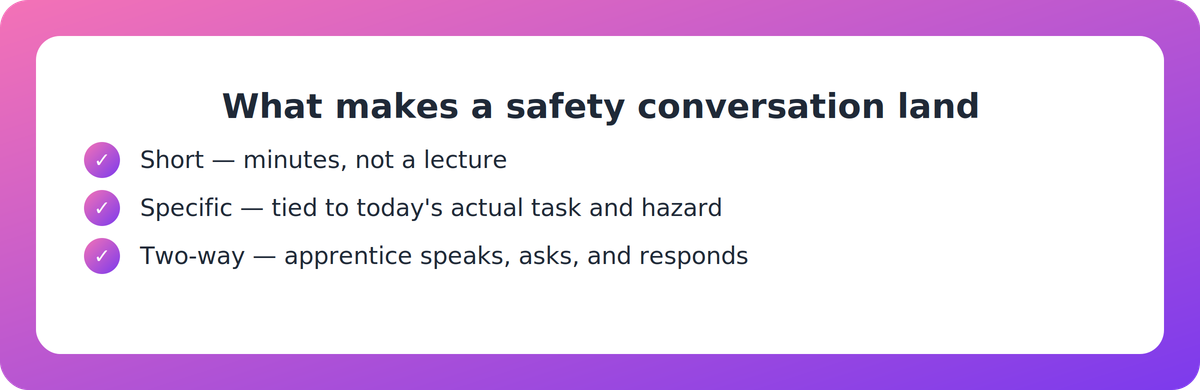
New Zealand already has solid, established guidance on this. NZOHS, Business.govt.nz, and the Business Leaders' Health & Safety Forum all describe the same shape for an effective toolbox talk or site safety conversation:
- Short — a few minutes, not a lecture.
- Specific — tied to the actual task and hazard in front of the crew that day.
- Genuinely two-way — the apprentice is expected to speak, ask, and respond, not just nod along.
That last point is where formal training tends to fall down. Guidance on running the conversation well has existed for years. Practice actually having it — before the apprentice's first real exchange with a site supervisor — has largely been missing from how trades training is delivered.
Where's the actual rehearsal gap?
Most apprentices in New Zealand's building, electrical, plumbing and engineering trades train through a mix of ITP or Te Pūkenga coursework, PTE delivery, and on-the-job supervision through organisations like BCITO, Competenz or ATNZ. Unit standards cover the technical and safety knowledge thoroughly. What they rarely cover is a rehearsed, low-stakes attempt at the conversation itself — the moment where an apprentice has to speak up about a hazard, respond to a supervisor's question, or push back respectfully when something looks wrong.
A single employer, especially one of the 97% with fewer than 20 staff, can't run that rehearsal repeatedly for every new apprentice. There's no facilitator budget, no spare supervisor hours, and no realistic way to simulate the pressure of a live site.
Can AI-generated role play close this gap before the site visit?
This is exactly the kind of scaling problem that structured, AI-generated role play is built to solve. Instead of one static induction video, an apprentice can work through a series of short, contextual scenarios — a supervisor asking why a barrier isn't up, a crew member dismissing a hazard call-out, a first toolbox talk they're expected to lead.
Nova by Supahuman, an NZ-built instructional design platform already in use with training providers here, generates this kind of role-play and simulation practice mapped to unit standard requirements, while keeping the actual competency sign-off with a human assessor. The apprentice gets repeated, coached practice at the conversation itself, not just the theory behind it — closing exactly the gap MBIE's consultation flagged, at a scale no single small trades employer can replicate with a one-off toolbox talk.
Key takeaways
- The Health and Safety at Work Amendment Bill takes effect 1 April 2027, shifting focus from documentation to managing critical risks and repositioning WorkSafe as educator as well as enforcer.
- MBIE's 2024 roadshow consultation found stakeholders specifically worried that safety training doesn't reliably convert into safe behaviour among younger workers.
- 97% of NZ businesses employ fewer than 20 people, meaning most apprentices train inside employers with little capacity to run rich, repeated safety conversation practice.
- NZ guidance already defines what a good toolbox talk looks like — short, specific, two-way — but rehearsing that conversation before a real site interaction has been largely absent from formal training design.
- AI-generated role play, mapped to unit standards with human assessor sign-off retained, offers a way to give every apprentice that rehearsal without adding facilitator headcount.
Our take
The reform is right to push toward real conversations over paperwork — but it also exposes how thin the industry's practice infrastructure has been for building that exact skill. Guidance on what a good safety talk sounds like has existed for years; giving apprentices a genuine chance to try it, get it wrong, and try again has not. Training providers who wait for WorkSafe's educative role to fully materialise before acting will be behind employers who start giving apprentices rehearsed practice now, especially inside the 97% of businesses too small to run that rehearsal themselves.
FAQ
When does the Health and Safety at Work Amendment Bill take effect in New Zealand? The Bill received Royal Assent on 9 July 2026. Commencement was moved from 1 November 2026 to 1 April 2027, giving businesses and training providers extra time to prepare, per MBIE and Securo.
Why does the reform focus on WorkSafe as an educator rather than an enforcer? MBIE and Russell McVeagh both note the reform sharpens attention on managing critical risks and shifts WorkSafe's posture toward advice and education, moving away from documentation-heavy, enforcement-first compliance.
Why are apprentices singled out as a risk group in MBIE's consultation? MBIE's 2024 roadshow consultation recorded stakeholders raising concern that safety training doesn't reliably translate into safe on-site behaviour for younger workers, a concern echoed in WorkSafe's guidance on young people at work.
What makes a toolbox talk effective, according to NZ guidance? NZOHS, Business.govt.nz and the Business Leaders' Health & Safety Forum agree effective safety conversations are short, specific to the task at hand, and genuinely two-way rather than one-way instruction.
How can training providers give apprentices rehearsal before a real site visit? Structured role-play and simulation practice, mapped to unit standard requirements with assessor sign-off retained, lets apprentices rehearse safety conversations repeatedly before facing them for real — something individual small trades employers struggle to provide at scale.