Contact Centre Training New Zealand: The Hard Calls Gap
1 October 2026 · 6 min read
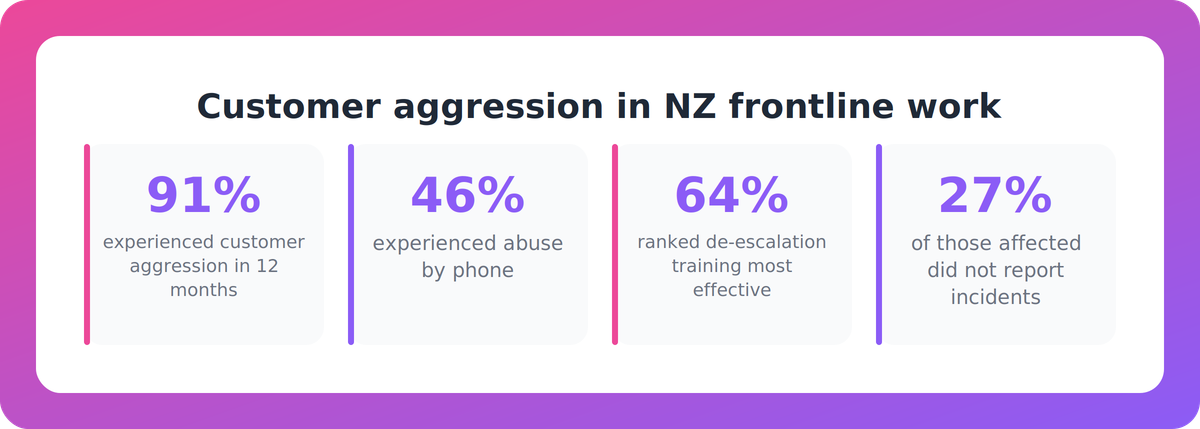
New Zealand contact centres are heading into a squeeze. AI is absorbing routine contacts, which leaves people with the hardest calls, yet contact centre training in New Zealand is still mostly generic and classroom-based. Frontline workers know what would help: in a 2026 national study, 64% ranked de-escalation training as the most effective employer action.
How common is customer aggression, including by phone?
More common than most leaders would like to admit. The ShopCare National Customer Aggression Survey, run with KPMG NZ and reported on 22 September 2026, is described as the first national study of its kind. It surveyed more than 2,500 frontline workers.
- 91% experienced customer aggression over 12 months.
- 46% experienced abuse by phone.
- 67% reported stress and 59% reported anxiety.
- 27% of those affected did not report incidents to their employer.
One caveat. The sample is mostly retail and frontline workers, not contact centre staff specifically. But the phone figure matters, and it matches what the contact centre sector has been saying for a while.
In November 2023, Contact Centre Network New Zealand (CCNNZ) warned that caller abuse of staff had reached unprecedented levels and was threatening workers' mental health. Lifeline Aotearoa's Lifeline Connect Training also reports that call centres are managing growing numbers of distressed, angry and aggressive callers. Its clients include Air New Zealand and Mercury NZ.
What preparation do contact centre workers get before they start?
Not much that's required. Careers NZ states there are no specific training requirements for contact centre workers. Entry routes are mostly general: Solomon Group, for example, runs a free 12-week programme covering complaints handling and resilience.
That's useful grounding. It isn't practice for the call that goes wrong at 4:40 on a Friday afternoon.
There's one clear exception. Emergency 111 communication centres have specific training. That tells us something: when a sector recognises the stakes, it finds a way to train for hard calls.
What does upskilling look like once people are on the phones?
Mostly short courses. Providers such as PD Training, Resolution Education and Nevis Training offer programmes on difficult callers and challenging customers. Lifeline's offering is largely face-to-face.
These have value. Techniques like active listening and staying calm under pressure are worth learning. But from the course listings, none appear to rehearse an organisation's own high-risk scenarios. That's our reading of the listings, not a stated finding.
A generic course can't know that your most dangerous call is a hardship arrangement gone wrong, or a bereaved customer closing an account.
Why are the calls that matter most so hard to train for?
To be upfront: we found no recent New Zealand research on training for complex or high-stakes contact centre calls. What follows is analysis, not evidence.
The pattern looks like this:
- The calls are rare. An agent might take a handful of truly difficult calls a month, so there's little chance to learn by repetition.
- Time off the phones is expensive. Pulling a team into a classroom costs coverage.
- Real calls are a poor place to practise. Learning on a live, aggressive caller costs the customer, the agent and the organisation.
- Workshops are generic. One session for everyone can't reflect each team's products, policies and risk profile.
Skill fades without rehearsal. A one-off course, however good, doesn't give people reps.
What changes when AI takes the easy calls?
The mix shifts. Salesforce's State of Service research, reported by Contact Centre Magazine, found 77% of ANZ service leaders say AI agents are essential to meeting business demand. 35% say keeping up with changing customer expectations is a challenge.
If routine contacts go to automation, what reaches a person is more emotional, more complex and more likely to be escalated. A US-focused Verint survey of 1,000 agents points the same way: 61% expect more complex, technical responsibilities, and 31% are considering leaving within six months. That's US data, so treat it as a comparison, not a New Zealand finding.
The risk is plain enough. We may be handing people the hardest work while preparing them with the thinnest training.
What would better practice look like?
The ingredients aren't exotic:
- Scenarios built from your own data. Drawn from QA reviews, common complaints, escalations and the interactions you already know are high-risk.
- Safe repetition. Agents can try a call, get it wrong, and try again without a customer on the line.
- Coaching in the moment. Feedback on tone, pacing and word choice, not just a score at the end.
- Short sessions. Fifteen minutes between calls beats a day off the floor.
- Evidence of change. Practice data that shows whether behaviour is shifting.
AI role play is the obvious candidate here. Vendors such as Mindtickle describe building scenarios from QA data and escalations. Keep in mind that's a vendor's account of its own approach, not independent proof. It's worth testing against your own results.
For providers and corporate L&D teams, there's a second question. If your learners are heading into contact centre roles, does your programme include any practice at all with a difficult caller?
Key takeaways
- 91% of 2,500+ frontline workers experienced customer aggression in a year, and 46% were abused by phone (ShopCare and KPMG NZ, 2026). The sample is mostly retail.
- 64% ranked de-escalation training as the most effective employer action, so the demand is there.
- Careers NZ says contact centre work has no specific training requirements, and most available upskilling is generic or face-to-face. 111 centres are the exception.
- As AI absorbs routine contacts, humans are likely to face a bigger share of difficult calls.
- There's no recent NZ research on training for complex calls. Why it's hard is an informed inference, not a proven finding.
Our take
We think the sector is treating de-escalation as a soft skill when it's closer to a safety skill. 111 centres already show it can be trained properly. The gap isn't knowledge about what good looks like; it's access to safe, repeated, organisation-specific practice. Whoever closes that gap first will keep more people and protect them better.
FAQ
Is there a required qualification for contact centre work in New Zealand?
No. Careers NZ states there are no specific training requirements for contact centre workers. Employers and training providers set their own entry programmes, which are typically generic and cover areas such as complaints handling and resilience.
How common is abuse of phone-based workers in New Zealand?
The ShopCare and KPMG NZ study found 46% of respondents had been abused by phone, and 91% had experienced customer aggression in 12 months. The sample is mostly retail and frontline staff, not only contact centre workers. CCNNZ raised caller abuse as a concern in November 2023.
What training do frontline workers say works best?
In the 2026 ShopCare study, 64% ranked de-escalation and customer aggression training as the most effective action employers could take. That's the worker's view, not a measured outcome of any particular programme.
Why is contact centre training in New Zealand hard to get right?
There's no recent NZ research on this, so this is analysis. Difficult calls are rare, time off the phones is costly, live calls are a poor place to practise, and most courses are generic rather than built on an organisation's own scenarios.
Can AI role play help with difficult-call training?
Potentially. Vendor sources describe AI role play built from QA data, complaints and escalations, giving agents safe repeat practice. That's a description of an approach, not independent evidence, so test it against your own outcomes.