Content Debt: NZ's 2026 Rules Just Made It Dateable
29 July 2026 · 7 min read

Content debt used to be a maintenance backlog you'd get to when the calendar allowed. Since 19 January 2026, it's a dateable compliance event. NZQA's rewritten rules, a renamed and restructured polytechnic sector, and the removal of a fixed five-year skill standard review cycle mean any programme material still referencing Te Pūkenga, Workforce Development Councils or External Evaluation and Review is now measurably out of step with the framework NZQA uses to assess it — not eventually, but right now.
Why this lands on your desk
You're the one who has to physically find every mention of the old structures across your content library — LMS modules, assessment guides, programme documents — and correct them before NZQA's 2026 Rules bite at your provider's next renewal or self-review. Search-and-replace doesn't cover it, because that terminology sits inside compliance-mapped content that also has to keep making pedagogical sense.
At the same time, annual self-review has replaced periodic External Evaluation and Review. You no longer get to prove currency once every few years and move on. You now have to demonstrate it every calendar year — a permanent line item on your workload, not a project with an end date.
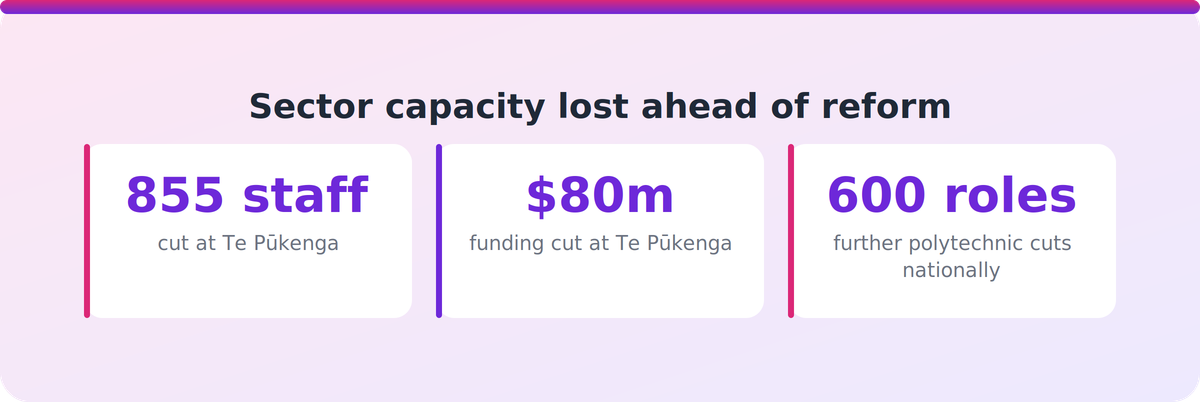
And you're doing this with fewer colleagues than you had eighteen months ago. Te Pūkenga cut more than $80 million in funding and 855 staff — roughly 10% of its workforce — ahead of disestablishment, and Cabinet papers point to a further 600 or so polytechnic roles and 500 courses affected nationally. Speed and quality of delivery are still what you're judged on. There are just fewer hands to deliver them with.
What actually changed on 19 January 2026
Three rule sets took effect on that date: the Quality Assurance of Tertiary Education Providers Rules 2026, the Programme Approval, Recognition, and Accreditation Rules 2026, and the Directory of Assessment and Skill Standards (DASS) Rules 2026. Together they update terminology, replace External Evaluation and Review with mandatory annual self-review, and require providers to hold a formal quality management system by 1 January 2027.
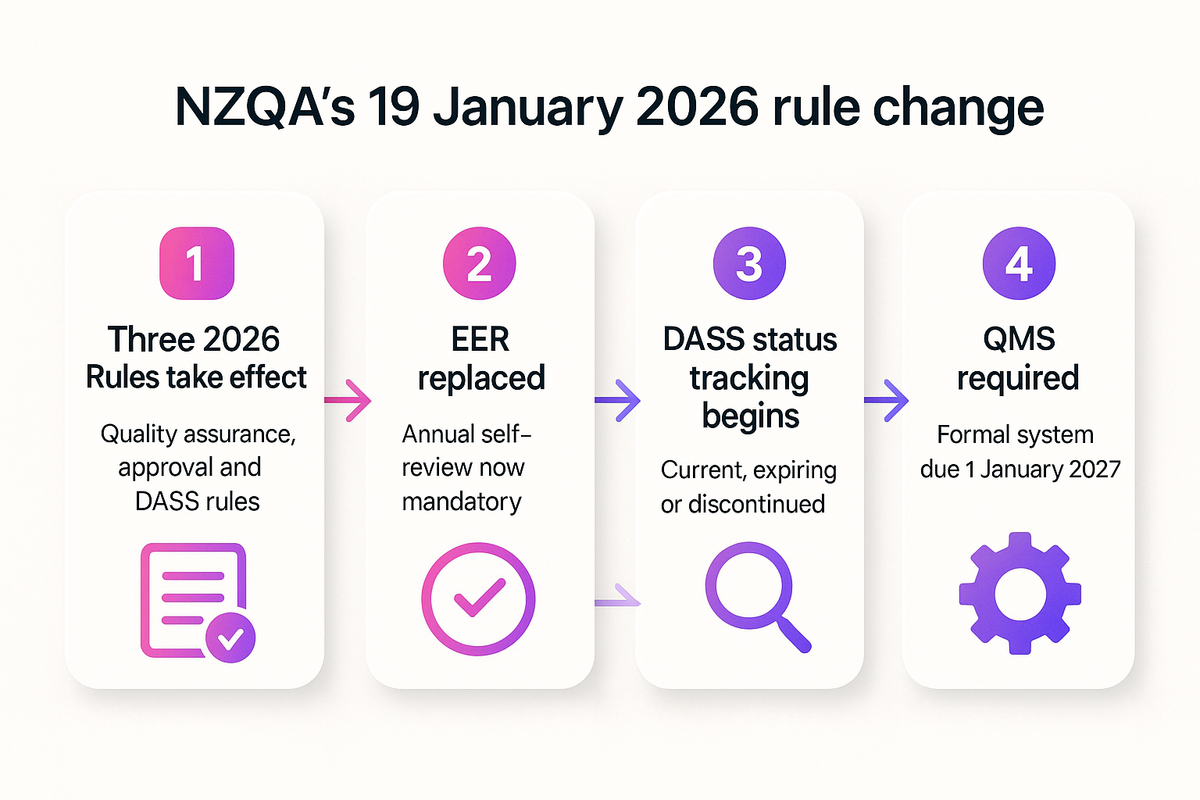
The DASS change matters most for content currency specifically. Skill standards are now tracked as current, expiring or discontinued, and the previous fixed five-year review period is gone. You can no longer assume a unit standard is safe until its next scheduled review — you have to monitor its status on an ongoing basis, because it can shift category without warning on a timetable you used to be able to plan around.
The restructure is a content problem, not just a rename
From 1 January 2026, Te Pūkenga — renamed the New Zealand Institute of Skills and Technology — is being disestablished into 10 regional polytechnics, and Workforce Development Councils have become Industry Skills Boards. Every programme document, induction module and assessment guide that names the old bodies is technically outdated the moment those changes land.
This isn't only a naming exercise. Restructuring is also removing content outright. The closure of Whitireia and WelTec's Te Auaha creative campus eliminated programmes including the NZ Diploma in Māori and Pacific Performing Arts — a reminder that reform doesn't just rename what you maintain, it sometimes deletes it. Four polytechnics — NorthTec, WITT, Whitireia/WelTec and Tai Poutini — remain inside NZIST while working toward financial viability, with decisions on their future due in the first half of 2026. Until those decisions land, you're maintaining content against structures that may themselves still change.
Cultural competency now needs a paper trail
Cultural competency grounded in Te Tiriti o Waitangi has always mattered in NZ vocational content. What's changed is that it's now written directly into NZQA-facing programme guidance, including the New Zealand Certificate in Adult and Tertiary Teaching (Level 5) guidelines, and into Teaching Council professional standards. That shifts it from something you design in good faith to something you have to evidence in your documentation — where the cultural competency decisions sit, why you made them, and how they map to the standard.
If your design documentation doesn't show that reasoning explicitly, it isn't enough to have simply included cultural competency in the finished content. The evidence has to be visible, not implied.
The honest framing
It's worth being precise here: "content debt" isn't a term NZQA, TEC or any other NZ regulatory body uses. It's a useful shorthand for the accumulating burden of content that no longer matches current terminology, structures or skill standard status — but treat it as your own working description, not a defined regulatory category, when you're talking to compliance stakeholders or auditors. Don't let a useful metaphor get mistaken for a rule.
Key takeaways
- NZQA's Quality Assurance of Tertiary Education Providers Rules 2026, Programme Approval, Recognition, and Accreditation Rules 2026, and DASS Rules 2026 all took effect 19 January 2026, replacing EER with mandatory annual self-review and requiring a quality management system by 1 January 2027.
- DASS skill standards are now tracked as current, expiring or discontinued with no fixed five-year cycle — currency has to be monitored continuously, not checked at a scheduled review point.
- Te Pūkenga's disestablishment into 10 regional polytechnics and Workforce Development Councils' replacement by Industry Skills Boards means any content naming the old structures is already outdated.
- The sector has lost over 855 staff and $80 million in funding at Te Pūkenga, with roughly 600 further polytechnic roles cut nationally — fewer people are now responsible for keeping more content compliant, faster.
- Cultural competency tied to Te Tiriti o Waitangi is an explicit, evidenced design requirement in NZQA-facing guidance, not a values statement attached after the fact.
Our take
The uncomfortable truth is that most content libraries weren't built to be re-verified every year. They were built to be approved once and left alone until the next big review. NZQA's move to annual self-review, combined with a DASS system that removes fixed cycles altogether, assumes a level of continuous content governance that most provider teams — squeezed by the cuts of the past year — simply don't have the headcount to sustain manually.
That doesn't mean the answer is working faster with the same tools. It means instructional designers need a much tighter, much more current map of exactly which content touches which regulatory reference, so a rule change or a skill standard status shift can be traced to specific modules in minutes rather than discovered during an audit. Whatever gets you there — a better content register, a disciplined tagging convention, or newer AI-assisted authoring tools that can regenerate scenario-based practice content quickly once source material changes — the goal is the same: shrink the gap between when a rule changes and when your content reflects it, without needing more people to do it.
FAQ
Does "content debt" appear in NZQA or TEC terminology? No. It's not a defined regulatory term. It's a useful working description for the accumulating gap between what your content says and what current rules, structures and skill standards actually require — treat it as your own framing, not something to cite as a formal category in compliance conversations.
What's the practical deadline instructional designers should be tracking? 19 January 2026 is when the Quality Assurance of Tertiary Education Providers Rules 2026, the Programme Approval, Recognition, and Accreditation Rules 2026 and the DASS Rules 2026 took effect. 1 January 2027 is when providers must hold a formal quality management system in place.
How often do skill standards need to be checked now that the five-year review cycle is gone? Under the 2026 DASS Rules, skill standards are tracked as current, expiring or discontinued on an ongoing basis rather than on a fixed schedule, so content mapped to them needs continuous monitoring rather than a periodic check.
Where does cultural competency need to be documented, specifically? NZQA-facing guidance such as the New Zealand Certificate in Adult and Tertiary Teaching (Level 5) guidelines and Teaching Council professional standards expect cultural competency grounded in Te Tiriti o Waitangi to be evidenced in design documentation, not just present in delivered content.