Contextualised Learning Design in VET: A Designer's Guide
5 October 2026 · 7 min read
A single scenario is no longer a defensible answer for a mixed cohort. Ten bespoke scenarios aren't a defensible budget either. Under the Standards for RTOs 2025, the workable path for contextualised learning design in VET is one assessment-aligned spine that flexes at the edges, so variation doesn't multiply your maintenance load.
Why this hits your desk
The 2025 Standards took effect on 1 July 2025. They have three parts: the Outcome Standards, the Compliance Requirements and the Credential Policy. ASQA describes the focus as the quality of outcomes for students and employers, with more flexibility in how providers show compliance.
That flexibility comes with a question you now have to answer: how do we know this design works for our cohort? A generic scenario that ticks the unit of competency is a hard answer to defend when the cohort spans industries, experience levels and cultural backgrounds.
There's a second pressure. JSA reports VET teacher shortages in every state and territory, a workforce that is highly casualised, and a projected need for 3,800 more VET teachers over five years. Almost 50% of the workforce is over 50. If your design relies on each trainer improvising differentiation on the day, you've handed a design decision to the people with the least time to make it.
And you carry the rework. Purpose-based qualification design was agreed on 6 December 2024, templates have been available to developers since 1 July 2025, and reformed qualifications are anticipated for delivery from 2026. Every variant you build is another asset to revisit when a unit or package changes.
What the Standards do and don't say
Be careful here. The research behind this piece did not retrieve the clause text on training and assessment resources or learner support. Read those directly in ASQA's Practice Guides, which were published on 17 June 2025, rather than relying on a summary, including this one.
ASQA also says providers must demonstrate compliance against the Standards in effect when a decision is made. That includes activity that began under the 2015 Standards and continues past 1 July 2025. Legacy designs deserve a fresh look, not a quiet carry-over.
Here is an inference, not an ASQA statement. An outcomes-based approach should leave room for several evidence pathways, including differentiated scenarios. Equally, the research found no explicit clause mandating cultural competency content. So your case for contextualisation rests on learner needs and outcomes, not on a prescribed requirement. That's a stronger argument anyway, because it survives a rewrite of the rules.
Cultural responsiveness is a design input
NCVER's 2026 research (Guenther, Ober, Osborne and Diplock) reports persistent achievement gaps for Aboriginal and Torres Strait Islander learners in VET. Its implications for practice include culturally safe spaces and strong community relationships.
For a designer, the practical reading is this. Scenario variation developed with community input is a different thing from a generic template with the names and locations swapped. The first reflects how work and relationships operate in a place. The second is a costume.
The report's contents also suggest Aboriginal and Torres Strait Islander trainers are best placed to deliver training. The evidence behind that needs the full text, so check it before you build it into a design rationale.
Build a spine, then let the context flex
The way to avoid multiplying production cycles is to decide, early, what must never change and what is allowed to.
What belongs in the spine
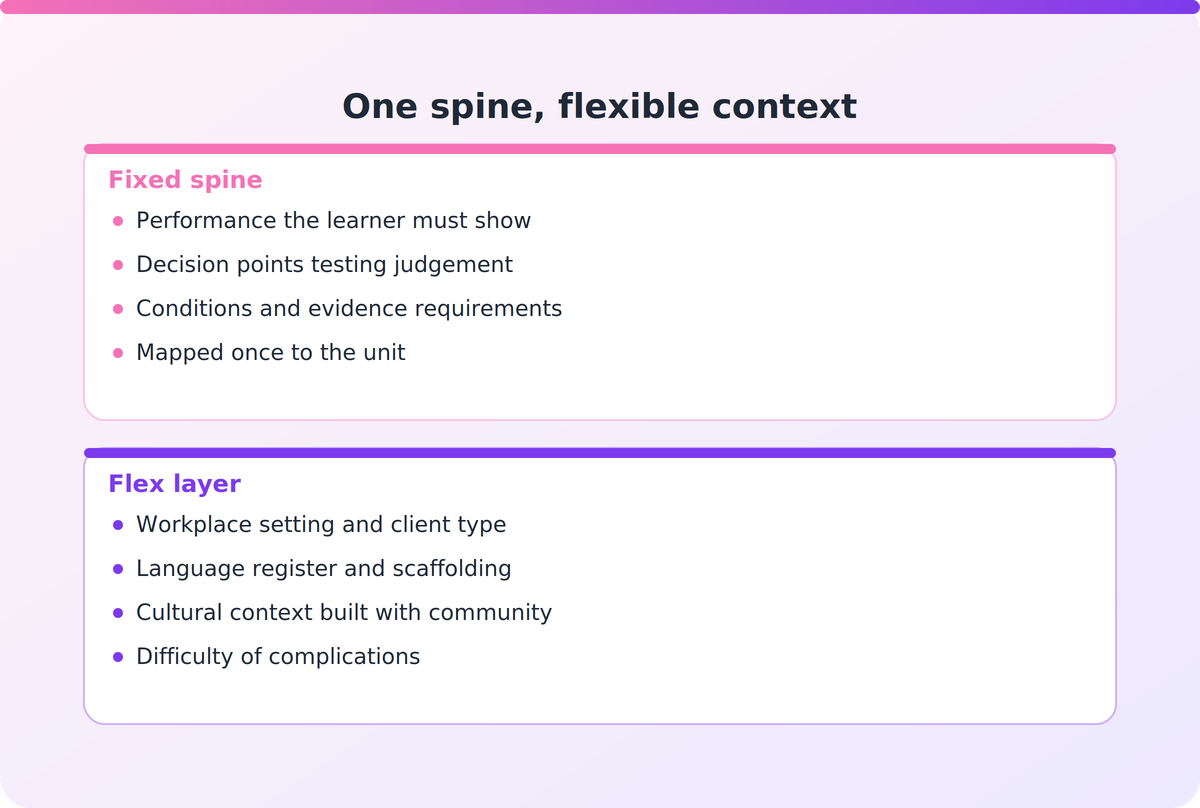
The spine is the part tied to the unit of competency and the assessment requirements. It holds the performance the learner must show, the decision points where judgement is tested, the conditions and the evidence you need to collect. You design it once and map it carefully.
What flexes around it
The flex layer is everything the learner experiences as context:
- the workplace setting, equipment and customer or client type
- language register and the level of scaffolding
- cultural context, built with community rather than for it
- the difficulty of the complications introduced at each decision point
Each variant points back to the spine instead of copying it. When a unit changes, you update the spine once, then review the flex layers against it. You aren't rebuilding five scenarios from scratch.
Keep the maintenance honest
Track which units each spine maps to, and record who contributed to each context variant, including community advisers. Check training.gov.au and the relevant Jobs and Skills Council for which packages have changed. DEWR has temporary oversight of the TAE and FSK training packages, so designers working there should watch for changes closely.
None of this requires a particular platform. The research found no regulatory standard on LMS integration, and the Standards are outcome-based rather than prescriptive about technology.
What we still don't know
The research found no authoritative Australian benchmark for instructional design cost or development time. It found no ASQA guidance on generative AI in training design, and no reliable figure for how often training products change. Anyone quoting you a firm number is guessing. Build your own baseline: hours per scenario, hours per revision, and how many assets each unit change touches.
Key takeaways
- The Standards for RTOs 2025 (in effect from 1 July 2025) focus on outcomes for students and employers, so a single generic scenario is hard to defend for a mixed cohort.
- Differentiation should be designed in, because the VET trainer workforce is casualised and in shortage nationally.
- Separate a fixed, assessment-aligned spine from a flexible context layer, so unit changes are updated once.
- Develop cultural variation with community input, drawing on NCVER's 2026 findings, rather than adapting a generic template.
- Verify clause detail in ASQA's Practice Guides and package changes on training.gov.au. Public benchmarks for design cost and time don't yet exist.
Our take
The real risk isn't that your cohort is diverse. It's that variation gets added as an afterthought, one copy at a time, until nobody can say which version maps to which unit. Good contextualised design is mostly an exercise in restraint: fix what the assessment needs, and flex only what the learner's context demands.
A first step for this quarter: pick one high-enrolment unit and write down its spine on a single page. Then count how many versions of it currently exist. That number tells you where your maintenance debt lives.
FAQ
Do the Standards for RTOs 2025 require contextualised scenarios?
The research found no clause that explicitly mandates scenario variation or cultural competency content. The Standards focus on the quality of outcomes for students and employers. Check the relevant clauses and ASQA's Practice Guides directly to see what applies to your training and assessment resources.
How do I justify differentiated scenarios to an auditor?
Tie each variant to the same unit of competency and assessment requirements, and document the cohort needs that prompted it. That is an inference from an outcomes-based approach, not an ASQA statement. ASQA says providers can show compliance with more flexibility, but they must still demonstrate it.
How should I approach cultural responsiveness in scenario design?
Treat it as a design matter grounded in learner needs. NCVER's 2026 report points to culturally safe spaces and strong community relationships as practice implications. Develop variants with community input rather than relabelling a generic scenario.
How often will I need to update scenarios?
No authoritative figure exists for how often training products change. Reform is phased, with reformed qualifications anticipated for delivery from 2026. Check training.gov.au and the relevant Jobs and Skills Council, and build around a spine so updates happen in one place.