Contextualised Training AQF: The Multi-Industry RTO Problem
1 October 2026 · 6 min read
Contextualised training under the AQF is now a systems problem, not a paperwork problem. Under the Standards for RTOs 2025, a multi-industry RTO has to show its resources were adapted to each industry and learner cohort, and bought-in packs don't remove that duty. Reformed qualifications from 2026 will add more rework.
What changed under the Standards for RTOs 2025?
The Standards for RTOs 2025 came into full effect on 1 July 2025. ASQA says they focus on outcomes for students and employers and give providers more flexibility. It published its final Practice Guides on 17 June 2025.
Flexibility cuts both ways. There's more room to design delivery your way, and less room to hide behind a document that merely exists.
Resource vendors describe the expectation in consistent terms. RTO Resource Australia, in a 2026 commentary, says training and assessment resources must be fit for purpose: sufficient in scope, current, accurate and appropriate for the learner cohort. It lists evidence of contextualisation, showing materials were adapted to the industry and learner context, as part of the audit evidence chain.
A caveat worth stating plainly: that is vendor commentary, not regulator guidance. We found no recent ASQA publication that deals with contextualisation at scale.
Why is contextualisation harder for multi-industry RTOs?
Because the same unit of competency turns up again and again. Compliant Learning Resources points out that a unit such as BSBADM409 sits in several qualifications across training packages, and needs heavy contextualisation for each industry it serves.
So an RTO running business, community services and construction-adjacent pathways isn't contextualising once. It's doing it per industry, per cohort, per delivery mode, and then keeping all of it current.
The pressure points are predictable:
- Volume. One unit, many industry contexts, each needing its own scenarios, case studies and assessment conditions.
- Currency. Industry practice moves faster than most review cycles.
- Consistency. Different trainers make different adaptation decisions unless something holds them together.
- Proof. Every adaptation needs a trail an auditor can follow.
Does buying in resources solve it?
No. It gives you a starting point.
NCVER research on independent validation of assessment reports that interviewees found third-party assessment tools suit compliance, but need contextual adjustment for the learner cohort, delivery mode or industry context. (We couldn't confirm the publication date of that report.)
That matches what resource vendors themselves say. Generic packs are built to be broadly compliant. Your obligation is to make them specifically appropriate for the people and workplaces you actually serve.
And superficial mapping is where RTOs get caught. RTO Resource Australia says it's one of ASQA's top audit findings. Again, that's a vendor claim, but it fits a wider argument in the sector: ASQA is increasingly interested in whether your systems work in practice, through self-assurance, rather than whether a document is on file.
What does a repeatable contextualisation process leave behind?
The test is whether you can show your working. Compliant Learning Resources recommends keeping versioned adapted resources, records of industry consultation, and trainer notes on contextualisation decisions.
That's a useful skeleton. Built into a standard workflow, the evidence trail looks like this:
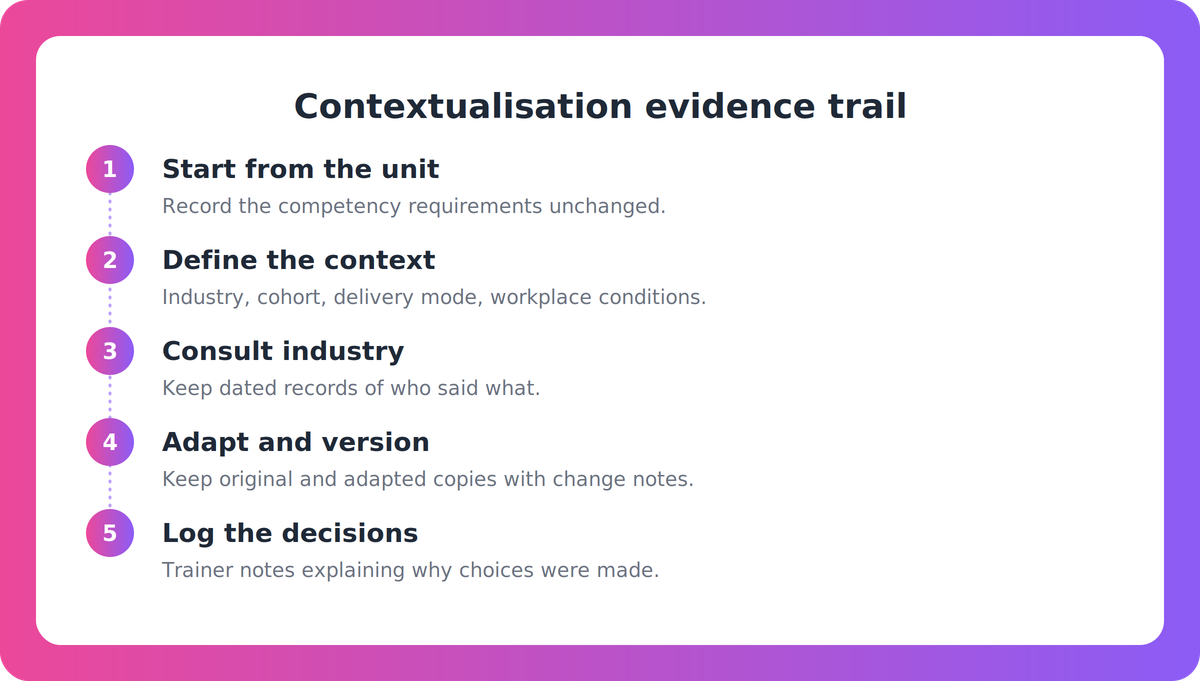
The contextualisation evidence trail
- Start from the unit of competency. Record the requirements you must meet, unchanged.
- Define the context. Industry, learner cohort, delivery mode, workplace conditions.
- Consult industry. Keep dated records of who you asked and what they said.
- Adapt the resource. Scenarios, examples, tools and language that reflect that context.
- Version it. Keep the original and the adapted copy, with change notes.
- Log the decisions. Trainer notes on why choices were made, so the next reviewer can follow them.
None of this is exotic. The difficulty is doing it consistently across ten industries and several hundred units, not once for a showcase qualification.
How does qualification reform raise the stakes?
The target is moving. Skills Ministers agreed on 6 December 2024 to a purpose-based approach to VET qualification design, with reformed qualifications expected for delivery from 2026. The Future Skills Organisation's April 2026 Jobs and Skills Council update describes a shift away from one-size-fits-all qualification design.
For a multi-industry RTO, that likely means rework across several industry packages at once. We'd treat that as a probability, not a certainty. The research found no 2026 implementation update on the Noonan AQF Review, and timing will differ by training package.
The practical implication is simple. Any process that depends on a person manually rebuilding resources each time a qualification changes will buckle under a reform cycle.
Where does AI fit, and what will auditors ask?
CAQA notes the 2025 Standards neither prohibit nor explicitly endorse AI use. They do expect assessment tools to be fit for purpose and contextualised, however they're developed.
That is the right frame. The question isn't whether AI was involved. It's whether the output is accurate, current, appropriate for the cohort and traceable to the unit of competency.
AI is well suited to the heavy lifting: drafting industry-specific scenarios, role plays and practice simulations in minutes rather than weeks. It can't replace the consultation records, the trainer judgement or the validation that make the output defensible.
So if you're weighing AI-generated contextualised content, ask three things:
- Is it anchored to the unit of competency and its assessment requirements?
- Can a human reviewer see, edit and sign off what was generated?
- Does the workflow automatically record versions and decisions?
How many of your current contextualisation decisions could you reconstruct for an auditor today?
Key takeaways
- The Standards for RTOs 2025 (in full effect from 1 July 2025) expect evidence that resources were adapted to industry and learner context.
- Bought-in resources are a starting point. NCVER interviewees said third-party tools still need contextual adjustment.
- Multi-industry RTOs carry the heaviest load: one unit of competency, many contexts, each needing its own adaptation and record.
- Purpose-based qualification reform from 2026 may force rework across multiple industry packages.
- AI use is neither banned nor endorsed. The fit-for-purpose, contextualised test applies regardless of how content is built.
Our take
Most RTOs treat contextualisation as an editing job. For a multi-industry provider it's closer to a production line, and the weak point is rarely drafting speed. It's the consultation records, version history and sign-off that prove the adaptation was deliberate. We think the RTOs that cope best with 2026 will be those that make that trail automatic, and use AI for the first draft while keeping humans accountable for the final call.