Continuous Improvement in RTO Operations: A COO's Guide
8 October 2026 · 7 min read
Reactive continuous improvement is the default in most RTOs, and it's now the riskiest one. The 2025 Standards for RTOs ask you to show, through your own self-assurance model, how you meet requirements in your context. A steady operating rhythm, rather than a heroic fix after each problem, is how operations builds that evidence.
Why this lands on your desk
The 2025 Standards for RTOs came into effect on 1 July 2025. DEWR says compliance and administrative requirements were moved out of the Outcome Standards into the Compliance Standards and Credential Policy. What's left in the Outcome Standards puts the onus on you. According to Skills Education's summary of DEWR material, RTOs must use their own self-assurance model to show the regulator how they meet requirements in the context of their operations.
Self-assurance isn't a document your compliance manager writes once. It's process design, evidence capture and review cadence, and those belong to operations. If you own enrolments, delivery support, reporting and finance, you own most of the raw material.
Two more pressures sit on the same desk:
- Reporting is changing. AVETMISS is moving to the VET Information Standard under the VET Data Streamlining Program. An amending instrument to the Data Provision Requirements takes effect on 1 October 2026 (ASQA). NCVER says all RTOs must report under the new standard by January 2029.
- Cost is rising. ASQA's cost recovery fees apply from 1 July 2026. The Productivity Commission reports government VET funding fell 11.2% in 2024 to $9.5 billion.
Firefighting is the most expensive way to run through all of that.
What the regulator seems to notice
A provider's notes from ASQA's Brisbane sector workshop on 11 March 2026 record that ASQA often notices reactive systems, where continuous improvement action is only taken when something goes wrong. This is a third-party record, not an ASQA publication, so treat it as a signal rather than a rule.
It's a believable signal, though. An improvement log that fills up only after a complaint, a failed validation or an audit finding tells a story, and it isn't the story of an organisation that knows how it's performing. A log with scheduled checks, some of which found nothing, tells a better one.
Build the rhythm in four cadences
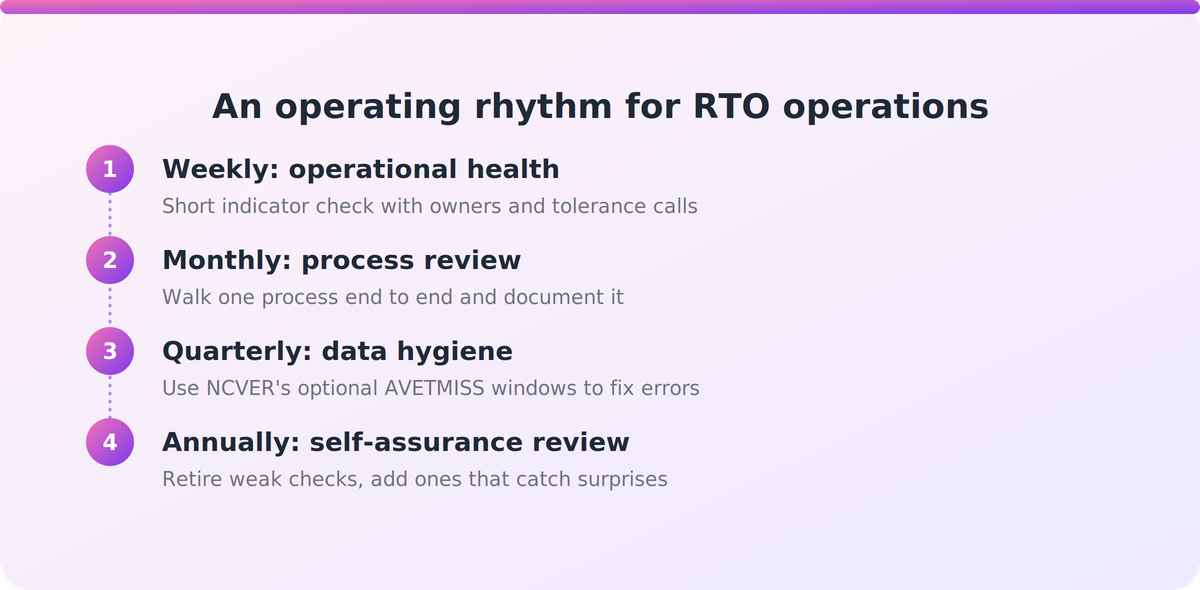
The aim isn't more meetings. It's a small number of fixed checks that run whether or not anything is on fire. A workable version:
Weekly: operational health
A 30-minute look at a short set of indicators you choose: enrolment backlog, outstanding data errors, unresolved student requests, staff capacity. Each gets an owner and a yes/no on whether it's in tolerance. Write down what you changed.
Monthly: process review
Pick one process, such as enrolment, certificate issuance or a funding claim. Walk it end to end with the people who do it. Where the steps live in one person's head, document them. This is how you start to fix the knowledge-in-individuals problem without a big project.
Quarterly: data hygiene
NCVER notes that optional quarterly AVETMISS submissions let RTOs find and fix validation errors during the year, making year-end reporting less onerous. The 2026 windows are 1–15 May, 1–17 August and 1–16 November. That's a ready-made rhythm: use the windows to turn annual scrambles into routine checking.
Annually: self-assurance review
Step back and ask whether the first three cadences are producing evidence you'd be comfortable showing a regulator. Retire checks that never find anything. Add ones that would have caught last year's surprises.
Treat the data shift as a rehearsal
Data quality is a live issue across the sector. NCVER did not publish its Government-funded students and courses January–March 2026 release, citing significant data quality issues identified in a submission. Queensland's department says upcoming changes to AVETMISS processing will identify duplicate records or invalid characters.
Duplicate records and bad characters are exactly the problems that disconnected systems and double entry produce. Cleaning them quarterly is cheaper than cleaning them under deadline.
On the system side, be disciplined about what you know. NCVER's AVETMISS Compliant Software Register warns that some compliant systems may not be listed. The research behind this piece found no confirmation of whether any particular vendor has committed to the new standard, so ask yours directly and get the answer in writing. Some consultancy commentary claims event-based reporting and new data elements. Those claims are unconfirmed, so check them against NCVER and DEWR before you plan around them.
Don't import a rhythm, tailor one
The same workshop notes caution against buying off-the-shelf continuous improvement systems without tailoring them to the RTO's context. That fits the logic of self-assurance, which is about your context. A template register full of generic categories produces generic evidence.
Start from your own failure history. List the last ten things that went wrong, then ask which cadence would have caught each one earlier.
Capacity is the real business case
Jobs and Skills Australia (October 2024) reported VET teacher shortages in every state and territory and a projected need for 3,800 more VET teachers over five years. There's no fresh 2026 update in the research, so the safe reading is that headcount pressure hasn't eased.
That makes scaling by adding people a risky default. Every hour spent on avoidable rework is an hour you can't redeploy. A rhythm won't create capacity on its own, but it shows where capacity leaks, and that's the evidence your board needs when it asks about cost and scalability.
Key takeaways
- The 2025 Standards for RTOs put the onus on providers to show, through their own self-assurance model, how they meet requirements. Operations owns much of the evidence.
- A provider's notes from ASQA's 11 March 2026 workshop suggest the regulator notices reactive improvement. Treat it as a signal, not an ASQA publication.
- Use fixed cadences (weekly, monthly, quarterly, annual) rather than responding only to incidents.
- NCVER's optional quarterly AVETMISS windows are a ready-made data hygiene rhythm ahead of the VET Information Standard.
- Ask your system vendor directly about the new standard, and verify unconfirmed claims against NCVER and DEWR.
Our take
Most RTO leaders treat continuous improvement as a compliance deliverable. We think it's an operating discipline that happens to generate compliance evidence as a by-product. If the rhythm is real, the evidence takes care of itself. If it's staged for an audit, it shows.
The uncomfortable part is that a good rhythm initially surfaces more problems, not fewer. That's the point. Problems found on a Tuesday check are cheap. The same problems found during a regulatory process or a data release aren't.
Your first step this week: pick the one recurring failure that cost your team the most time last quarter, and put a fixed check for it in the calendar before the next reporting window opens.
FAQ
What does reactive continuous improvement look like in an RTO?
It's improvement action taken only when something goes wrong, such as after a complaint, a data error or an audit finding. A provider's notes from ASQA's March 2026 Brisbane workshop record that ASQA often notices this pattern. Scheduled reviews that run regardless of incidents are the alternative.
How does the 2025 Standards for RTOs self-assurance requirement affect operations?
Under the Outcome Standards, RTOs must use their own self-assurance model to show how they meet requirements in their operating context (per Skills Education's summary of DEWR material). That makes process design, evidence capture and review cadence operational responsibilities, not just compliance tasks.
Are quarterly AVETMISS submissions mandatory?
No. NCVER describes them as optional. They let RTOs find and fix validation errors during the year, which makes year-end reporting less onerous. The 2026 windows are 1–15 May, 1–17 August and 1–16 November.
When do I need to be reporting under the VET Information Standard?
An amending instrument to the Data Provision Requirements takes effect on 1 October 2026 (ASQA). NCVER says all RTOs must report under the new standard by January 2029, with a gradual transition and new API-based reporting technology. Ask your system vendor directly about their plans.