Cost Per Student at a NZ PTE: The Hidden Content Cost
12 October 2026 · 6 min read
Your cost per student probably leaves out one of its biggest variables: what it costs to build, maintain and re-moderate your assessment and learning content. That cost is spread across salaries, assessor time, contractors and rework, so it never appears as a line. With subsidies flat and the rules shifting, that invisibility is now a risk.
Why this lands on your desk
You own the margin. Budget 2026 left most tertiary subsidy rates unchanged, with a 2 percent increase for foundation courses, after Budget 2025 funded a 3% lift from 1 January 2026 for targeted priority provision (RNZ, TEC). The fees-free scheme was axed. Revenue per student is largely fixed, so any cost buried in payroll and overheads carries more weight than it did two years ago.
You also answer for regulatory standing. The Private Training Establishment Rules 2026 came into force on 19 January 2026, and a registering PTE must supply a copy of its quality management system as required under the Quality Assurance of Tertiary Education Providers Rules 2026 (NZQA). You are accountable for how assessment and learning content is controlled, not just that it exists.
The third pressure is the one nobody budgets for: change. If a standard moves, someone reworks your content, and you carry that cost without having planned for it.
Where the content cost actually hides
Ask your finance lead what it cost to develop and moderate the content for one unit standard last year. Most can't answer. The money is real. It is just filed under other things:
- Salaries: trainers and assessors building materials between classes.
- Moderation effort: the back-and-forth when an assessment fails internal or external checks.
- Rework: revising content after a standard, programme or client requirement changes.
- Contractor spend: subject experts or writers engaged for one-off builds, often coded to general operating costs.
The sources don't quantify what content development costs a typical PTE, and I won't invent a figure. That is the point. If the sector can't give you a benchmark, you need your own number.
Why 2026 makes the blind spot expensive
Several changes are landing at once, and each can trigger content rework:
- NZQA replaced the Evaluative Quality Assurance Framework with the integrated Quality Assurance Framework (iQAF) for PTEs and institutes of technology and polytechnics (Immigration New Zealand).
- The PTE Rules 2026 replaced the PTE Registration Rules 2025 and the PTE Enrolment and Academic Records Rules 2022. They also removed references to external evaluation and review (NZQA).
- The VET system began operating on 1 January 2026 with eight Industry Skills Boards. After the 2027 transition they focus solely on standards-setting and programme endorsement (TEC).
- One trade publication, FE News, says the boards are responsible for developing qualifications and moderating assessments. My reading is that this implies rework risk for PTE content. It is an inference, not a sourced figure.
There is also upside. Budget 2026 gave Trades Academies an extra $69m over four years to double student numbers to 20,000 by 2030 (RNZ). Work-based learning divisions are moving to polytechnics, wānanga or PTEs across 2026 and 2027 (TEC, Connexis). Growth like that needs new or adapted content. If you can't price a unit standard build, you can't price the opportunity either.
Three numbers to get this quarter
You don't need a new system to start. You need three numbers, even if they are rough.
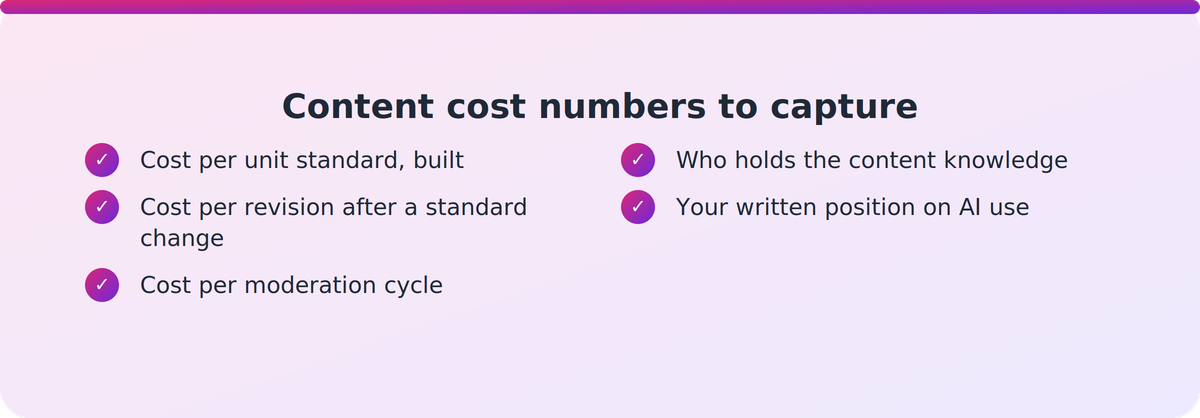
- Cost per unit standard, built: staff hours, contractor invoices and moderation time for a recent build.
- Cost per revision: what the last standard or programme change cost you in rework hours.
- Cost per moderation cycle: how many rounds a typical assessment takes to be signed off, and who is tied up while it happens.
Sample two or three recent projects and ask the people who did the work to estimate their hours. An imperfect number you can argue with beats a blank.
The key-person question
When you map who holds content knowledge, you will probably find a short list. One experienced assessor knows which tasks pass moderation. One manager knows how each unit standard maps to evidence. Their absence stalls delivery, and their time goes on rework rather than learners.
That is a governance issue. If your quality management system depends on what a few people carry in their heads, it is documented in name only. The same applies if you deliver with another organisation. SAARA notes that PTEs delivering with another organisation need to understand the effect on their quality management system, and sub-contracting now sits in the Quality Assurance of Tertiary Education Providers Rules 2026.
A deliberate position on AI
AI will touch content work whether or not you decide anything. NZQA's guidance expects providers to support staff to understand how generative AI can be used in teaching, learning and assessment. It also expects regular review of academic integrity policies, covering upholding, preventing, detecting and responding to misconduct, including generative AI use.
Treat that as a leadership prompt. Where is AI use in content development acceptable? Who reviews the output against the standard? How is that recorded for your quality management system? An ad hoc answer from each staff member is a position by default, and a weak one.
Key takeaways
- Content development cost is spread across salaries, moderation, rework and contractors, so it rarely appears in cost per student calculations.
- With most subsidy rates flat in Budget 2026, hidden costs hit margin harder.
- The PTE Rules 2026, iQAF and the Industry Skills Boards raise both documentation expectations and the chance of rework.
- Measure cost per unit standard, per revision and per moderation cycle before you try to fix anything.
- Content knowledge held by a few people is a key-person risk. A deliberate, NZQA-aware AI position belongs with leadership.
Our take
This is a visibility problem first and a technology problem second. Tools can speed up content work, but they can't tell you whether the work is worth doing, what it costs or who depends on it. Only a number can do that, and leadership has to ask for it.
We'd go further. A PTE that can't price a standards change is guessing when it quotes for new programmes, and guessing about margin. The first step is small: pick one unit standard you delivered last year and ask your team what it really cost to build and maintain. The size of the gap between their answer and your P&L is your starting point.
FAQ
Why doesn't content development show up in my PTE's P&L?
Because it is spread across salaries, assessor time, moderation rework and contractor spend. None of those is coded as content development, so the total is invisible unless you track it deliberately.
How should I calculate cost per student at my PTE, including content?
Start with your usual delivery and overhead costs, then add an estimate of content build, revision and moderation effort per unit standard or programme. The sources don't give a benchmark, so use your own sampled staff hours and contractor invoices.
What 2026 changes could trigger unplanned content rework?
The PTE Rules 2026 (in force 19 January 2026), the move to iQAF, and the Industry Skills Boards, which focus on standards-setting and programme endorsement after the 2027 transition. Any changed standard or programme may mean revising your learning and assessment content.
What does NZQA expect on AI in assessment?
NZQA's guidance expects providers to support staff to understand how generative AI can be used in teaching, learning and assessment. It also expects regular review of academic integrity policies covering generative AI misconduct.