Cost Per Student in NZ Vocational Training: A CEO's View
18 October 2026 · 7 min read
Most PTE and ITP leaders still budget as if quality and cost move together: better delivery costs more, and tighter budgets mean a thinner learner experience. The 2026 settings make that assumption harder to defend. The more useful question is which of your delivery costs actually buy outcomes, and which are simply inherited habit.
Why this lands on your desk
You own the P&L, and the funding signal is blunt. TEC's 2026 Plan Guidance says total funding will be limited and that TEC will reprioritise in a fiscally constrained environment. Providers should not assume funding will be increased or maintained, and additional funding is unlikely in 2026. TEC has also said that means moving away from lower-performing and some non-priority provision.
Budget 2026 helps at the edges, but it isn't a general uplift. The Ministry of Education lists $284.021 million in operating funding for TEC to fund 99% of forecast tertiary volume at Levels 3 to 10 over two calendar years, a 2% increase to foundation education subsidies, and 1,000 additional Youth Guarantee places from 1 July 2026. Those are targeted measures. They won't ease a margin squeeze caused by delivery and compliance costs.
So cost per student in NZ vocational training has to come down, or at least hold, without the learner experience getting thinner. That only works if you know which spend is doing the work.
The quality regime has changed shape
The way quality is judged has moved too. According to Immigration New Zealand, NZQA is replacing the Evaluative Quality Assurance Framework with the integrated Quality Assurance Framework (iQAF) for PTEs and ITPs. Universities and schools aren't affected. NZQA's PTE Rules 2026 came into force on 19 January 2026 and update wording to reflect the removal of external evaluation and review.
Some load has eased:
- The annual financial return becomes biennial for non-funded PTEs, unless NZQA gives notice otherwise.
- The annual fee is removed.
- The PTE Enrolment and Academic Records Rules 2022 are revoked and folded into the PTE Rules.
But the savings are partial and uneven. Funded PTEs still face a financial viability assessment condition in TEC's 2026 Funding Conditions Catalogue.
One PTE-sector provider blog (CTMES, not an NZQA statement) describes the iQAF as intended to be more risk-informed and to reduce the compliance burden for high-performing providers. That is a plausible direction. We found no official figure for compliance cost removed, so don't bank it in your forecast.
Programme currency is now a funding issue
TEC's consultation document says Industry Skills Boards will endorse vocational programmes before they go to NZQA for approval, and that a TEC-funded programme won't be funded without that endorsement. The Ministry of Education says ISBs manage work-based training temporarily, with transition running to the end of 2027. After that they focus on standards-setting and programme endorsement.
Keeping programmes current and employer-relevant used to be a teaching concern. Now it sits in the approval and funding path. If updating a programme takes months of design effort, that slowness has a cost that doesn't show up as a line in the budget.
Sorting delivery spend into "buying quality" and "habit"
The sector's structure is also in motion. RNZ reported that Te Pūkenga is due to be disestablished by 31 December 2026, replaced by stand-alone polytechnics and a new system for work-based industry training. The Spinoff reported it lost over $80m in funding and 855 staff ahead of that. In that environment, nobody should be defending a cost line by pointing to "we've always done it this way".
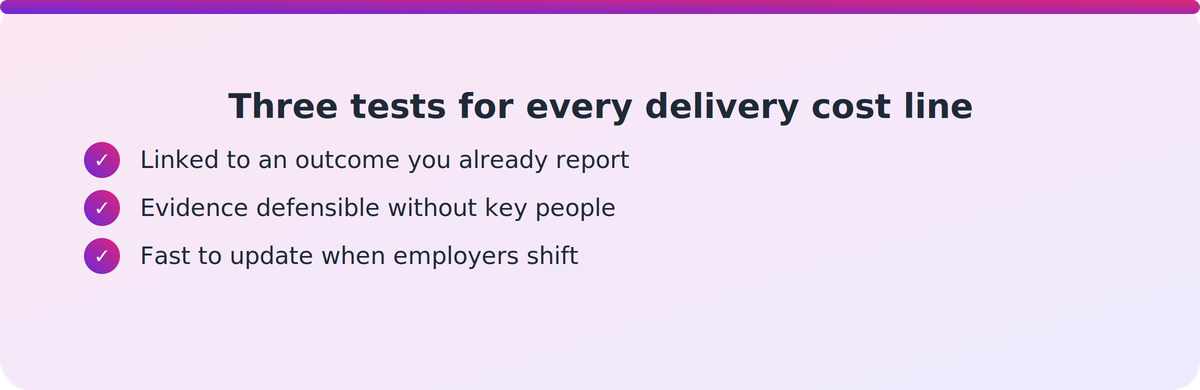
Three tests for each major cost line
Take your largest delivery costs: facilitator and assessor time, workshop and practice sessions, learning materials, programme updates, and the manual effort of gathering evidence. Then ask three things of each.
- Does it connect to an outcome you report? Completion, progression, employer feedback, whichever measures TEC and your board already watch. If you can't draw the line, it may be habit.
- Could you show it under a risk-informed review? Evidence that lives in two people's heads or a private spreadsheet is key-person risk, and it is hard to defend when a regulator looks at risk rather than ticking boxes.
- How fast can it change? If an Industry Skills Board shifts what employers expect, what does it cost and how long does it take to update the delivery?
Some of what you find will confirm the old trade-off: certain costs, like skilled practitioner time with learners, really do buy quality. Others won't. Both findings are useful.
What we don't know about technology and practice-based learning
Practice-based learning is where cost and quality collide hardest. Role-play, simulation and coached practice are effective and expensive, and most of us have assumed they have to be.
Whether new technology changes that, in NZ vocational education specifically, is not established. The research behind this piece found no local evidence quantifying how AI or simulation-based practice changes delivery cost or learner outcomes. NZQA's published AI material that we found concerns academic integrity and assessment, not delivery economics.
So be wary of anyone, vendor or consultant, who tells you the trade-off has been broken. Equally, don't assume it hasn't. Treat it as a hypothesis, and test it on one programme.
A workable pilot is modest:
- Pick one practice-heavy programme with a stable cohort.
- Record the current cost per student and the outcome measures you already report.
- Change one thing in the practice component.
- Compare against the baseline, and have someone other than the sponsor judge the result.
If it doesn't move cost or outcomes, you've spent little to learn that.
Key takeaways
- TEC says 2026 funding is limited, with no assumption of increases and reprioritisation away from lower-performing provision. Budget 2026's measures are targeted, not a general uplift.
- The iQAF replaces the previous framework for PTEs and ITPs, and the PTE Rules 2026 took effect on 19 January 2026. Compliance savings are partial and unquantified.
- ISB endorsement is now a gate to NZQA approval and TEC funding, so programme currency has a financial consequence.
- The useful question is which delivery costs demonstrably buy outcomes, not how much quality you can afford.
- Evidence on how technology changes practice-based delivery costs in NZ is thin. Test it on your own programmes before committing.
Our take
The quality-versus-cost trade-off was never a law. It was a reasonable rule of thumb in a system that paid for volume and reviewed quality at intervals. A funding environment that rewards performance, and a quality model that looks at risk, both reward leaders who know exactly what their money is buying.
We think the real risk in 2026 is not underspending on quality. It is defending costs you can't link to outcomes, while the evidence trail that would protect you sits with a handful of people. The first step is cheap: pick your three biggest delivery cost lines this quarter and put the three tests to each. What do you find that you can't justify?
FAQ
How should a PTE or ITP CEO think about cost per student in NZ vocational training in 2026?
Treat it as a question of what each cost buys, not a single number to push down. TEC's 2026 Plan Guidance says funding is limited and will move away from lower-performing provision. Cutting indiscriminately risks outcomes; protecting every cost out of habit risks margin.
What has changed in NZQA's quality assurance for PTEs and ITPs?
According to Immigration New Zealand, NZQA is replacing the Evaluative Quality Assurance Framework with the integrated Quality Assurance Framework (iQAF) for PTEs and ITPs. The PTE Rules 2026, in force from 19 January 2026, reflect the removal of external evaluation and review. Universities and schools aren't affected.
Will the iQAF reduce compliance costs?
Possibly, but it is not proven. A PTE-sector provider blog describes the iQAF as intended to be risk-informed and to ease the burden for high-performing providers. No official figure for compliance cost removed was found. Some changes are concrete, such as biennial financial returns for non-funded PTEs and no annual fee, but funded PTEs still face a financial viability assessment condition.
Can AI or simulation lower the cost of practice-based learning in NZ?
The evidence isn't there yet. The research for this piece found no NZ data quantifying AI or simulation effects on delivery cost or outcomes, and NZQA's AI material concerns academic integrity and assessment. Run a small, baselined pilot on one programme rather than relying on claims.