Beyond the Checkbox: Cultural Competency in NZ Learning Design
4 August 2026 · 8 min read

Cultural competency in learning design is too often treated like an accessibility statement — something pasted into a course shell once and forgotten. Ako Aotearoa's own research says that's backwards: a rubric translated into te reo Māori is not the same as design grounded in Tikanga Māori values, and the same logic now applies to regulatory compliance itself.
Why this lands on your desk
You are the person who decides whether cultural responsiveness lives in the bones of a learning pathway and its assessment design, or gets bolted on as a standalone module. Ako Aotearoa's research on Māori and Pacific learner success suggests the bolt-on version is measurably shallower — it changes what learners see, not what they understand.
That decision now carries more weight than it used to. NZQA's rules covering programme approval and accreditation, the Directory of Assessment and Skill Standards, and qualification and micro-credential listing came into force on 19 January 2026, replacing External Evaluation and Review and consistency reviews with self-review and monitoring under the integrated Quality Assurance Framework (iQAF). There is no longer an external check quietly validating whether your content meets cultural and quality expectations. If the design is shallow, self-review is the only thing standing between that and a learner cohort.
At the same time, the standard-setting landscape underneath your content has moved. From 1 January 2026, Te Pūkenga was disestablished and replaced by 10 regional polytechnics and 8 Industry Skills Boards, which took over standard-setting from the Workforce Development Councils, with NZIST operating as a transitional entity through to 2027 to manage the handover. Any programme you built pre-2026 against Workforce Development Council standards needs re-grounding against Industry Skills Board content — which is exactly the kind of design debt you get judged on.
And the stakes for learners are not abstract. Proactively released government information, reported by the NZ Herald, forecast 257 qualifications being paused or closed and 620 full-time jobs lost by the end of 2025, with officials specifically warning that learners with low prior achievement, some disabled learners, and those facing barriers to online study would be most affected. These are precisely the learners cultural responsiveness in design is meant to serve — so shallow design during a disrupted transition isn't a neutral risk.
The rubric isn't the practice
An Ako Aotearoa-supported project at Otago Polytechnic found that Māori interviewees held genuinely different interpretations of cultural competency, safety and diversity within a Kaupapa Māori context — and that translating capability frameworks into te reo Māori changed and deepened understanding, rather than simply relabelling it. That's direct evidence that applying one standard rubric uniformly across a cohort does not capture authentic cultural competency, no matter how well-intentioned the checklist.
Ako Aotearoa's Māori Cultural Capability pathway is built around four Tikanga Māori values — Ako, Rangatiratanga, Manaakitanga and Whanaungatanga — and it is explicitly positioned as relevant not only to kaiako but to workplace learning and support roles. That includes you. It's a framework for how a programme is structured and how practice is coached, not a section to insert into a module outline.
The Teaching Council's 2026 Standards offer a useful cross-sector signal here, even though they don't bind vocational instructional designers directly. Where the 2017 Standards treated Te Tiriti o Waitangi as a standalone element, the 2026 Standards integrate it across all three professional domains. That's the sector-wide direction: from add-on to embedded. Vocational learning design is moving the same way, whether or not a rule forces it.
What embedded design actually changes
"Embedded" sounds soft until you translate it into concrete design decisions:
- Assessment tasks and scenarios reflect real contexts learners recognise, rather than generic case studies with names changed.
- Formative practice — role plays, simulated workplace conversations, coached feedback — is built with enough variation that it doesn't default to a single cultural frame as "normal".
- Pathway sequencing accounts for prior learning and access barriers up front, not as a support-services referral bolted on after a learner struggles.
- Language and framing are checked with the communities the programme serves, not translated after the English version is locked.
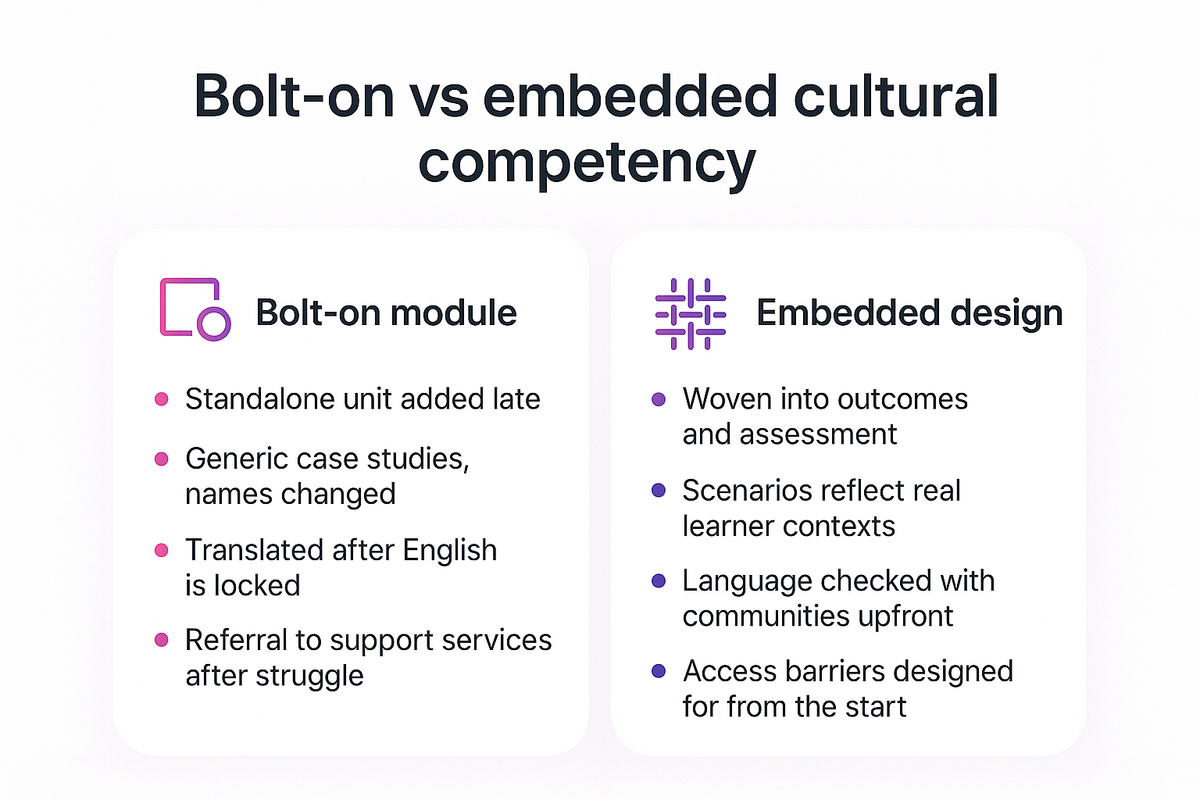
None of this is achievable by adding a slide. It requires cultural grounding to be part of the same design conversation as learning outcomes, assessment strategy, and — now — Industry Skills Board content mapping. Treat them as one job, because under self-review, they functionally are.
The cost of building it twice
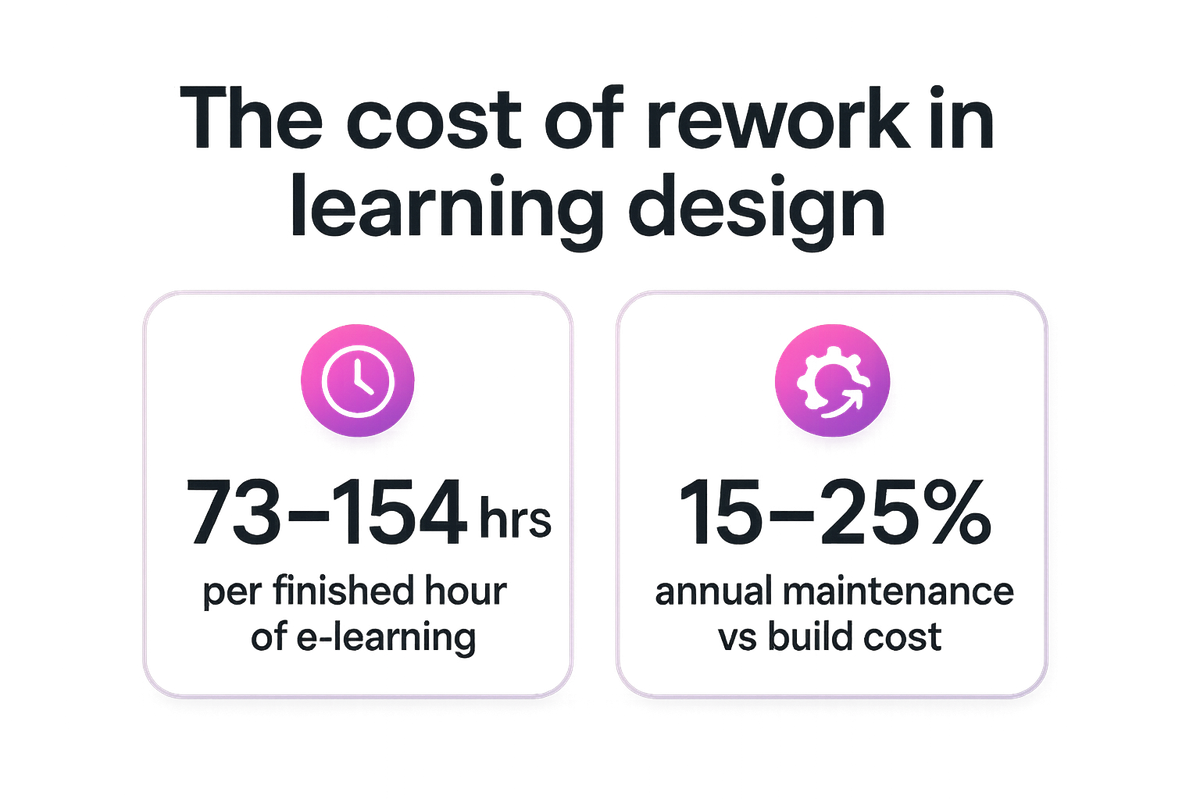
Here's the practical problem: doing this properly, then having to redo it, is expensive in a sector that is already time-poor. Industry benchmarks widely cited in instructional design — Chapman Alliance data via Cognota — put e-learning development at 73 to 154 hours per finished hour of content, with annual maintenance and update costs running at roughly 15 to 25 percent of original development cost. Every time cultural responsiveness or regulatory grounding is patched on after a build rather than designed in from the start, you're paying that maintenance cost again, on top of the original build.
An Education Counts review of e-learning capability in NZ Industry Training Organisations recommended using the NZ-developed E-Learning Maturity Model (eMM) so organisations can see where limited design resources are actually going. The relevance here is direct: it's a way to check whether your team's time is going into embedded, durable design work or into repeated surface fixes — cultural or compliance-driven — that never quite land.
Key takeaways
- Under the iQAF (in force since 19 January 2026), self-review has replaced External Evaluation and Review and consistency reviews — design decisions now carry the compliance weight an external check used to share.
- The shift from Workforce Development Councils to Industry Skills Boards means pre-2026 programmes need re-grounding against new standard content, not just a cultural competency refresh.
- Ako Aotearoa research (including the Otago Polytechnic project) shows that translated rubrics and standalone modules produce shallower understanding than design genuinely built on Tikanga Māori values like Ako, Rangatiratanga, Manaakitanga and Whanaungatanga.
- Chapman Alliance benchmarks (73–154 hours per finished hour, 15–25% annual maintenance) show why bolt-on fixes for either compliance or cultural responsiveness compound cost rather than solving it once.
- Officials flagged learners with low prior achievement, disabled learners, and those with online-access barriers as most at risk during the 2025–2026 transition — the same group genuine cultural and pedagogical responsiveness is meant to protect.
Our take
We think the checkbox era is ending for a reason, and it's not really about audits. External review let organisations outsource the question of whether their design was good enough. Self-review under the iQAF, and the sector-wide move toward embedded (rather than standalone) cultural responsiveness, both hand that question back to the person actually building the programme. That's you.
The honest tension is resourcing. Genuinely embedded, contextual design — the kind Ako Aotearoa's research supports — takes real time to do well, at a moment when the sector has fewer instructional design hours to spend, not more. There's no shortcut that makes deep design free. But there is a real difference between spending your limited hours once on architecture that holds, and spending them repeatedly patching modules that were shallow from the start. If you're choosing where to put your next block of design time, that's the question worth asking before you open the template.
FAQ
Do I need to redesign programmes built before 2026? Any programme built against Workforce Development Council standard content needs re-grounding against the Industry Skills Board that now sets that content, following the 1 January 2026 disestablishment of Te Pūkenga and the transition to 10 regional polytechnics and 8 Industry Skills Boards, with NZIST managing handover through 2027.
What's the practical difference between a bolt-on cultural competency module and embedded design? A bolt-on module adds a standalone unit or translated resource without changing the rest of the programme. Embedded design builds Tikanga Māori values — Ako, Rangatiratanga, Manaakitanga, Whanaungatanga — into assessment tasks, scenario context, sequencing and language from the start, which Ako Aotearoa's research links to genuinely different (and deeper) learner understanding.
Does the move to self-review under the iQAF mean less documentation? It means a different kind of accountability. External Evaluation and Review and consistency reviews are gone as of the rules in force from 19 January 2026, replaced by self-review and monitoring — so the evidence trail for cultural and quality standards now needs to be built into your own design and review process, not produced for an external assessor after the fact.
Where do Industry Skills Boards fit into instructional design work? Industry Skills Boards have taken over standard-setting from the former Workforce Development Councils as part of the Te Pūkenga to polytechnic transition. That means the content instructional designers must design against — the Directory of Assessment and Skill Standards content, specifically — now sits with these new bodies rather than the councils used previously.