Cultural Competency Vocational Training Design for 2026
4 August 2026 · 7 min read

A cultural competency scenario built in 2019 and reused unchanged in every cohort since isn't neutral anymore. Under the Standards for RTOs 2025, it's either evidence of a genuinely contextualised training product, or evidence your design hasn't kept pace with what ASQA now expects to see — and the difference will show up in your 2026 audit file.
Why this lands on your desk
You're the one who decides whether the cultural competency module sitting in your LMS is still fit for purpose or quietly turning into design debt. That call used to be a professional judgement. Now it's a compliance judgement too.
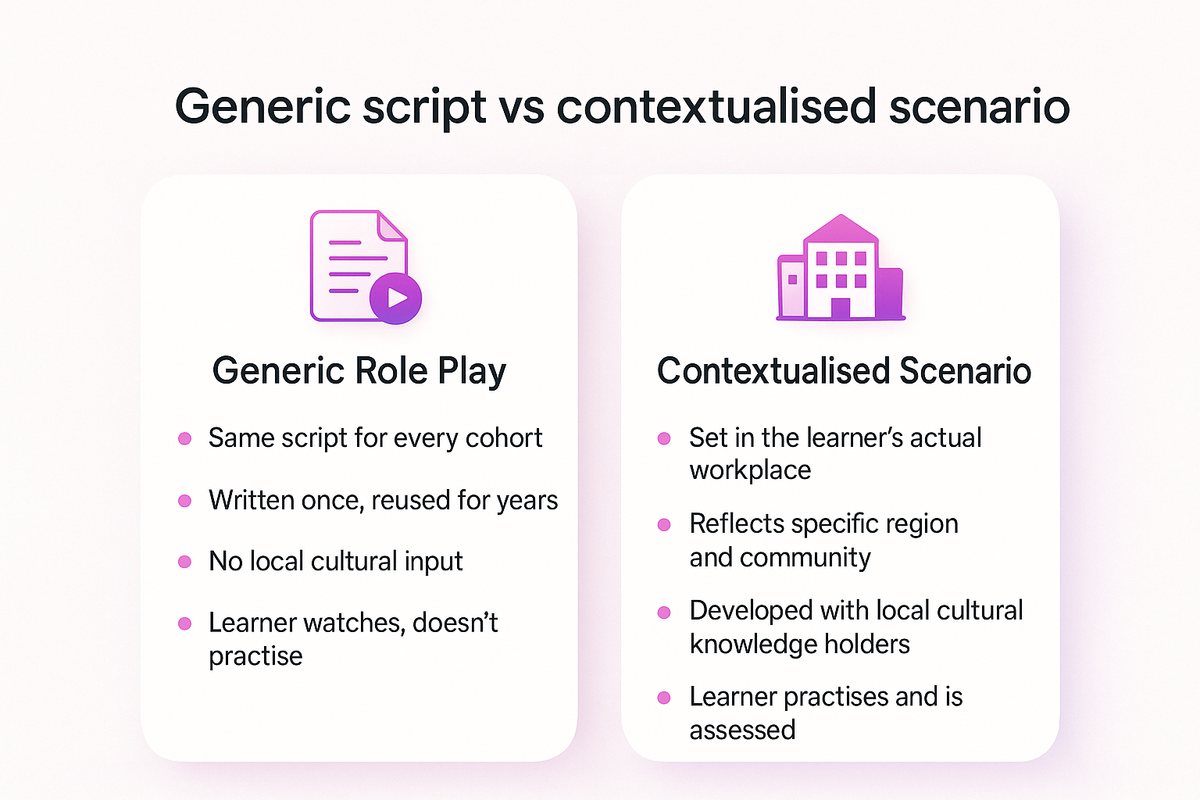
The Standards for RTOs 2025, which commenced 1 July 2025 under the National VET Regulator Act 2011, shifted ASQA's focus from checking that policies exist to checking that outcomes are demonstrated in real delivery and assessment. For scenario-based learning, that's a material change. A generic cultural awareness role play — the kind built once and rolled out across every cohort regardless of industry, region or community — is exactly the kind of artefact that's hard to defend as evidence of contextualised practice under the new lens.
You're also the one who has to reconcile two pressures that don't naturally sit together: doing this properly, and doing it on a design budget that's already stretched. Australian instructional design now runs $85–$170 an hour, with specialist and compliance-literate designers at the top of that range. Bespoke, locally grounded scenario work isn't a nice-to-have line item — it's a genuine cost decision, and workforce shortages across the VET sector, flagged in Jobs and Skills Australia and Skills Insight research through 2025, mean smaller RTOs are least able to absorb it.
The standard moved from paperwork to proof
Read ASQA's own material on the 2025 Standards and the throughline is consistent: less "show us the document," more "show us it happened, for this cohort, in this context." That's the direction of ASQA's practice guides and its Standards Workshop series.
For scenario-based learning, this means a cultural competency role play has to do more than exist. It has to be traceable to a specific unit of competency, mapped to a specific cohort, and defensible as evidence that a learner actually practised the capability, not just watched someone talk about it. Static content, reused unchanged across training packages and cohorts, is now a bigger audit risk than it was under the previous Standards.
The Cultural Capability Framework was never meant to be a script
Here's the trap a lot of scenario libraries fall into: treating the Aboriginal and Torres Strait Islander Cultural Capability Framework as source material to convert into a generic module. It explicitly isn't designed to work that way. The Framework — built around Knowing, Doing and Being domains — is stated to be non-prescriptive. It exists to prompt organisations to build their own context-specific strategies, not to hand over content that can be dropped into any RTO's LMS unchanged.
Sector guidance backs this up from a different angle. The Victorian Public Sector Commission's advice on cultural capability is blunt: this needs to be ongoing practice, not a single module, and organisations should be engaging local Aboriginal and/or Torres Strait Islander providers who hold knowledge of local history and culture — not running a generic script written for no particular place at all. That's a direct challenge to the reusable role-play asset most content libraries are built around.
CHCDIV002 gives you an anchor, not a shortcut
If your training package includes CHCDIV002 Promote Aboriginal and/or Torres Strait Islander cultural safety, you already have a nationally recognised unit of competency to map scenario design against — which is genuinely useful. It gives you defensible language for what evidence needs to look like, and it forces the question of contextualisation into the assessment mapping itself, not just the delivery.
But a unit of competency tells you what to assess, not how to make the practice authentic. The updated Training Package Organising Framework, effective from 1 July 2025, gives you more flexibility to build adaptable, contextualised training products against that unit — good news for design freedom, but it also means existing scenario content built for the old framework needs remapping, not just relabelling.
What contextualised actually requires
A scenario that will hold up as evidence usually shares a few traits: it's set in the learner's actual industry and likely workplace situations, it reflects the specific community and region the RTO delivers into, it's been developed with input from people with local cultural knowledge, and it gives the learner something to practise and be assessed on, not just watch. A generic script ticks none of these unless you deliberately build it that way — and building it that way, one cohort at a time, by hand, is where the hourly-rate maths starts to bite.
Key takeaways
- The Standards for RTOs 2025 shift ASQA's audits from checking documentation to checking demonstrated, contextualised outcomes — generic scenario content is a growing compliance risk heading into 2026.
- The Aboriginal and Torres Strait Islander Cultural Capability Framework is explicitly non-prescriptive; it's designed to be adapted, not converted into a reusable script.
- CHCDIV002 gives instructional designers a nationally recognised anchor for assessment mapping, but the unit doesn't guarantee authenticity — the scenario design still has to be locally grounded.
- The Training Package Organising Framework (effective 1 July 2025) allows more flexible, contextualised design, but existing content needs remapping, not just relabelling.
- With Australian instructional design running $85–$170 an hour, bespoke cultural scenario work is a real budget decision — and workforce shortages mean smaller RTOs feel this hardest.
Our take
The honest tension here is that "compliant" and "meaningful" aren't the same thing, and the 2025 Standards are pushing them closer together without making them identical. You can build a scenario that technically maps to CHCDIV002 and still misses the point of the Cultural Capability Framework entirely. The Framework's non-prescriptive design is deliberate — it assumes organisations will do the harder, slower work of local grounding, not the faster work of generic content. That's the right call for learners. It's a harder call for a design budget that hasn't grown to match it. The RTOs that get ahead of this before 2026 audits will be the ones treating contextualisation as core assessment design, not an add-on layer applied after the fact.
FAQ
Does the Standards for RTOs 2025 specifically require cultural competency training? The Standards don't mandate a specific cultural competency module. What changed is the compliance lens: ASQA now expects demonstrated, contextualised outcomes and evidence of practice, not just documented policy — which affects how any existing cultural competency scenario is assessed as evidence, including in relation to units like CHCDIV002 Promote Aboriginal and/or Torres Strait Islander cultural safety.
Is the Aboriginal and Torres Strait Islander Cultural Capability Framework something we need to follow exactly? No — it's explicitly stated to be non-prescriptive. It's built around Knowing, Doing and Being domains to help organisations design their own context-specific strategies, not to be applied as fixed, generic content across every RTO or cohort.
What's the actual audit risk if we keep reusing an older cultural competency role play? ASQA's 2026 audits apply a risk-based approach against the current Standards. Scenario content built and left unchanged since the previous Standards, that can't be shown as contextualised to the specific cohort, industry and community, carries more non-compliance risk than it did before 1 July 2025.
How do we contextualise scenario-based training without blowing the design budget? There's no way around the fact that locally grounded, community-informed design takes more time than a generic script — sector guidance, including from the Victorian Public Sector Commission, recommends engaging local Aboriginal and/or Torres Strait Islander providers directly. The budget conversation is really about how much of that groundwork is treated as one-off design cost versus built into an ongoing, updatable process.